
While we wait for substantial news about the Brewers this offseason, we’ve reached the point where I thought it would be fun to take a look back a little bit. How many of these articles get written is kind
of up to Milwaukee’s front office, but we’ll get started with this one, a somewhat forgotten figure who was one of the team’s very first All-Stars.
Early career
Dave May is a bit of a rarity, a major league talent who comes from Delaware — only six Delawareans in baseball history have more career WAR.* May signed with the Giants out of high school and impressed in his first year of minor league ball but was drafted by the Orioles a year later (the rules around amateur signings and drafts were much more convoluted back then). May spent the better part of the 1963 and 1964 seasons at Single-A Fox Cities in Appleton, where he raked — in 1964, at just 20 years old, May hit .368/.456/.554 and stole 36 bases.
Despite his success, May’s rise through the Orioles’ system was slow. He spent all of 1965 at Tri-City, another Single-A outfit, then spent two full years playing at Triple-A Rochester in 1966 and 1967. The Orioles were one of the best teams in baseball during the 1960s, which was likely a contributor to his slow ascent; during May’s first season in Rochester, the big-league club won the pennant and then swept the World Series behind an MVP performance from their new trade acquisition Frank Robinson, and center field —May’s position — was covered by the young Paul Blair, one of the best defensive outfielders in the game’s history.
Finally, late in the summer of the 1967 season, May got his first crack at the big leagues. He was only 23, but he’d played almost 700 games in the minors already and was hitting over .320 in his minor league career. He appeared sporadically with the Orioles in ‘67, which was a portent of the rest of his Baltimore career. From 1967-1970 as an Oriole, May appeared in 223 games but got only 430 plate appearances, and the sporadic nature of his role made it difficult for him to find any success. He hit just .216/.291/.314, and while he won a World Series as a bench player for the 1969 Orioles, in 1970 May found himself as a 26-year-old who was struggling to hang on to his big-league career.
*If you can name those six, I’m very impressed. In order of most WAR to least: Paul Goldschmidt, Sadie McMahon, Chris Short, DeLino DeShields, Hans Lobert, and Webster McDonald.
Trade to the Brewers
May’s lack of a role in Baltimore led to an opportunity for the Brewers, who in 1970 were playing in their first season in Milwaukee after their lone season as an expansion team as the Seattle Pilots. The 1970 Brewers weren’t any good, as you’d expect from a brand-new squad; despite a shockingly good season from third baseman Tommy Harper, the team went just 65-97-1, second-to-last in the American League.
The early Brewers had holes everywhere, but they were particularly shallow in the outfield, so on June 15, 1970, they made an upside play and sent two pitchers, Dick Baney and Buzz Stephens, to Baltimore for May. They wouldn’t know it at the time, but this turned out to be a fleece-job by the Brewers. Baney, 23, had thrown 18 2/3 innings for the Pilots in 1969 but hadn’t appeared for the Brewers in 1970. He never pitched for the Orioles and made only 33 more major league appearances, all for the Reds in 1973 and 1974. Stephens was 25 at the time of the trade and hadn’t pitched in the majors since making two starts for the Twins in 1968; it turned out that those two appearances would be the only major league ones of his career, and he was out of organized ball after pitching to a 9.62 ERA in 29 innings for the Orioles’ Double-A team over the rest of the season.
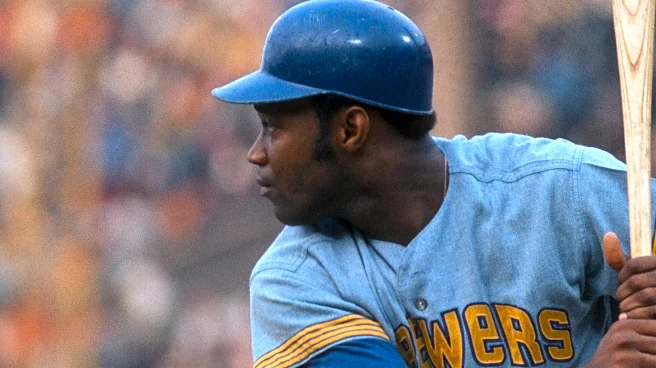
May, meanwhile, found exactly what he needed in 1970: a consistent role. The Brewers plugged him into center field and didn’t look back, and in 100 games with Milwaukee in 1970, May didn’t hit very well (.240/.329/.330, an 83 OPS+) but he played excellent defense in center field and gave the Brewers value that way. In 1971, he was the team’s starting center fielder, and given 562 plate appearances, he finally made good on the offensive promise that he’d shown as a minor leaguer. May hit .277/.343/.425 (a 119 OPS+ and 125 Rbat+) and flashed some power, with 16 homers and 20 doubles. He moved around a bit on the basepaths with 15 steals, and while his defense didn’t rate particularly well, he earned 3.1 WAR, behind only first baseman Johnny Briggs among the team’s position players.
Peak with the Brewers
1972 was modestly disappointing — his batting numbers fell back a bit, but he was still one of the more valuable Brewers with 2.5 WAR — but May hit his peak as a 29-year-old in 1973. The 1973 outfit finished just 74-88 but that was the most successful team in the five-year history of the franchise, and May was a big part of the reason why.
But it didn’t always look like 1973 was going to be a good season. May got very cold in the back half of April and on May 6, he was hitting just .213/.250/.404. But suddenly, in the second week of May, his bat didn’t just wake up — it caught fire. From May 8 through May 31, May played 22 games and hit .360/.411/.570 with five homers and three doubles, and he raised his OPS by over 150 points. July was even better: starting on June 28, when he homered off of Detroit’s Mickey Lolich, until the end of July, May hit .402/.440/.591 in 31 games.
May’s hot summer earned him his first, and only, All-Star appearance, where he and the guy who blocked him from regular playing time in Baltimore, Blair, served as the team’s backup center fielders behind starter Amos Otis. May got into the game but went 0-for-2, hitting pop-outs off of Wayne Twitchell and Jim Brewer.
While he couldn’t maintain his July pace, May finished the season strong. At the end of the year, he’d put up a .303/.352/.473 batting line, good for a 134 OPS+, and had 23 doubles, four triples, 25 homers, and 93 RBI. May’s 295 total bases led the American League (tied with his teammate, George Scott, and a future Brewer, Sal Bando), and he finished with a career-high 4.7 WAR.
May’s big season earned him MVP votes, and he finished in eighth place on the ballot, ahead of Scott (who led the Brewers with 6.7 WAR and finished 14th) and Briggs (who finished 23rd), all of whom were behind the unanimous MVP choice, Oakland’s Reggie Jackson.
Decline
Unfortunately, May’s 1973 season was the beginning of the end. The 1974 season was disappointing. In 135 games, he couldn’t get his bat going and hit just .226/.273/.325, which meant a shocking 61 point drop in OPS+ from 134 in ‘73 to 73 in ‘74. After the season, the Brewers were given an opportunity to make a major splash of relevance, which was an important move to make even if it wasn’t a particularly good baseball move: on November 2, May was traded (along with a player to be named later) to Atlanta for the soon-to-be 41-year-old Hank Aaron.
The Aaron move did what it needed to do for Milwaukee; he served as their DH in 1975 and 1976 and added 22 more homers to his record-breaking total before retiring, a retirement which has allowed the Brewers to forever claim his 755th and final homer.
The move to Atlanta initially worked for May, too. He played only 82 games in 1975 but found his form at the plate again and hit .276/.361/.493 with 12 homers in those 82 games (a 133 OPS+). But in a career of ups and downs, 1976 was another down year, and after the season, May was sent to Texas in a big trade that netted the Braves the 1974 MVP, Jeff Burroughs. Burroughs had a couple of big seasons in Atlanta, but May was almost finished; he struggled at the plate and but played decent defense in Texas in 1977, and Texas sold his rights after the season — back to the Brewers.
The move may have been made for nostalgia reasons, and it didn’t work out. May played 31 games for the Brewers in 1978 and hit under .200, and his rights were sold again to the Pirates, for whom he made five appearances as a pinch hitter. He was released after the season and didn’t play in the majors again — he spent the 1979 season playing in the Dominican Republic for the Santo Domingo Azucareros, and retired after the season at age 35.
Wrap-up
After a slow start, May’s big-league career spanned 12 years, the best of which came from 1971-73 in Milwaukee. He earned 10.3 WAR in that three-year stretch, which is the fourth-best three-year run for a Brewer center fielder behind Robin Yount (1987-89, 14.8 WAR), Carlos Gómez (2012-14, 14.5 WAR), and Gorman Thomas (1978-80, 11.1 WAR). (It should be noted that Lorenzo Cain likely would’ve had a better three-year run as well if not for the 2020 COVID season.) In his 12 years, May collected 920 hits, 96 homers, 60 stolen bases, and 130 doubles. He earned 13.5 total WAR.
May and his teammate Jim Colborn were the sixth and seventh All-Stars in franchise history, fourth and fifth if you don’t count Mike Hegan and Don Mincher making it as Pilots in 1969. May was the first Brewer outfielder to make the Midsummer Classic, again excepting Hegan as a Pilot. He was the first center fielder with any kind of consistency in franchise history.
After his playing career, May spent a couple of seasons as a minor league instructor in the Braves’ system before hanging it up for good after the 1982 season. But his legacy didn’t end there: May’s eldest son, David Jr., became a scout in the early 2000s, and his middle child, Derrick, had a 10-year big-league career that included a 32-game stint with the Brewers in 1995. Derrick finished his career with 52 homers and 103 doubles in 797 games between 1990 and 1999.
Dave May Sr. passed in October 2012, at the age of 68. He was inducted into the Delaware Sports Hall of Fame in 1984 and into the Delaware Afro-American Sports Hall of Fame in 2004.
A shout to the Society for American Baseball Research for some of the info in this article.