


There’s a term I use quite often when discussing player performances and whether they’re living up to expectations: price for value paid
.My former general manager used it often when we discussed the experiences we were providing to guests staying at our resort. The idea was simple. You want people to feel like they’re getting bang for their buck, that every dollar they’re spending is being returned in the form of a worthwhile experience. Because when price for value paid exists, people rarely think
about it. They’re satisfied with what they’re receiving. But when it doesn’t? It becomes the poster child for a negative experience.
I apply that same philosophy when evaluating NBA players because, ultimately, isn’t that what every fan and organization wants? Someone who lives up to their contract. Someone whose production and contributions reflect the compensation they’re receiving. And in the NBA, we’re talking about some pretty substantial compensation.
The absence of price for value paid was one of my primary frustrations after Deandre Ayton cashed in on his lucrative contract. It’s also at the heart of my current frustrations with Jalen Green. I actually like much of what Green brings to the table, particularly his athleticism and ability to generate offense. If he were making somewhere between $16 million and $20 million annually, I’d probably feel considerably better about his contributions. But when the financial investment increases, so do the expectations. Conversely, I never had much of an issue with the value Jusuf Nurkic provided during his time in Phoenix. He was a big body who could rebound, provide physicality, and occupy space in the paint. At roughly $16 million annually, that was reasonable compensation when compared to what other centers around the league were earning.
I’m not sure there’s anyone on the current Suns roster who embodies the concept of price for value paid better than Jordan Goodwin.
Goodwin returned to the lineup last night after missing four games, and his impact was immediate. He brought the connectivity, defensive swagger, and relentless energy that have become synonymous with his presence on the floor. There’s something infectious about the way he plays, an intensity that seems to elevate everyone around him and reminds his teammates that basketball requires a little more than simply going through the motions.
And boy, did Phoenix need that reminder.
The Suns were sleepwalking through the opening quarter, struggling to generate anything resembling offensive rhythm until Goodwin entered the game and provided the spark they desperately needed. He finished with 18 points in only 13 minutes, shooting an absurd 6-of-7 from the field, including 5-of-6 from beyond the arc. His true shooting percentage? A ridiculous 126%.
“We talk about just his energy and his general enthusiasm for life in basketball is always at a high
level,“ Suns head coach Jordan Ott said of Goodwin following the Suns’ win on Wednesday. ”And tonight on top of it, he made shots, so he’s definitely improved in that area. It feels like every time it leaves his hands, it’s going to go in.”
“Both sides of the ball, he always knows the right spacing to be in and he makes teams pay for overcrowding,” Devin Booker added. “He had some pretty good looks that will knock you down.”
Goodwin’s value extends beyond the box score. It’s the defensive intensity, the willingness to compete for every possession, and the energy he injects into a lineup that occasionally needs someone to remind it there’s a basketball game taking place. When you consider what the Suns are paying him relative to the impact he provides, it’s difficult to find a better example of price for value paid.
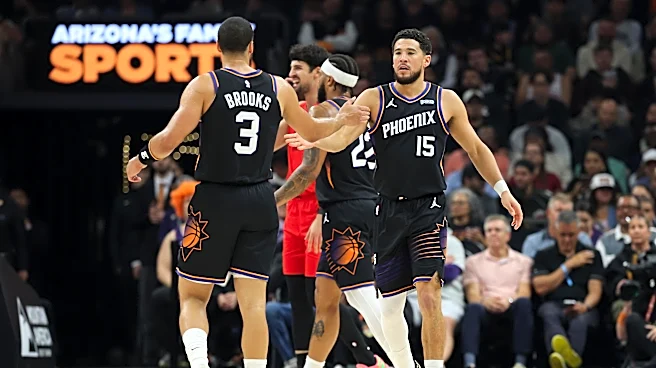
I know many people point to Dillon Brooks as the player responsible for changing the culture in Phoenix, and that’s an entirely fair assessment. That’s where much of Brooks’ value lies. He’s intense, he cares, and he holds himself and those around him accountable in a manner that his teammates appear to embrace. The officials aren’t particularly receptive to his version of accountability, but that’s a different conversation entirely.
While Brooks might be the culture changer, Jordan Goodwin has become the culture amplifier.
Brooks is the guy who can intimidate you on the basketball court, whose intensity demands that everyone around him elevate their level of play. Goodwin is the guy you want playing alongside you because his energy is infectious, his enthusiasm is genuine, and the joy with which he approaches the game makes everyone around him want to compete a little harder.
When we return to the concept of price for value paid, the numbers make Goodwin’s contributions even more impressive. He’s earning $5.9 million this season, and although we’re working with a sample size of only six games, he’s averaging 9.5 points, 3.3 rebounds, 2.3 assists, and 1.5 steals in 17.8 minutes per game. His true shooting percentage ranks in the 86th percentile, while his 48.4% shooting from beyond the arc places him in the 84th percentile.

That’s some remarkable production for a player whose primary responsibility isn’t necessarily to score.
And when you begin digging into his on/off numbers, the value becomes even more apparent. The Suns perform better in nearly every meaningful category when Goodwin is on the floor, including plus/minus, offensive rating, net rating, effective field goal percentage, offensive rebounding percentage, assist percentage, and steal percentage.

In other words, Phoenix becomes a more effective offensive team while simultaneously playing with greater aggression and purpose. The Suns attack the glass more effectively, generate more turnovers, move the basketball with greater consistency, and create better scoring opportunities when Goodwin is part of the rotation.
It’s the kind of impact that reinforces what your eyes are already telling you. Goodwin brings an energy that changes how the Suns operate collectively, and the statistical production supports the influence he has on the game. And for $5.9 million? That’s some pretty exceptional price for value paid.
Perhaps that’s what makes Goodwin such an important piece of this roster. On a team burdened by expensive contracts and questions about whether certain players are worth their salaries, he represents everything you hope to find in a complementary contributor. He understands his role, embraces it, and consistently makes the players around him better.
You can’t put a price on that kind of influence. Well, apparently you can. And at $5.9 million, the Suns are getting one hell of a bargain.