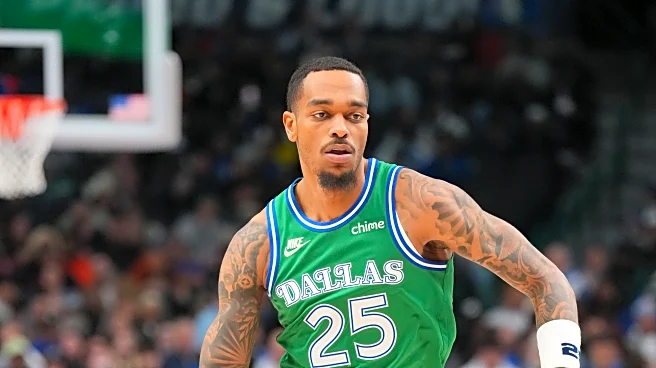



The Mavericks fell to the Timberwolves in what was easily one of the most tedious and disjointed games of the season. Dallas was led by P.J. Washington’s 21 points, Naji Marshall’s 18, and Brandon Williams’ 17, who was forced into a larger role with Cooper Flagg sidelined. Minnesota countered with 31 from Julius Randle, 23 from Naz Reid, and 20 from Anthony Edwards, controlling the game whenever it threatened to slip into chaos. And chaos was everywhere. The night was defined by turnovers, missed
layups, and nonstop trips to the free-throw line, with the two teams combining for 66 free-throw attempts in a game that rarely found any flow. Dallas’ biggest problem was self-inflicted: the Mavericks committed 19 turnovers, repeatedly giving Minnesota extra possessions and preventing any sustained offensive rhythm. In a game this ugly, the team that took better care of the ball was always going to win, and Dallas never did.
The night opened in chaos, with two quick Julius Randle buckets coming directly off live-ball turnovers, setting the tone for a sloppy start in which Dallas committed three turnovers before the 10-minute mark and struggled to establish any offensive rhythm. Minnesota couldn’t capitalize cleanly, however, as the Timberwolves missed jumpers and free throws, allowing Daniel Gafford to dominate the early possession battle with multiple offensive rebounds, a dunk, a putback, and four points in a two-minute stretch that kept Dallas attached despite the mistakes. The quarter devolved into a parade of missed shots, blocks, and giveaways, with both teams trading empty possessions. At the same time, Brandon Williams and Dallas’ bigs kept generating trips to the line, accounting for the Mavericks’ scoring more than shot-making. By the end of the quarter, Dallas had already attempted 13 free throws, which was the only thing preventing Minnesota’s cold shooting from turning into a deficit instead of a narrow lead.
The quarter opened in the same ugly fashion as the first, with Ryan Nembhard and Bones Hyland trading free throws before both teams immediately fell back into a mix of misses, turnovers, and stalled possessions, until Minnesota finally broke the drought with a Joan Beringer alley-oop dunk to extend the lead. Dallas started the period 1-for-5 from the field, and after Jaden Hardy hit a three, the Mavericks went on another cold stretch, missing four straight shots and scoring only on two Max Christie free throws over more than three minutes. The Wolves pushed the lead to 40-34 behind Randle jumpers, Gobert putbacks, and Hyland drives, forcing Dallas into a timeout while the offense continued to sputter. The sloppiness piled up: Dallas committed 13 turnovers in the quarter, both teams combined for 25 fouls, and the Mavericks managed just 2 made threes, leaving almost every possession to be decided at the line or on broken plays. Naji Marshall and Brandon Williams kept Dallas afloat with drives, layups, and trips to the line, but with turnovers and missed shots piling up on both sides, the quarter never found a rhythm, and Minnesota carried a 58-48 lead into halftime.
Dallas briefly showed life out of halftime when P.J. Washington scored twice inside, but that momentum disappeared almost immediately as the offense stalled. Minnesota went on a run powered by Anthony Edwards and Donte DiVincenzo, including a pair of Edwards threes that stretched the lead to 66–52 early in the quarter. With the Mavericks unable to generate clean looks, Naji Marshall was the only consistent source of offense, keeping Dallas afloat with floaters, layups, and free throws. At the same time, Julius Randle continued to score through contact to keep Minnesota in control. The Wolves pushed the lead to 80–63 behind Randle’s free throws and a step-back jumper, forcing Dallas into desperation mode as the quarter wore on. A brief Dallas push late in the period, highlighted by a Powell cutting layup and a Ryan Nembhard jumper, was immediately erased by a Naz Reid three, and even a rare Anthony Edwards technical didn’t help when Jaden Hardy missed the free throw, leaving the Mavericks staring at a 92-75 deficit heading into the fourth.
The quarter opened with Daniel Gafford throwing down back-to-back dunks in the first 90 seconds, cutting the margin to 92-77 and briefly injecting life into a building that had been quiet most of the night. Dallas followed that with a Jaden Hardy three, a Gafford hook, and a P.J. Washington driving layup, trimming the lead to 101–84 and forcing Minnesota into a timeout as the Mavericks finally showed some urgency. That was as close as it would get, as the Wolves immediately answered with Naz Reid threes, Anthony Edwards jumpers, and Randle finishes, rebuilding the cushion to 106-9. At the same time, Dallas fell back into missed layups, turnovers, and foul-trading. Even a late Washington tip-in flurry only cut into a deficit that never truly moved, as Minnesota comfortably closed out a 118-105 win with Reid’s floaters and Edwards’ late-clock shot-making sealing the game.
What has happened to PJ Washington?
P.J. Washington was one of the moves that bought Nico Harrison real time after the Luka trade, and at the time, it made sense. He was a starter on a 2024 Finals team, followed it with a career year through one of the most chaotic seasons this franchise has ever had, and looked like a long-term piece worth committing to. But this season, after signing a four-year extension that effectively locks him in through the summer, Washington has quietly slipped, missing 11 games with nagging injuries and losing lineup security to the emergence of Naji Marshall and Cooper Flagg. Even when the box score looks fine, the impact doesn’t match it anymore. Tonight was the perfect example. Washington finished with 21 points and seven rebounds, but he went 0-for-3 in the first half. He didn’t really start scoring until the game was already out of reach, eventually finishing 10-for-19 as the fourth quarter turned into extended garbage time.
The numbers looked respectable, but they feel hollow, padded by minutes that didn’t actually swing anything. When a player is sharing closing-time relevance with Caleb Martin, that alone tells you how far his grip on this role has slipped. The effort gaps show up, too. Late in the third quarter, Washington missed a jumper, watched his own rebound bounce past him, and then got beaten to the loose ball by Mike Conley, a sequence that summed up the frustration with his season. For a player who once defined Dallas’ physical edge, too many nights now feel like he’s just along for the ride, collecting stats after the outcome has already been decided.
A reminder to be thankful for Cooper Flagg
Tonight’s game was one of the most lifeless and dreadful watches of the season, not because the Mavericks were missing stars, but because it exposed what this roster actually is without one. Even without Kyrie Irving, Anthony Davis, and Cooper Flagg, there were still plenty of rotation players on the floor, yet what unfolded looked exactly like the version of this season Dallas was headed toward before the lottery balls bounced their way. We’ve spent weeks talking about empty numbers, inflated box scores, and lineups that can’t finish possessions, and this was that problem laid bare: role players trying to self-organize offense, settling for bad shots, and bleeding momentum whenever anything went wrong. That made the night especially jarring. The franchise was honoring Norm Sonju, one of the architects of what a real NBA organization is supposed to look like, while putting a patchwork roster on the floor built around short-term fixes rather than structure. We’ve seen it in games where P.J. Washington’s points came after the outcome was decided, in nights where turnovers piled up with no one able to stabilize, and in stretches where the bench had to hold everything together.
Without Cooper Flagg to give this team a true center of gravity, the result is exactly what this game was: disjointed, hollow basketball that would feel normal if not for the luck of last summer.
Turnovers, turnovers, and more turnovers
The Mavericks finished with 19 turnovers, 14 of them in the first half, and that alone explains why this game never felt stable for even a few minutes. Every time Dallas had a chance to settle into something functional, the ball went the other way, turning empty possessions into easy opportunities for Minnesota and preventing any rhythm from ever developing. For a team lacking ball handlers and finishers who aren’t designed to organize offense on their own, that first-half carelessness wasn’t an anomaly either; it has been a recurring theme throughout the season. When you’re giving away a quarter of your possessions before halftime, it doesn’t matter how hard you play or who gets hot late, you’re spending the night trying to dig out of a hole you created yourself.