
Two thoughts on the National Basketball Association club known as the New York Knickerbockers, Esq.
These Knicks are good! What that means is unclear.
If somebody were to ask “What’s special about the Cleveland
Cavaliers, Atlanta Hawks and Golden State Warriors?”, what would you say?
Nine players have suited up for all three teams, though unless you gave birth to any of Butch Beard, Chucky Brown, Bimbo Coles, Larry Robinson, Jimmy Jackson, Damian Jones, Mike Dunleavy Jr., Joe Smith or Bobby Sura, that pro’ly doesn’t seem special. Each franchise has had multiple identities: the Warriors started out in Philadelphia, became the San Francisco Warriors, then were Golden State before getting the song wrong and leaving their heart in Oakland for San Fran 2.0.
The Association’s first-ever Hawks were of the Waterloo, Iowa variety, though only for the 1949-50 campaign. Those Hawks were the league’s second-worst squad, ahead of another one-and-done franchise, the Denver Nuggets (somehow historically unaffiliated with today’s strain). Today’s Hawks trace their ancestry to both Milwaukee and St. Louis, before those forefathers and foremothers forged a new haunting grounds in the ATL.
LeBron James failed to make the All-Star team his rookie year in Cleveland. Know who didn’t? John Johnson. John Howard Getty Johnson, to be precise. Johnson was the franchise’s first-ever draft pick in 1971 and an All-Star his first two seasons. 25 years prior, the Cleveland Rebels were a founding member of the BAA. In their lone year of existence, the Ed Sadowski-led Rebs fell in the opening round of the playoffs to the Stan Stutz-led Knickerbockers.
But the past isn’t what ties these three clubs together. The here and now does.
I’m writing this Sunday morning, a couple hours before the Knick/Magic tilt, with the Cavs and Hawks both 14-11 and the Warriors 12-12. Nothing remarkable in those marks, though all three probably hoped to be winning more. No, what stands out is those are the only three teams out of 30 not on pace to win or lose 50-plus games.
27 outta 30 teams tracking to earn an A or an F for the semester seems strange, right? I looked at the last 10 years to track how many teams won or lost at a 48-win pace (there are two COVID years in this sample), by conference. The first number is how many were on a 48-win pace; the second, 48 losses:
2016-17: 9 teams (4 East, 5 West); 10 teams (4 East, 6 West)
2017-18: 11 (5 E, 6 W); 9 (5 E, 4 W)
2018-19: 13 (5 E, 8 W); 9 (5 E, 4 W)
2019-20: 11 (5 E, 6 W); 10 (7 E, 3 W)
2020-21: 7 (3 E, 4 W); 7 (4 E, 3 W)
2021-22: 11 (5 E, 6 W); 9 (3 E, 6 W)
2022-23: 7 (4 E, 3 W); 6 (3 E, 3 W)
2023-24: 10 (4 E, 6 W); 9 (5 E, 4 W)
2024-25: 13 (5 E, 8 W); 8 (5 E, 3 W)
2025-26 so far: 14 (7 E, 7 W); 13 (6 E, 7 W)
(The most striking difference is how many more teams are just awful in this alleged post-tanking world. Typically this is where I’d elaborate on the gross juxtaposition of the “load management” witch hunts being led by the same cadre of gluttons that are literally codifying their right to try less and disappoint fans more, all while raking in more and more $$$ via the CBA. Like, literally: “Hey, players! Rest less. Meanwhile, we’ll spend less, all the while charging our customers more.” But this a basketball piece.)
Early days still, yes, yet 90% of the league is at either a 50-win or 50-loss pace. Only the Cavs, Hawks and Warriors ain’t. Is the same ever-growing blob of data-driven front office groupthink that hollowed the midrange out of teams’ offenses also hollowing out the competitive middle class? Capitalism 101: nothing exceeds like excess.
The Knicks are on pace to win 56 games, which would be their most since 1997. They’re doing pretty nicely across the board, mostly. 12-1 at MSG. 4-1 against the division. 11-6 outside the division, although that starts to get weird once you realize that plus them being 4-0 against the West means they’re just 7-6 against the non-Atlantic East. Only they, Oklahoma City and Houston rank in the top-5 in points per game scored and allowed — mind you, Mike Brown’s Blue & Orange Crew are doing all this with a brand new coach and a rotation that runs 25-40% longer. They’re four up in the loss column on Cleveland, the team considered their biggest threat in the conference. Das ist gut, ja?
Historically, if the current trends hold — admittedly the opposite of “historically” — we’d be witnessing a drastically top-heavy concentration of Ws. In the 30-team era, the Knicks have won 50-plus games 10 times; each of those seasons, between seven and 10 teams won as many. I know as little about statistics as Rick Carlisle does about losing with grace, but these numbers could mean 2025-26 turns out to be something exceptional. Kinda like the 2025-26 Knicks. I hope.
The G.O.A.T. is a Knick. Correction: a G.O.A.T. is a Knick.
All due respect to Trooper Washington, Goose Ligon and Bob Netolicky, but any effort to define the greatest offensive rebounder in NBA history will not include them, despite — in fact, directly due to — the bulk of their years doing yeomen’s works on the ABA’s glass. Didn’t know this until diving into the numbers: the Knicks have an extensive history with this lot. Check out how many top-5o all-time NBA OREB-ers passed through 33rd and 8th:
47) Marcus Camby
41) Patrick Ewing
27) Terry Cummings
26) DeAndre Jordan
23) Zach Randolph
15) Tyson Chandler
13) Dikembe Mutombo
10) Charles Oakley
3) Buck Williams
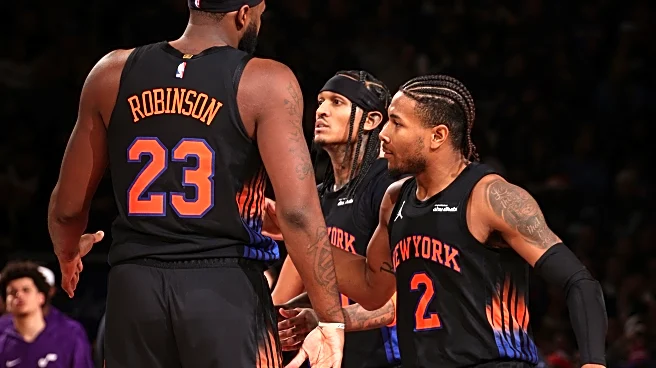
Yet no Knick ever approached what Mitchell Robinson is doing this year on his own glass. At 9.2 offensive rebounds per 36 minutes, he’s hauling in mates’ misses at a rate never before seen. That’s not an exaggeration. And not just Knick history.
Moses Malone is usually the first name you’ll hear mentioned as the OREB G.O.A.T. Cross-era comparisons are a waste for a hoary host of reasons, and Moses versus Mitch lays out one of the biggest: minutes-wise, 1986 and 2026 aren’t apples to oranges; they’re apples to silicon. As a rookie for the ABA’s Utah Stars in 1975, Malone led that league in offensive boards. Two years later he was in the NBA, where he led that league in the same stat his first eight years. He’s tops all-time in total offensive rebounds. Mitch could never . . . but only ‘cuz he can’t. Lemme explain.
Moses averaged 39 minutes a game as a teenager. Mitchell averaged half as many his rookie year. In Malone’s next nine seasons, he played between 36 and 42 minutes a night, twice leading the league. At 36, he still played 31 minutes a night. So while he had three seasons of 7-plus offensive rebounds per game, something Mitch has never done, his per 36 stats obviously come up short. Same with Dennis Rodman. Today, Steven Adams is usually cited as a best-in-class offensive rebounder. He’s gobbling a career-best eight per 36 this season — 15% fewer than Robinson.
Mitch has never averaged more than 27.5 minutes a game, dropping to a career-low 17 last year and this; if the Knicks used to keep him in bubble-wrap, he’s now in cryogenic stasis. That may or may not optimize the odds of him being healthy and ready to roll through a whole postseason, and that matters. A lot. If his career regular-season ratings don’t make it clear, ask the 2023 Cavs or 2025 Celtics how much of a difference Robinson can make in a playoff series. Ask the 76ers how come 2024 Joel Embiid assaulted Mitch.

Mariano Rivera isn’t the greatest pitcher in baseball history. But he’s rightfully baseball’s first and only unanimous Hall of Fame inductee (pre-Ohtani) because gun to your head, you need one guy to get an out? Or three? Or six? Pick Mo and live.
Over his career, Rivera faced a little more than 300 hitters per season. Pedro Martinez saw nearly 900. At 20, Dwight Gooden faced more than 1000 (and made them all look silly). Steve Carlton averaged more than that, one year leading the bigs at 1,351. In his first three full years as a Cleveland Spider, Cy Young faced nearly 2,000 batters each season. So you see: not only is comparison the thief of joy, but a specious thief at that.
G.O.A.T.s can’t be game-planned around. When Darrelle Revis and Deion Sanders were Revis Island and Prime Time, teams avoided their half of the field. Shaquille O’Neal is the only NBAer I ever saw for whom there was literally no defender, no defense. Hopefully he missed his free throws. That was it.
Here’s a doozy of a peach for ya: Robinson’s 12 offensive rebounds per 48 minutes is more than 19 whole-ass teams! The Thunder average the second-fewest offensive boards in the Association. I think the Knicks can surprise people and upset OKC in the Finals. As big a reason as any is the biggest Knick I’ve ever seen live. I was in the nosebleeds as a kid when I saw Ewing and Mark Eaton and Rik Smits, so maybe the distance shrunk them. But even with the last game I attended featuring 7-foot-4 Boban Marjanović, Mitch looked bigger. Way bigger. When Mitch gets in a cab, his shoulders gotta wait for the next one.
Outside of J.R. Smith and opponent shoelaces, I’m not sure how often the Knicks have ever had a player who was (in)arguably the G.O.A.T. at anything in my lifetime. Ewing used to be in the “greatest shooting 7-footer” conversations, though our spiritually lacking 21st-century spiral doesn’t love itself enough to project him into the chat. #33’s shot was so consistently wet water diviners were drawn to it. Carmelo Anthony is up there as far as scoring sharks, a.k.a. nature intelligently designed this organism to get buckets.
But as far as the big-4 skills — best scorer alive, best shooter, best passer, best defender? Dunno that they’ve ever had one of those. Best offensive rebounder ever? Check. And still with enough energy left over to hustle and hype his TikTok mid-game.