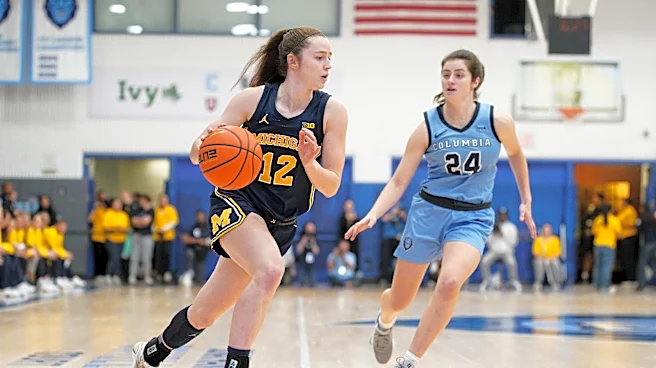




The No. 2 Michigan women’s basketball team has a goal to hold each opponent below 15 points per quarter. The Wolverines know if that lofty goal is completed, their offense can generally surpass those 60 points to secure a win.
Buoyed by its consistent defense, Michigan had two key stretches — a 7-0 run in the first quarter to establish its 10-point cushion, and a 16-5 third quarter burst — to seal the game. Those runs pushed the second-ranked Wolverines (3-0) to their first road win of the 2026-27
campaign, defeating Columbia (3-1), 81-58. Junior guard Syla Swords led the scoring with 17 points, followed by 15 apiece from junior guard Olivia Olson and junior forward Kendall Dudley.
“The better team sometimes can wear you down and wear you out,” head coach Kim Barnes Arico said. “And I knew that we would probably be able to do that. And I was hoping we would be able to do that at the start of the third quarter. And that kind of happened for us. I also think we got super stagnant in the second quarter, and we didn’t share the ball enough. The ball wasn’t moving enough, and that’s something we talked about at halftime.”
Michigan’s transition-based offense struggled to score fast break points against Columbia in the first half. The Lions got back in transition whether or not they made a basket, forcing the Wolverines to execute in the half-court. Passing and off-ball movement stagnated early, resulting in one-on-one actions and guards driving to the basket in isolation.
That offensive approach worked to an extent, lapsing for stretches but also connecting in the mid-range. The Wolverines largely stagnated in the second quarter besides Dudley, whose nine points of Michigan’s 13 in the frame prevented Columbia from closing the gap. Dudley’s final 15-point, 10-rebound statline bolstered the Wolverines, marking her first career double-double. Swords, a 3-point threat who is often ran off the line, drove for pullup jumpers to help Michigan separate, leading 36-26 at half.
“We were really clunky,” Barnes Arico said. “… I thought we tried to attack more one-on-one than moving the ball. I thought when we moved the ball and we used screens, we got some slips, we got some really good looks. We just weren’t patient, and I think part of it is staying patient in those moments because we are such a high transition team. We’re used to scoring so quickly. If we don’t score quickly, you know, can we be able to execute in the half court? And it’s our third game, I think we’re not nearly a finished product in that space.”
At halftime, the Wolverines adjusted in the half-court, moving the ball more and creating cleaner looks. The changes created a 10-2 run beginning with Michigan’s first second-half possession, reversing the ball and opening up the floor in the half-court. Layup attempts were products of well-spaced cuts rather than isolation drives into traffic, yielding better conversion rates. The 10-2 run continued into the 16-5 outburst, leading 52-31 after a three-point play from Olson with 4:51 remaining in the quarter.
Michigan cooled off in the half-court, but the Wolverines’ press generated some turnovers and transition buckets, maintaining the cushion even as Lions guard Riley Weiss started getting open looks. Weiss went for 23 points, including 7-for-8 shooting from the free throw line, despite being circled on the scouting report as the reigning Ivy League Player of the Year.
“I wasn’t really happy on the defensive end, but you know we forced 21 turnovers and they shot 32.8 percent,” Barnes Arico said. “That’s actually pretty good when I reflect. Riley Weiss is a really good player. … Where we fouled her, we’re late on some stuff and put her to the free throw line. I think that’s another area where we’re trying to get better too, is not fouling people and putting them to the free throw line.”
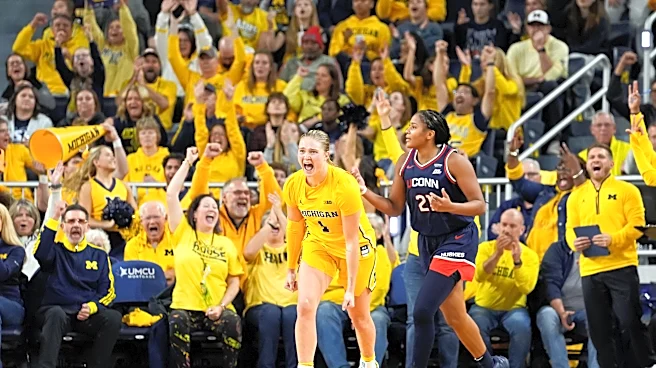
In the season-opening win against Connecticut, Michigan largely avoided foul trouble and limited the Huskies to seven shots from the charity stripe. The Wolverines have struggled to keep opponents off the line since then, surrendering 15-for-18 shooting to the Lions from the line — more than Columbia scored in each of three quarters.
Certainly, the road game exposed some things for Michigan to clean up — half-court offense, limiting shooting fouls, three-point shooting (4-for-18) — yet the Wolverines wore down the Lions and strung together enough dominant stretches to separate by 23 in the end.