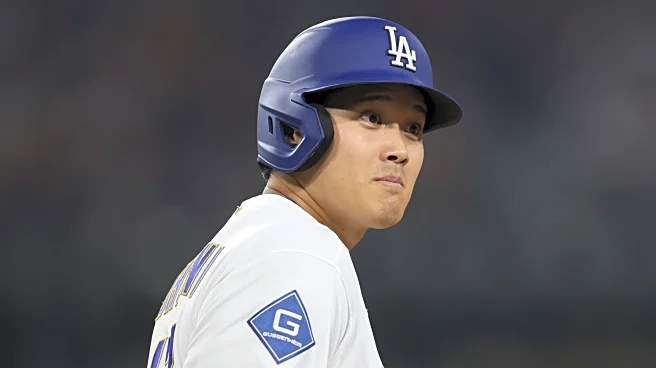

As if the Dodgers were trying to successfully distract me from working on the third of three planned essays I have for the revival of the “It’s Not My Money(ball)” series, word began circulating that the Dodgers had released a refillable Shohei Ohtani souvenir soda that was originally $75 before tax, and only good for the game it was purchased.
In hindsight, the controversy that arose both over the price and over the original marketing was entirely foreseeable. Had these facts remained constant, the Dodgers
would have been spectacularly outrageous, gouging their fans for a few cents’ worth of water and soda syrup.
Soda math
Let us not kid ourselves. Buying soda is a mug’s game.
We all willingly play it — you can pry my Coke Zero at the ballpark from my cold, dead hands.
And before anyone asks, yes, I judge any ballpark for being a “Pepsi ballpark.” As if asking if Pepsi is okay is ever correct. The answer is firmly, but politely no. I remember the days when the Oakland Coliseum was a 7UP/Dr. Pepper ballpark, which just ensured that no one was happy. Naturally, the alternative when there is no Coke is Dr. Pepper (Diet or otherwise), but allowances have to be made.
That bubbly diatribe aside, a three-gallon bag of soda syrup for a brand-name soda is usually around $100, maybe a bit more or less, depending on the vendor. From here, we can do a little math to illustrate.
For a single three-gallon box, we have 384 ounces, and for the following calculations, we assume no ice. Soda is generally dispensed in a five-to-one ratio of water to syrup. Dividing the 32-ounce cup by 6 (5:1) gives us the total ounces of syrup per cup: 5.33 ounces.
384 total ounces divided by 5.33 ounces of syrup per cup yields roughly 72 32-ounce cups per box, assuming no one gets anything larger or smaller, which is paramount in back-of-the-envelope math. At roughly $15 per cup, a single box of syrup yields $1,080, which is basically a tenfold return on every box of syrup.
Multiply that profit by literally all the concessions stands, and/or if the Dodgers water down their soda, and you can see the soda profits very quickly.
We willingly pay that mug’s game, even under this math, because soda is soda. Or pop, if you live in Minnesota.
The prospect of the Dodgers squeezing $5,400 per box of the same syrup is hard to swallow. The timing of this news bubbling up is appropriate, given the recent fizz about ticket prices and parking at Dodger Stadium at the start of the season. Needless to say, the team had to do something lest everyone go flat.
Soda puns aside, it does feel like this moment is a test of how eager fans will be to pay for Ohtani gear when all logic and common sense say caution might be warranted.
But wait, there’s more!
I am the last person to chide people on their personal spending (says the person who went to Game 7 in Toronto on a whim), but at the same time, the whole concept of the Othani Cup does feel a little gross.
Matthew Moreno of Sports Illustrated confirmed on March 29 the original marketing, the amended marketing at concession stands stating that “fountain soda refills included,” and a price update to $68.99. The team’s food account confirmed that the Ohtani Cup’s free refill benefit applies for the rest of the regular season.
I recall paying about $15 out the door for a souvenir cup at Dodger Stadium in 2025. Using that math, one would need to remember to bring the cup to Dodger Stadium and refill it at least five times to recoup the purchase price. Mr. Moreno estimated it would take about six refills.
Based on a pure value metric, the earlier one bought the Ohtani Cup, the faster it would be before they were essentially drinking “free” soda at Dodger Stadium in 2026. But before we pat the Dodgers on the back for their “generosity” on this point, it is important to realize that other ballparks have a similar setup without the considerable markup.
For all my mockery of T-Mobile Park’s baffling inability to get people into and out of the ballpark and the general dinginess of Tropicana Field, I was able to enjoy unlimited refills without the markup.
For those who want to buy the Ohtani Cup, they need only go to the field level at sections 9, 22, and 23; the right field pavilion; sections 137, 154, and 163 on the loge; reserve sections 12, 17, and 36; and the top deck section 4.
A Japanese Innovation…sort of.
For those who do not know, there are self-service beer vending machines at Dodger Stadium in 2026. Upon showing ID, and yes, paying the stadium mark-up ($20?!? No, thank you.), the machine dispenses an open can of beer to the customer.
At the risk of sounding like a Luddite, it seems like a lot of effort to poorly replicate something I have seen infinitely better in Japan, in two different ways.
First, vending machines in Japan are ubiquitous. Although they may start disappearing in the next few years, which is a topic outside the scope of this essay. One does not need identification, just correct change to buy either hot or cold beverages, including alcohol. The quest for a trash can is often a uniquely Japanese problem, but the ability to instantly obtain a Strong Zero (drink responsibly) whenever I feel like it is a perk one misses when it is gone.
Second, as to beer sales, there was a far more prevalent option in Japanese baseball: the uriko, the veritable army of Japanese women carrying kegs on their backs, dispensing alcohol seatside.
Progress marches on, I suppose. Speaking of Japanese baseball, Homecoming: The Tokyo Series is now available on the CNN streaming service, for which you can read my review here.