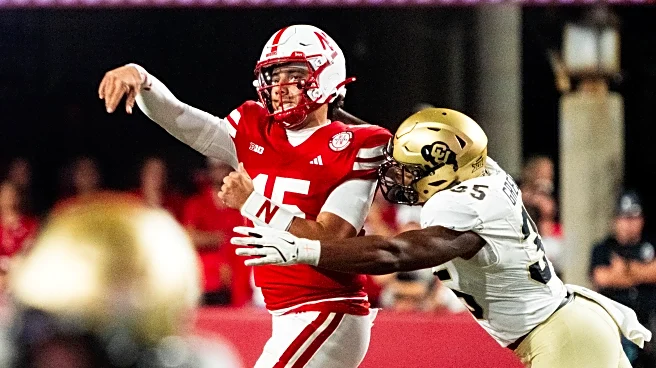

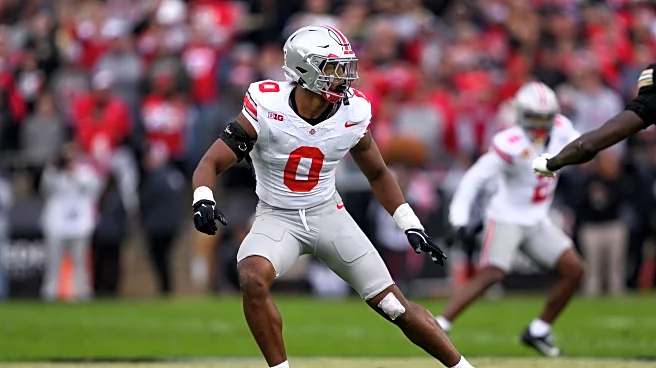
Raiola was recruited to Nebraska in the 2024 cycle as a 5-star (.9926) in the 24/7 composite. He was named the starter in Fall camp as a true freshman and played every game that year, leading the Cornhuskers to their first winning season capped by a bowl victory since 2013.
Raiola returned as starter his sophomore year and played through week 10, when he took a sack on the second drive of the 3rd quarter against USC which broke the fibula in his right ankle and removed him from competition for the rest
of the season. He entered the transfer portal in December and committed to Oregon in January, with three years of eligibility to play two remaining.
I’ve charted the last five years of Nebraska football … a tumultuous time for the Huskers, as head coach Scott Frost in his fourth year in Lincoln replaced his OL coach with Raiola’s uncle Donovan, then Frost was fired three weeks into his fifth season, and new coach Rhule spent his first year in 2023 with a disastrous QB rotation before finding stability with Raiola only to lose it again with his injury.
There are also three notable phases within Raiola’s tenure – in addition to the notable and expected jump in performance as a sophomore as well a reconfigured group of receiving targets for 2025, Rhule switched offensive coordinators in the middle of the 2024 season and there’s a clear difference in strategic run/pass emphasis between the original playcaller Marcus Satterfield and the new one for the second part of 2024 and all of 2025, OC Holgorsen.
Complicating the evaluation further is that the offensive line has been completely baffling. Over the period of time I’ve charted this team they’ve consistently been one of the better run-blocking lines (though one year they had a rash of running back injuries so it wasn’t immediately obvious), but despite top recruiting talent, consistent coaching, and what appear to be appropriate management decisions, they’ve been absolutely atrocious in pass protection every year. While other lines or individual linemen in the Big Ten have come in for worse overall grades in the five years I’ve been charting this league, Nebraska is at the bottom in the specific area of cumulative pass protection from both offensive tackles.
While far from perfect, Raiola’s stability in his true freshman season throughout 2024 was a massive improvement on the mess of previous years in which the Huskers each week devised new and extraordinary ways to lose close games. In 2023, three different QBs (one who’s gone on to be a tight end) combined for a sub-100 NCAA passer rating, three standard deviations below median. Raiola played well within norms for a talented true freshman, at a 22.3% QB error rate on my tally sheet and a 127.4 adjusted passer rating. The change in playcaller had them leaning into the run game more and dialing back the attempts at explosive passing for more efficiency throws, which was a better balance for Nebraska’s resources and resulted in an overall uptick in production, but Raiola’s passer rating remained basically unchanged that season.
In 2025, Raiola’s passer rating grew tremendously, to 158.6 in raw stats and 148.4 with garbage time and field position adjustments. That’s a flip of nearly two full standard deviations, from below FBS median to well above it. A sophomore leap is expected, though this big of a jump is a bit higher than the model would predict. Tracing factors for why that might be, I don’t believe it has to do with playcalling, since the OC change was baked in for the previous season and the playbook I saw was largely similar to the back half of 2024, and it certainly wasn’t improvements to pocket protection because if anything that got worse. I think it’s almost entirely organic development from Raiola as his QB error rate came down to an on-model 18.4%, with a some extra contribution from passing targets that netted out to be more effective, though even that Raiola should be credited for and requires some unpacking.
In 2024, there was a “long tail” of passing targets, which included three RBs, three TEs, and seven WRs. Some of Raiola’s underwater passer rating that year had to do with locking on to a few favorite targets or underperformers. In 2025, some of that problem solved itself by certain underperformers being replaced and the rotation tightening up, but it was still the case that there were better and worse targets to throw to, and this is where Raiola just got smarter as a sophomore.
I’ll detail the full list in my upcoming Summer preview of the Huskers’ 2026 season but the most significant is the use of #2 WR Barney – the most frequent target in 2024 but with a very poor 47.5% per-target success rate and 5.6 YPT. In 2025, Raiola lightened up with Barney, cutting about about five percent of his targets but improving his success rate a massive 13 points to 60.6% and YPT to 8.4. As further evidence of their improved chemistry, when Raiola was hurt and the backup took over, Barney’s numbers completely collapsed to 35.3% success and 2.1 YPT, while other receivers’ numbers stayed fairly similar.
What’s immediately obvious on Raiola’s tape is his arm talent as a former catcher in baseball – I’ve never seen a QB throw with this much velocity or precision, from this many arm angles, while essentially drawing no power from his base. Raiola simply doesn’t step into his throws at all, he generates all of his power from his upper body alone and his footwork is an afterthought. For every other QB I’ve watched like this, it dooms them to inaccuracy and lack of range and control, making them gimmick passers at best, but Raiola is the exception – he absolutely paints the field and with astonishing accuracy, maintaining a completion rate above 71% since Holgorsen took over and changed the playbook in the middle of 2024 (under Satterfield he was throwing at 62.5%). Some examples:
(Reminder – you can use the button in the right corner to control playback speed)
- :00 – Nice throw threading the needle between the backers and the umpire, on time as Barney breaks across over the top of them but before the safety can collapse. The line has given up pressure to Akron because of course they have but the ball is out in rhythm.
- :27 – Michigan’s defensive keys were badly set up to handle the RPO, though the timing on this one is off and the OL has climbed too far downfield (naturally the Big Ten officials ignore it). Raiola delivers a submarine sling to get around the nickel in tension – his momentum is carrying him the other direction and the upper body control to do this is with precision is remarkable.
- :49 – Reader, do you know how many Big Ten QBs I’ve watched in the last five years of tape who couldn’t make this 30-yard throw from the opposite hash standing up?
- 1:21 – Correct field read on the zone blitz, the middle linebacker is outleveraged covering the tight end and Raiola gives a pumpfake to move the overhang backer off onto Barney, the motion man. The safety bites inside and as soon as his feet move Raiola delivers into the coverage hole.
The most significant gap in the tape is standing in the pocket and throwing deep downfield – Satterfield tried making these the centerpiece of the offense in 2024 but the line wouldn’t hold up, and this was the period of time when Raiola was at his most green. There are some very long passing plays in the 2025 season, but they’re almost all in garbage time, tunnel screens that broke big, one hail mary on a rollout which I am appalled Michigan’s defense surrendered, or off of broken plays (more on those in a moment). Instead, the moneymaker plays of the passing offense tended to be pass rush neutralizers: RPOs and deep-drop play action from under center. Raiola did very well at these as a sophomore, here’s a representative sample:
- :00 – Absolutely perfect ball placement, teach tape stuff. The receiver here is a freshman who only played in the first few games but had some of the best film all year, they really connected because Raiola always hit him right in stride so he could get extra.
- :19 – More of Michigan’s haywire RPO programming. The DE and LB are on the back so Raiola properly keeps outside, the nickel and corner are both on the outside route so he throws inside. No problem throwing while moving left and with open hips, ball is nicely zipped so the receiver can get a couple extra before the safety arrives.
- :41 – The pass rush is delayed by the play action and slide, which gives time for the route to develop, even though the sixth offensive lineman brought in to do exactly this job just doesn’t feel like blocking the green dog (he might have gone for the sideline route if he had time for a bigger windup but protection failures like these were so universal I really have no way of knowing). Ball placement is great, right up against the sideline spacing.
- 1:03 – Correct read of the zone defense here: the DE stays inside so Raiola rolls to the boundary, the LB incorrectly vacates the throwing lane the X-receiver is slanting across so he threads the ball between them on time without setting his feet.
While Raiola is not a hair-trigger scrambler — truth be told, if the offensive line had to be this bad, Nebraska would have been better off with the type of QB who’s itching to take off instantly — he’s also far from a statue in the pocket and has made quite a few impressive escapes. He’s usually in scramble-to-throw mode, working laterally behind the line of scrimmage with his eyes downfield and only occasionally tucking the ball to run it. Paradoxically, almost all of Raiola’s big downfield passing plays during meaningful time have come after escaping a collapsed pocket and finding a throw. Sometimes that’s for the usual reason that the defense has gone all-in on a blitz and left the coverage sparse, but remarkably, the majority have been against normal or extra defensive numbers in coverage – he’s just not bothered by processing and throwing on the hoof. Some examples:
- :00 – If there was some Lion in Winter-style intrigue where the OL coach was trying to get his nephew killed then the TE was in on it. Raiola comes out of his play action turn and the DB blitzer is right in his face unblocked, but gives him the shake while keeping his eyes downfield. The LB has drifted too far inside with his hips turned instead of square so he can’t recover and Raiola fires on target.
- :28 – Nebraska’s formation is unbalanced to the field and the RB’s route makes it even more extreme. The backside end bails to cover the back door and the other seven defenders are in man with a couple backers and a safety to help to handle the flood, but they’re expecting something short on 3rd & 10 for some reason. Raiola takes the front door out of the pocket to create a better angle when he sees single coverage on Barney’s out & up, he knows the safety will go outside but doesn’t have the help he needs inside.
- :47 – Here the center decides blocking the 1-tech for a moment is enough and wants to help triple-team the 3-tech on a simulated pressure for reasons that surpass understanding. Raiola dodges that guy, runs around looking for an outlet, gets it off before the LB whom the LG and RB couldn’t handle hits him, to find the TE on the other side of the field, who’s been abandoned by the DE in coverage mesmerized by this dumbshow in the backfield.
- 1:27 – Northwestern rushes three, and one of them gets knocked over immediately by the TE so it’s really just two, but that’s still plenty of firepower against Nebraska’s line. The RT gets beat then takes some friendly fire from the RG (his “help” was a problem all year). Raiola steps up through it and fires with open hips, no loss of accuracy or power. He doesn’t take the short dumpoff to the TE but the downfield throw to the hole in zone coverage, meaning he’s been processing the nickel’s leverage on whether to throw to the No.1 or No.2 receiver during the drama.
There isn’t much tape on Raiola running the ball himself – when he scrambles he’s usually trying to throw, and the design of the run game was almost entirely straight handoffs with only RPO triple-option plays giving one potential outcome of the QB keeping the ball. What tape we have indicates he’s a smart runner in protecting the ball, his body, and efficiency yards, and that he’s got some decent athleticism, if not the quickest guy on the field. I’d say that he’d be a credible run threat in a different kind of rushing offense and could at least keep defenses honest – they couldn’t just ignore him like some Jugs machine QBs. Some examples:
- :00 – This is not a great pattern for 3rd & 6 and a predictable blitz call, there’s no quick throw to fill it and two routes into the boundary are effectively taken away by one corner jamming. The pocket doesn’t last a second so Raiola’s got to move; the backdoor is open because of the stunt and from there he curves back to where the man coverage is going to vacate from what he knows of the pattern to get a 1st down, then goes down safely but shoulder first for yardage.
- :27 – Not a conversion but actually my favorite scramble in two years of tape – the Huskers got to the goalline on a 43-yard pass, then took a TFL, a sack, and a targeting penalty on the left tackle (he threw himself head-first on a prone defender), which knocked them back possibly out of field goal range. Converting a 1st down would basically require completing a hail mary touchdown pass, and Minnesota is defending it as such. The new LT can’t handle the inside rush so Raiola just goes, dodges the backer and runs into the open grass to get them their three points back.
- 1:09 – Each of these are the correct reads on the RPO – the DE pinches in so the QB keeps, Northwestern turns out to be in their disguised zone so the TE toss is covered while the WR routes are handed off from the corner to the backer with the safety on top, the cleanest shot at efficiency yards is just to take them directly and he dives for about seven at no safety risk.
- 1:24 – I don’t love this playcall on 3rd & 8, the defense — especially this one, which faces the RPO in practice every week — gets to pick the play in the triple option and they can choose for the rational set of reads to be a 5-yard gain. Each of Raiola’s decisions are correct here and he makes a nice move to get a little more but put this one on Holgorsen. If your call requires the defense to screw up royally or the QB to be the Flash … well, not the worst bet when you’re playing USC, but for the latter question no dice.
In assessing Nebraska’s failed passing plays, calculating the QB error rate, and determining where Raiola falls on the development arc I’ve algorithmically modeled through 15 years of charting data, the challenge is breaking out how each play was designed and why it failed. This in order to isolate the issues Raiola has to work on, as opposed to which issues others were responsible for and might be different in another setting. The Huskers’ offense was challenging indeed, because I think there’s often multiple overlapping things going wrong, and even on plays where Raiola doesn’t initiate the problem, there’s still criticism to be made for how he deals with it.
I’m first going to document the stuff I think Raiola is clean on, including some issues where others might have blamed the QB but I think a careful review of the film will show that the problem lies elsewhere. That will give context to the final section of this article, which are the simple issues that Raiola wholly owns and the complex issues of improper responses to other people’s problems.
The clear, and frankly, shocking problem upon turning on the tape is just how awful the line is at pass protection. There are more complicated questions once the pocket is established — all pockets collapse eventually, so how long is long enough, and is the QB letting the perfect be the enemy of the good — but immediate pocket failures of this sort precede those questions. No route has a chance to develop at all, the QB has no chance to set up or complete his throwing motion, even an attempt to throw the ball away risks a turnover or an intentional grounding flag. These represented about 36% of failed passing plays in 2025; here’s a representative sample:
- :00 – Michigan rushes three and still collapses the pocket in 1.5 seconds. The eighth defender who’s bailed into coverage occupies the throwing lane for Raiola’s quick throw, the crosser, and there’s no time to go anywhere else.
- :26 – Nebraska’s running a mesh-sit with a deep release and an RB wheel, which was one of their most frequent patterns but had the lowest success rate because none of the routes develop quickly enough. There’s a pocket for about 2 seconds and Raiola steps up to hit the TE on the sit-down in the midfield, but the LT has allowed the DE so far in, with his inside arm free, that the defender can just reach out and yank Raiola down as he’s cocking his arm.
- :47 – Lots of extra blockers to create a couple one-on-one routes, but still not enough time, the RG is immediately beat. The inside receiver is getting mugged and Raiola can’t wait for the outside receiver to break free because he’s about to get hit, so he dirts the ball intelligently.
- :57 – Railoa comes out of his play-action drop and the RT has already lost; he would have needed at least some protection for the route development on this pattern, but even if the RT hadn’t folded he doesn’t have a throw as the X is bracketed by the corner and safety and the Z always has a safety over and both backers underneath. The defense has numbers advantage because Nebraska is using a 7-man protection plus a checkdown against a 4-man rush, with only two in the pattern but still losing the pocket the offense is at a permanent disadvantage.
The next problem was the set of receiving targets, each of whom seemed to have at least one major drawback. Both the top WR and top RB out of the backfield had problems with drops and spatial awareness, the main receiving TE is a huge guy and tough to bring down once he’s caught the ball but had real trouble creating separation, Barney as mentioned above was fickle and needed to only be used on highly specific occasions, and their ostensibly big-bodied contested catch receiver just never won routes physically or athletically.
I’ll break this up into two videos, but what this amounted to was a disconnect between what Raiola was asked to do and what was actually available – either he’d put the ball where it needed to be and the pass-catcher wouldn’t get it done, or there simply was no throw to be had because the pattern had no viable outlet or wouldn’t get one by the time the pocket collapsed (more on that last part in a moment).
In 2025, I have a little less than a quarter of failed passing plays in which I think Raiola did his job and the problem was the receiver and/or the pattern. Here’s a representative sample of plays in which it’s more about tactical execution by the receivers:
- :00 – Nebraska puts five in the pattern, but Cincinnati has eight in coverage since they’re very comfortable rushing only three and still collapsing the pocket in under 2.5 seconds. The entire pattern is totally locked up, the top target is even triple covered, and the defense still has enough resources to leave a QB spy in place.
- :25 – Raiola pretty calmly rolls away from the LT getting mauled towards the unbalanced formation to the field. He extends it long enough for the No.1 to break away from the corner (the primary read in the play design is the No.3 receiver cutting under the other two to the pylon, but he gets illegally held and no flag there). Raiola puts the ball where it needs to be but the WR in his excitement has lost field awareness and stepped out of bounds, and the touchdown is called back.
- 1:07 – This was a recurring theme multiple weeks: defenses would play press-man, jam everybody up at the line, and then just … no one would break the press, ever. Evidently part of Nebraska’s playbook was to throw a certain number of deliberately 50/50 balls and allow the receiver to go up and beat the DB to win the catch; I couldn’t imagine a WR corps I’d be less sanguine about doing this with, these throws had success rates that ranged from 25% to the single digits.
- 1:29 – I had to take several plays out that the computer algorithmically suggested to be representative because I felt it would be picking on this one WR too much; the coaching staff brought him in as a one-year transfer and had tremendous faith that he’d Moss a bunch of corners and … whatever the opposite of Moss’ing is what happened instead. Here the right play is to stop up shorter on the route while the CB is still backpedaling to create some room and go vertical to high-point the ball, not bunnyhop while the CB is in your pocket.
The issues with the passing pattern are complex; a brief summary might be that the receivers are frequently locked up in man, and pass protection issues make defeating zone a nightmare. Zone coverage was especially problematic for this offense because the more blockers Nebraska added to shore up the pocket — which usually didn’t even help, defenses would still get pressure with four or even three against six or seven in protection — the more lopsided the numbers advantage the coverage had against the limited routes. In addition, all of Holgorsen’s built-in quick developing hot routes were man beaters like crossers and RB wheels, while the zone beaters took longer to develop than the pockets would hold up … and unlike against man coverage, the QB can’t just throw the ball on faith when in trouble against zone, because defenders’ eyes are in the backfield so it’s an intolerable interception risk. Here’s a representative sample:
- :00 – Four hitches and a checkdown, Lord have mercy. Where is the vertical or horizontal stretch to open up the defense? Cincinnati rushes three and the pocket holds up for 3.5 seconds but Raiola still winds up throwing it away and I don’t fault him, there’s no throw here and anything he forced is an interception risk against zone. The defense has multiple layers squatting — stationary! — on each outlet and anyone could break on a ball to house it.
- :19 – This was Holgorsen’s favorite low redzone playcall for some reason, the jumbo set predetermined lob to the corner. It worked exactly once all year, every other time it looked like this – the ball is exactly where the play asks it to be, but the CB maintains downfield position and legally keeps the receiver from getting hands on the ball.
- :49 – This is a coverage sack. By leverage the pattern has the outside receivers from the teacup running into the coverage, while Barney gets to dance in front of the backers and future Duck #3 DB Perich, and the TE is locked down. If the pattern used this to run Barney right to the pylon and force a LB to keep up with him or put the nickel in tension that’d be something, but it seems stretch concepts are too spicy for the Midwest.
- 1:21 – The dryly delivered comment on the broadcast, after an entire first half in which Nebraska couldn’t defeat man coverage vertically on any route with any receiver, was that they were making USC look like the physical, athletic defense.
Using the above as context (and I left quite a bit on the cutting room floor; the Huskers’ tape has been difficult to watch for the last several years and I am impressed with Nebraska fans’ fortitude in sticking with it), this final section of the article concerns the issues which can be isolated to Raiola alone as well as how he’s dealt with stress situations. These are things which, in my opinion, would persist if they went unaddressed no matter what team he was with, and are for him to work on with the new coaching staff.
Of the issues that Raiola owns entirely, the clearest are his interceptions. In 2024 he threw one more interception and several more interceptable balls than he did in 2025, some of which were understandable freshman mistakes and at least two were just plain bad luck. But as a sophomore each one of his six interceptions was his fault (four were clean pockets, two were rapid pocket breakdowns and he’d have been blameless if he got rid of the ball but instead he did something foolish), and on a per-throw basis Raiola’s interceptable pass rate actually increased in his second year. In my opinion, contrary to the descriptions I’ve seen from some that he’s overly cautious and waits for the perfect pass, I believe Raiola grew somewhat more cavalier in 2025, and he’d benefit from centering himself:
- :00 – Right, so, this is exactly why you do not throw the short-out into the flat against zone with two DBs squatting. The pocket is getting creased but Raiola has time to make a better decision, he should be gaining depth and throwing the slant behind those guys.
- :21 – I can’t explain this one at all. This isn’t the throw, that receiver isn’t open, the robber is right there. The throw is to Barney, the back releasing has pulled the WILL out of the lane as intended.
- :46 – This is one of the two pressure-related picks. The Vaudeville act from the line is hardly novel; what’s troubling is Raiola trying to play superhero. This isn’t a throwaway gone wrong, he’s trying to hit the outside receiver who’s broken free from coverage on the scramble drill, and doing it while jumping up on one foot and falling backwards. Raiola’s done some physically impressive stuff but figuring out the line between courage and recklessness is part of development.
- 1:16 – There isn’t a great throw available here, Northwestern is playing sound cover-2 man, but the pocket is holding up and the field safety is staying low on the slant instead of helping the corner on the sideline route. That would make it the throw to challenge the CB on regardless of how the linebacker reacts to play action — Raiola should be reading the safety first — but he definitely shouldn’t throw the slant with the backer underneath.
The other major issue I would like to see Raiola work on is developing more traditional quarterback throwing mechanics so that they’re second nature, and so that he would reach for the unconventional stuff only in extraordinary situations. It’s hard to quantify exactly how much this issue contributed to failed passing plays, since arguably he threw unconventionally every time and whether the same play but with conventional mechanics would have succeeded is a counterfactual. Subjectively speaking my sense is this may have flipped 5-7% of passing plays but I have no way of testing that. Here are some examples where I think Raiola’s unique mechanical toolkit got him in trouble:
- :00 – It’s not surprising that a pull protect with the RB picking up the RG’s gap would just result in an awkward pileup of bodies in pocket, but it is that Raiola would try to hop back and away from it while dropping his arm slot. Since the TE on the crosser is running away from him and coverage, zip isn’t the important thing, it’s catchability – he needs to give it some arc so the TE knows what’s coming and can fit his hands to his eyes.
- :11 – Raiola is staring at Barney’s wheel but that’s not isn’t going to work against this coverage, the corner and safety switched off. The throw on this play is the over route to the X, who’s beaten coverage and the 7-man protection has given Raiola time to throw it. But waiting too long to figure it out, then rushing his mechanics to this weird jumping lob instead of stepping into it with pointed hips and delivering a flat arc, gives the coverage time to catch the WR and get the breakup.
- :18 – This is the correct read on the RPO of the OLB and DB, but no rightie can throw well goofy footed, this is Raiola pushing is unconventional mechanics way too far. He has time to flip his hips around and step into it … with his left foot.
- :30 – I felt like watching this play was a culmination, in a sense, of everything I’d seen from Nebraska’s passing offense and how each factor informs the others. The protection, route running, and throwing mechanics are all poor, and it’s difficult to say “if not for this, it’d be fine.”
The most frequent comment I’ve heard from Raiola’s critics — and apologists for the larger program — is that he holds the ball too long and takes extra sacks because of it. I think this had a lot of validity during 2024, when he was a freshman and in Satterfield’s version of the offense which emphasized deeper routes. Since the change at coordinator and the incorporation of more RPO plays, and after the 2025 offseason’s development, this hasn’t held much water to my observations.
As a sophomore, the ball was getting out of his hand on time because that’s the structure of the play in the case of RPOs or predetermined reads, or because his progressions were in rhythm – it would simply be impossible for his completion percentage or passer rating to be as high as they are, especially with an offensive line this flimsy, if he had a chronic problem with indecision. The vast majority of broken plays are exactly as described in the previous section of this article: instantaneous pocket collapses to which “holding the ball” is a farcical thing to say, or outlet problems where releasing the ball would be worse.
That said, the silver rule in analysis is that a negative is not an inverse – all the plays that failed because of protection failures or pattern problems should not be counted as wins if Raiola were behind a better line looking at more appetizing routes, they’re just a giant hole in the dataset. We don’t know what would happen had Raiola been given more time to throw, it’s probably a normal distribution but even that’s a guess. Some data suggest that he’d hesitate on a certain percentage of plays that aren’t instant collapses and a throw is available, because of course that’s so, it’s true of any QB. We just don’t have a good way of measuring it in Raiola’s case because of the sample size. What I can say is that 2025 wasn’t entirely free of such plays, here are the ones with clean tape (the broadcast cut off most of another):
- :00 – This is the right throw but it’s way too late, the CB’s hips go wrong in relation to the sideline very early in the route so he can’t recover, and Raiola should release with arc at the top of his drop and let the WR come back to it. I don’t even know what he’s waiting on visual confirmation of, this is a timing route.
- :21 – Based on the CB’s leverage, the throw is the in-route to the X-receiver, the ball should be out just under 2 seconds after the snap so it intersects with the WR at the hashes. He needs to get it over the LB’s head but that’s what the TE on the crosser is for, to smush him in so he can’t make a leap on the ball. As soon as Raiola hesitates, the TE comes free, the underneath backer retreats on the hashes, and the route disappears.
- :43 – Minnesota is blitzing out of cover-1 as usual, the safety is on the back so he has to come down, and Barney is pulling the dime to the other side of the field, so Raiola has the coverage he wants with the No.2 vs the nickel – the ball should be out at the top of his drop. The OL’s lockon instead of playing gaps against stunts means he doesn’t get a second chance.
In Nebraska’s case, there’s about a 6% gap – these are plays in which Raiola read the defense properly and made the right throw, on time and accurately for a connection, but the defense still won because it didn’t get sufficient yardage given the down & distance for one reason or another. These are almost all due to quick-but-not-immediate pressure.
What remains, and accounts for the largest chunk of Raiola’s individual QB error rate, are simply mistakes in field processing. This is expected, every QB gets it wrong some of the time, all the way up to Super Bowl winners and hall-of-famers, and bringing the quotient down over time is just what development is about. Raiola’s rate is well within norms for a sophomore with his experience level, and was bending down to the point where I would say he was ahead of schedule by midseason of year 2, but unfortunately his injury cut that short.
We’ll just have to wait and see how the time off affects Raiola’s development — the data on QBs who start, sit a year, then start again is too noisy to model, and those who do so at the highest level of college football is a sample set of two young men, right now, at the University of Oregon — but in the meantime there are certainly things to work on:
- :00 – Raiola goes through his first two progressions, the X and then Z receivers, and doesn’t like either one; fair enough, they’re pretty well covered and he’s got time with a 3-man rush. The throw should be his third read, Barney on the man-beater, since the safety on him has way too much junk to run through and the backer is spying, not helping cover. Instead Raiola loses patience and takes off, which is the wrong choice.
- :24 – Everybody is kind of lazy on this play – the whole line false starts, the WR is running the route sloppily, and Raiola releases the ball before he’s cleared the backers. One of them gets a hand on it for a breakup. The right move is to step up against the pressure the LG is surrendering (to, I stress, Akron) to buy another beat and lead the WR away from the robber.
- :46 – I’m not sure this stunt pickup is entirely legal, but what is in the lawless wilds of the Big Ten, and at any rate there’s no reason for Raiola to be feeling phantom pressure here. The fieldside switch concept to Barney is the right throw as it exploits Michigan’s zone defense — the nickel just stands around after giving him a pat on the back — but instead he’s telegraphing a dumpoff to the RB which the corner is already collapsing on for a PBU before Raiola even releases.
- 1:13 – This mismatch of a linebacker trying to cover Barney is exactly the kind of “just the right circumstances” for which reserving him resulted in better outcomes than 2024, so I don’t get the hesitation here. Raiola doesn’t like the No.1’s odds to the corner, fair, the No.2 is bracketed, move on … Barney’s cooked the LB, hit him for a TD and go home. Instead Raiola sees ghosts and throws it away.