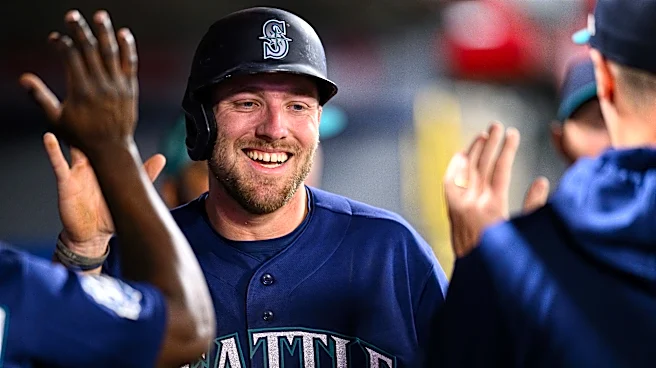





When Mariners prospect Colt Emerson signed his (then) record-breaking extension before ever appearing in an MLB game, much of the conversation focused on the risk the Mariners were taking, allocating such a long-term, significant chunk of payroll to a player who has yet to take a big-league at-bat.
Considerably less attention was paid to the risk Emerson was taking on – an easy thing to do when minting generational wealth before one of is of legal drinking age. But if the financial risk is somewhat
less impactful for Emerson (what is a slight contract valuation difference between friends, especially some of those friends are inveterate proles from whom $10M/year is as outlandish a figure as $20M/year), the cultural risk is significant. José Ramírez bet on the perpetually-pesky Guardians and has received years of playoff appearances; Mike Trout signed up to be an Angel for life in 2019, only to miss the playoffs for the past decade, see his fellow generational superstar leave for the “cross-town” “rival,” and for internal organizational failures to be documented in excruciating detail in the press.
It’s a heady decision to make as a player deep in a major-league career, but even more so for young players signing the peak years of their 20s away to an organization, like the high-dollar long-term deals signed by Corbin Carroll with the D-Backs, Roman Anthony with the Red Sox, or Ronald Acuña with the Braves. The organization might choose a player, but the player has to choose that organization back.
That’s a trust that touches every level of the organization: from trusting the team’s commitment to winning baseball as shown in things like investing in good development and allocating organizational resources to the on-field product; to trusting the team to share your values about how to treat people and the surrounding environment. Luckily for the Mariners, they have a current track record with signing young players to extensions – Julio Rodríguez, followed by Cal Raleigh – that allows them to demonstrate firsthand what it means on and off the field to be a long-term Seattle Mariner. Raleigh, especially, has emerged as a team leader whose voice helps shape organizational decisions. It’s an appraisal Raleigh has earned, first with his daily dedication to the team’s operations, but also a right he’s granted as a stakeholder in the team’s future when he signed his extension.
It’s not hard to see Emerson, who possesses Raleigh’s same drive and a similarly keen mind, following in those footsteps. Emerson has spoken glowingly of Raleigh as a player and a person, as someone whose minor-league career he has sought to emulate.
“You just go around and look at the clubhouse, look at the guys in the clubhouse, and they’re role models,” said Emerson ahead of a game in Tacoma on Saturday. “Cal Raleigh, I mean, he shows up to the field at spring training at 5:30 in the morning, every morning. That’s the example that he sets, and that’s the example I follow and want to set, too.”
Emerson’s work ethic did stand out this spring, as he found himself shoulder-to-shoulder with seasoned veterans like Rob Refsnyder, Brendan Donovan, and Josh Naylor, all of whom were happy to have the rookie in their midst, eagerly absorbing their wisdom – listening more than he spoke, but not without contributing his own thoughts. The image of Emerson enmeshed among players several years his senior wasn’t a surprising one to Mariners President of Baseball Operations Jerry Dipoto.
“I think Colt is universally respected for how he goes about his business; for who he is as a person; the respect he has for his teammates; the way he prepares and his thoughtfulness,” said Dipoto in a meeting with the media after the contract was announced. “You can’t not appreciate that. And I know his teammates do. He got rave reviews from the veteran players in the spring.”
For Emerson, as is typical, he deflects the praise, makes it bigger than himself.
“There’s a lot of hard workers in the clubhouse,” he said. “Lot of hard workers in the minor leagues. And, that’s just a testament to the Mariners and how they pick guys. Everybody’s got the same goal. Everybody works really hard, and it’s cool to be able to do that. I don’t know too many organizations that have that type of culture.”
“The culture here is just so incredible.“
Emerson paused for a moment, the normally whip-quick shortstop at a rare loss for words.
”I can’t even describe it.”
Emerson is young, but he’s not without experience in high-pressure environments. As a prep prospect, he played on the showcase circuit, and for Team USA. Shortly after Emerson was drafted, Scott Hunter, Mariners Director of Scouting, said the thing that stood out the most about Colt was a question not asked of Emerson himself but a boilerplate question asked of other prospects the Mariners were considering: which player from this process would you most want to be teammates with?
The answer, overwhelmingly: Colt Emerson.
Watching Emerson this spring, his leadership was obvious: certainly in high-profile moments, like watching him command the infield from the shortstop position; but in quieter moments, as well. How he took time to greet every person at the complex, from teammates to media members to custodial staff, by name if he knew it. How he held the curtain at the batting cages open for the next hitter to go through. A stray empty water bottle picked up and deposited in a nearby trashcan. The kind of leadership that’s still there when no one is looking.
The Mariners have had an opportunity to log these small moments of leadership by Emerson for years. They might not know exactly how Emerson performs on the field, but they absolutely know the person they are getting. That, along with the treasure trove of proprietary data to which they’re privy, might have given them the advantage in a deal that carries some degree of risk for both sides.
If anything, it’s Emerson who is taking a leap of faith, choosing to believe in the organization that has drafted him, developed him, and offered him stability – something that means a lot to the process-driven, routine-oriented infielder, who says he’s grateful for the opportunity to be able to focus on his singular goal when he’s on the field.
“For me, going out on the field every single day, I’m trying to do what the team needs to win. I like to say I’m a winning ball player every time I show up to the field,” says Emerson, invoking a favorite phrase. “So, given the security of being in the same city for the next eight years, just allows me to stay the same guy. I mean, I’m never planning to change as a person, so I’m just happy to go out there and be a winning ballplayer for the team and do whatever they need me to do.”
It’s that stability and clarity of purpose that seems to matter to Emerson, even more so than the money – “I’m not a very materialistic person,” he said, noting that everything has “come so quickly” that he hasn’t had an opportunity to process it. Signing on with the Mariners at this stage in his career allows him to do the thing he most wants to do: focus on “being a winning ballplayer” without any outside distractions.
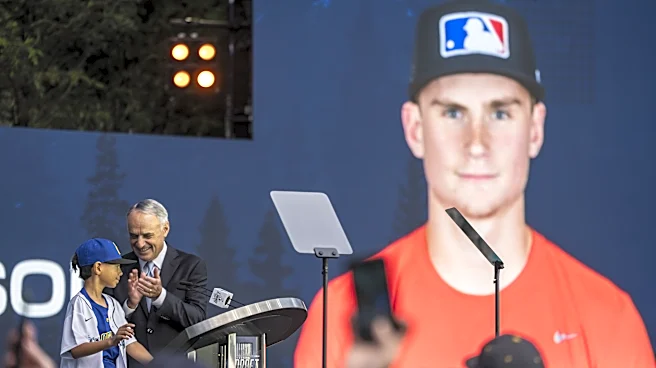
In a way, it’s something Emerson has been angling towards his whole career. Quick, deep cut Mariners trivia quiz: when the All-Star Game was in Seattle in 2023, who announced the Mariners’ first-round pick?
If you remember the adorable nine-year-old cancer survivor Tiago Viernes, good for you. Colt Emerson remembers Tiago, who is inextricably tied to the moment he knew he wanted to be a Seattle Mariner for a long time.
“When I got drafted in ‘23 and the All-Star game was in Seattle, and Tiago called my name, I knew it was special from that moment,” said Emerson.
“And from that moment on, I was just like: this is going to be my spot. You know? Or, I hoped so. And it ended up being [so], and that’s all part of God’s plan.“
“I’m just so thankful and grateful just for the opportunity, really.”