


It’s no secret that the Colorado Rockies starting rotation is close to empty. Four of the pitchers that occupied the team’s rotation at the start of 2026 are free agents, their highest potential young starter likely won’t be available until mid-season, and there is not an obvious wave of promising pitching prospects waiting in the high minors ready to fill in the gaps.
Simply put: Filling the starting rotation will be a primary focus of the offseason for the Rockies.
It has historically proven difficult
to lure free-agent pitchers to the elevation of Coors Field, so whenever the front office is able to convince one to give the team a shot, they need to seriously consider retaining their services. So, before looking around the rest of the league for new and novel rotation options, let’s weigh the positives and negatives of possible reunions with last year’s starters.
Kyle Freeland
Exactly what, if anything, Kyle Freeland still has in the tank isn’t clear.
In 2026, injuries prevented him from hitting the 150 inning mark for the second time in the past five years, and he saw his ERA balloon to an unsightly 6.65. On the surface, it seems pretty clear that his days of being able to give the team a plausible chance to win every fifth day are behind him.
Under the hood, however, he looked pretty similar to how he did in 2025 when he managed a sub-five ERA and 1.4 rWAR.
His K/9 and BB/9 both improved marginally with the only real difference being a spike in HR/9 from 1.22 in 2025 all the way up to 1.93. His velocity and pitch mix didn’t drastically change between seasons with the only notable shift being his increased usage of his changeup against right-handed hitters.
He was, essentially, the same pitcher he had been with some injuries and worse results.

All this to say, moving forward Freeland could very well either be entirely washed or able to look like the serviceable back-of-the-rotation starter that he has been for the second half of his career.
Given how little salary he is expected to command on the free agent market, his history with the organization (not to mention the greater Colorado community), and how close he is to reaching the vaunted 10 years of Major League service time threshold, it would be an understandable move to bring him back on a one year prove-it style deal.
If the Rockies do that, though, it would need to be with the understanding that his spot in the rotation was not guaranteed. They cannot afford to have a pitcher performing as poorly as he did this season if they want to avoid the 100-loss mark in 2027.
José Quintana
Of the trio of pitchers the Rockies signed last offseason, José Quintana is the most difficult to evaluate.
After four straight seasons of reliably outperforming his expected stats to run an ERA south of four, injuries wiped out the majority of 2026 for Quintana. The time he did spend on the mound looked much more in line with his previous seasons expected stats, but it’s unclear how much of that was regression, age related decline, or simply the effects of not being fully healthy.
Quintana was able to end the season having returned from the injured list in mid-September in time to make two short starts for the Rockies. While he didn’t look particularly sharp in either appearance, simply being able to showcase that he could get through seven Major League innings gives some hope that he’ll be able to return to form after a full offseason of rest.

Re-signing Quintana would be a roll of the dice.
The Rockies could either get a repeat of the injury/age compromised player they got in 2026, or they could actually see the stabilizing force they thought they had signed last offseason. It would be a risk to sign Quintana, but given how effective he was at limiting runs until 2026, he could represent a savvy buy-low option for the team.
Michael Lorenzen
When the Rockies signed a trio of starting pitchers last offseason, Michael Lorenzen was commonly thought of as the one with the most upside. His large pitch arsenal, average fastball velocity, and stated embrace of the challenges of pitching at Coors made him seem, on paper, like the perfect low-cost match for the Rockies 2026 pitching experiments.
When the rubber actually hit the road, however, Lorenzen simply did not pitch well enough to warrant keeping on the roster for the full 2026 season.
Given that, and his failure to bounce back after signing with the Toronto Blue Jays, it’ pretty clear that the Rockies have little to no interest in a reunion heading into 2027.
Tomoyuki Sugano (菅野 智之)
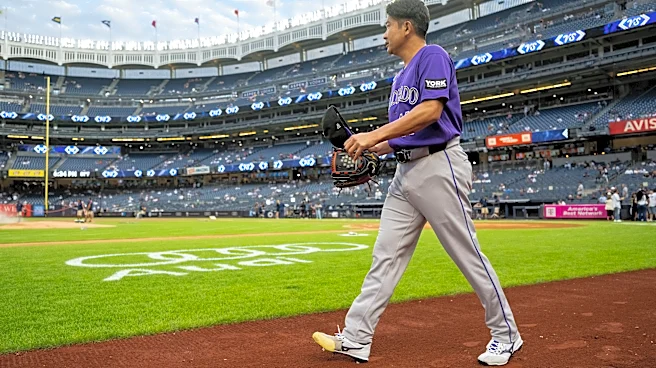
Over the course of the 2026 season, Sugano was the most consistent Rockies starting pitcher.
His 5.37 ERA over 154.1 innings pitched were the definition of competent innings eating given the context of Coors Field. This is a baseline that the team has, in recent seasons, struggled to meet. What’s more, looking forward to their current pitching depth chart for 2027, they have approximately zero options that you can feel confident will be able to match that line.

As a soon-to-be 38 year old with now two seasons under his belt in MLB, there is little chance of Sugano having upside beyond being a stable innings-eater as he was for the Rockies in 2026.
The pitching lines in Sugano’s two MLB seasons were remarkably similar. His 5.39 FIP last season was only 0.03 higher than it had been in 2025, and his xFIP of 4.74 was only 0.04 higher than the previous season. Even the shape of his season followed the same trajectory as his first half numbers in both 2025 and 2026 were noticeably better than the second half.
Sugano appears to be a solid bet, regardless of where he’s pitching, to maintain a similar level of back-of-the-rotation style production next season.
As a known quantity in Colorado, the Rockies could make far worse moves than reuniting with Sugano to provide length to their meager rotation. The problem is, Sugano simply would not offer any hope of the team improving on its record from 2026.
Conclusions
Given the lack of internal options, a reunion with any one of Quintana, Sugano, or Freeland on a modest deal would be an understandable move. Any one of them could be seen as a cheap and familiar means of filling some of the many innings that the 2027 Rockies do not currently have accounted for.
For that role each of the three have something slightly different to recommend them:
- Freeland would provide institutional stability at, presumably, the lowest price point of the three.
- Quintana offers the best potential for average run prevention instead of just purely eating innings.
- Sugano has the least uncertainty surrounding his current health and effectiveness.
The important thing is that the Rockies don’t just bring back these departed starters.
If the Rockies are to improve significantly on their 2026 record, they will need to take a look at a higher tier of starting pitcher for multiple spots in the rotation. Re-signing one of Quintana, Sugano, or Freeland would be a fine complementary move but ultimately disastrous if they did not pair it with a clear talent upgrade that can only come from fully outside the organization.
Join the conversation!
Sign up for a user account and get:
- Fewer ads
- Create community posts
- Comment on articles, community posts
- Rec comments, community posts
- New, improved notifications system!
Download the SB Nation app on iOS or Android.
Please keep in mind our Purple Row Community Guidelines when you’re commenting. Thanks!