

The Lakers were relatively quiet at the trade deadline aside from swapping Gabe Vincent for Luke Kennard. That’s in part because their proximity to their first-apron hard cap (less than $1.5 million away) limited what they could do.
That shouldn’t be the case this offseason.
The Lakers have long been projected to boast max or near-max cap room and the trade deadline did not change that. Because both Vincent and Kennard are on expiring contracts, that trade had no bearing on the Lakers’ outlook beyond
this year.
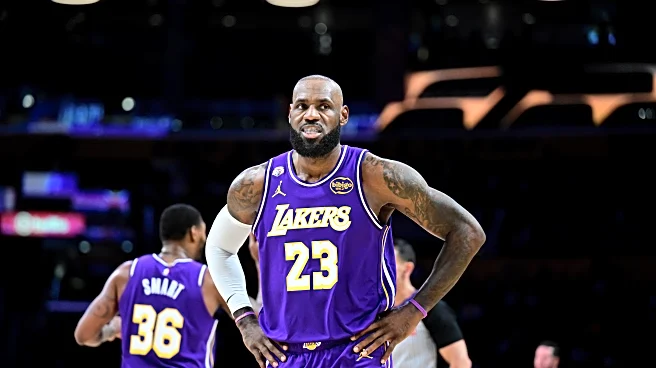
That was undoubtedly intentional. With LeBron James’ future still very much up in the air, the Lakers are keeping their options open.
That isn’t the case for every team that was initially projected to be a factor in the 2026 free-agent market. The Washington Wizards were initially projected to have $80-plus million in cap space this offseason, but they spent it all in “pre-agency” by acquiring Trae Young and Anthony Davis ahead of the trade deadline. The Utah Jazz blew through theirs as well by acquiring Jaren Jackson Jr. while the L.A. Clippers made a pair of trades that suggests Kawhi Leonard could be next to go this offseason.
Keith Smith of Spotrac now projects only three teams to have significant cap space this offseason, plus/minus the Atlanta Hawks and Detroit Pistons. The Lakers are leading the way.
Longtime salary-cap analyst Yossi Gozlan took it one step further.
That seems good. Is that good? (Just don’t spend it all on a 34-year-old Paul George. Take it from a Sixers fan.)
The Lakers’ 2026-27 cap sheet
The Lakers have two major variables to confront this offseason: LeBron’s future and Austin Reaves’ free agency. The good news is that until they re-sign Reaves, their cap sheet is relatively clean at the moment.
Luka Dončić will begin the three-year max extension he signed this past August, which will start at 30% of whatever next year’s salary cap ends up being. Based on the current $166 million cap projection, Dončić’s new deal would start at $49.8 million.
For now, Dončić is the only Lakers player under contract for next season who’s earning more than $15 million. Jarred Vanderbilt ($12.4 million), Jake LaRavia ($6.0 million), Dalton Knecht ($4.2 million) and Adou Thiero ($2.2 million) are the only four other players on guaranteed contracts, while nearly $1.26 million of Bronny James’ $2.3 million salary is guaranteed.
The Lakers will also enter the offseason with a $20.9 million cap hold on their books for Reaves. As we’ve covered before, the Lakers will presumably try to follow the same blueprint the Philadelphia 76ers used with Tyrese Maxey to take advantage of his below-market cap hold. They’ll spend the rest of their cap space first, then re-sign him via Bird rights even though that will push them over the salary cap.
Between Dončić, Vanderbilt, LaRavia, Knecht, Thiero, the guaranteed portion of Bronny’s contract and Reaves’ cap hold, the Lakers will be entering the offseason with $96.7 million in guaranteed salary on their books.
That doesn’t mean they’ll have nearly $70 million of cap space to spend, though.
For one, they’ll have an incomplete roster charge of roughly $1.36 million for every open roster spot below 12. Even if they fully guarantee Bronny’s contract, they’d have $6.8 million of incomplete roster charges on their books until they filled those spots.
The bigger swing factors are Marcus Smart and Deandre Ayton, who have $5.4 million and $8.1 million player options for next season, respectively. They also have a $2.5 million team option on Kobe Bufkin, which they figure to decline to maximize their financial flexibility.
Assuming the Lakers do decline their team option on Bufkin, here’s how much cap space they’re projected to have depending on what Ayton and Smart do with their respective player options.
- Both decline: $61.4 million
- Smart picks up, Ayton declines: $57.1 million
- Ayton picks up, Smart declines: $54.7 million
- Both pick up: $50.3 million
All of those figures would require the Lakers to renounce the rights to all of their free agents other than Reaves, including LeBron and Rui Hachimura. They also don’t factor in whichever first-round pick the Lakers land this summer.
The Lakers’ free-agency outlook
Based on the current $166 million cap projection for 2026-27, a max contract for someone with 0-6 years of NBA experience would start at $41.5 million, someone with 7-9 years of NBA experience (like Luka) would start at $49.8 million and someone with 10 or more years of NBA experience would start at $58.1 million.
That makes James the first domino that must fall for the Lakers. Until they either re-sign him or renounce his free-agent rights, they won’t have any cap space whatsoever.
If the Lakers do clear $50-plus million in space, they’ve already discussed going after Andrew Wiggins, Tari Eason and Peyton Watson, among others, according to ESPN’s Dave McMenamin. He mentioned Tobias Harris, Quentin Grimes and Dean Wade as other possible candidates who fit the Lakers’ need for more long-range shooters and defenders.
After the trade deadline, general manager Rob Pelinka told reporters that the Lakers had been “aggressive” in conversations, but they decided to prioritize their long-term future.
“I would say we were aggressive,” Pelinka said. “And one form of being aggressive is saying no to moves that come your way that might not be best for the short- and long-term future, that’s like being aggressive even though you end up doing nothing. Because it’s hard to say no sometimes to getting a good player that could be a quick short-term fix but could have implications for the long-term where it doesn’t fit into the overall vision you have for the team.”
If the Lakers look to maximize their financial flexibility, there’s a wide range of possible outcomes this offseason. The NBA has become even more unpredictable in the second-apron era, as teams are more desperate than ever to dump overpaid stars (or former stars) on massive contracts.
The Wizards acquired both Young and Davis for pennies on the dollar ahead of this year’s trade deadline. The Memphis Grizzlies were reportedly eager to offload Ja Morant as well, but they couldn’t find a taker even after trading Jackson to Utah.
Pelinka believes the Lakers might be able to take advantage of other teams this offseason that are looking to dump contracts for whatever reason.
“Knowing that there’s an unintended consequence when a new system comes into place — teams kind of learn their way through it — we felt like creating optionality or having optionality now is really a positive thing for us this coming offseason,” Pelinka told reporters. “Because there’s some teams that maybe have gotten too deep into the aprons. And I think players, we see around the league, that become available when teams get in that position.”
“Whether it’s through free agency, whether it’s keeping our own players, whether it’s looking around the league for players that are really good that maybe teams are trying to get off salary, we feel like there’ll be so many different ways to complete our roster in the offseason.”
The Lakers have a megastar in Dončić and a unique amount of potential cap space for a title hopeful this offseason. This summer will go a long way toward determining how well they can build a championship contender around Luka over the next few years.
Unless otherwise noted, all stats via NBA.com, PBPStats, Cleaning the Glass or Basketball Reference. All salary information via Spotrac and salary-cap information via RealGM.
Follow Bryan on Bluesky.