


Betteridge’s law of headlines states that any headline written as a question can be answered in a single word – “no”. Unfortunately for the Mets, that likely holds true at a high level in this instance; it will be exceedingly hard to duck the tax in 2027. At a more granular level though, the answer is probably more like “no, at least not without significant pain”.
How much pain, you ask? Here’s the full set of potentially guaranteed contracts the Mets will have on the books for next season, including
those with either player or club options, along with the accompanying tax hit:
- Juan Soto – $51M
- Bo Bichette – $42M (player option)
- Francisco Lindor – $34.1M
- Marcus Semien – $24M
- Sean Manaea – $22.1M
- Jorge Polanco – $20M
- Luis Robert – $20M (club option)
- Devin Williams – $15M
- Kodai Senga – $15M
- Clay Holmes – $12.67M (player option)
- Luke Weaver – $11M
- Luis Torrens – $5.75M
That works out to a $272.5M tax bill for only 12 players. Add in the cost of arb, pre-arb, and free agent players brought in to fill out the 40-man roster and you pretty quickly get up to a payroll approaching $300M for 2027.
We don’t know exactly how the new CBA will change these rules, but at the moment the first CBT threshold is $244M and would likely increase to $247M under a continuation of the current system. Critically, exceeding that threshold by $40M incurs a draft pick penalty in addition to more intense financial costs, dropping your 1st round pick 10 spots unless you win the lottery and pick in the top-6. That’s the spot the Mets have found themselves in the last few years, and it’s one you’d like to get out of if at all possible. As of right now, that possibility is looking slim.
That’s obviously not ideal, so the next question is what can be done about it. We can break these guaranteed deals into a couple groups to talk about.
Money you want around
There’s one guy in this group, and it’s Juan Soto. He’s one of the 3 – 5 best hitters in baseball. He’s signed forever. And he’s only 27, meaning he’s someone you want around even if you decide that 2027 needs to be something of a reset year. There is no conceivable world where moving this money off the roster is a good idea.
If you’re wondering where Francisco Lindor is….we’ll get to him in a minute.
Money you’re stuck with
Simply put, you are probably not going to find a team willing to take on a meaningful portion of the money owed to Marcus Semien, Sean Manaea, Jorge Polanco, or Kodai Senga without attaching a prospect to them. That’s not the sort of trade that happens frequently in baseball, nor is it something that I think the Mets should be considering in the first place. Realistically this is $81.1M against the tax threshold that the team is stuck with, for better or worse.
Money you have control over
Working in the Mets favor here is that there is a good chunk of change they can conceivably move off the roster without too much fuss. Let’s start with Luis Robert, who has a straight up club option that can be declined to save $20M. Robert looked good to start the season but has since, unsurprisingly, gotten hurt. He’s reportedly nearing a return but unless he has a monster second half (certainly possible, there’s still a good player in here potentially), this seems like a player the Mets will likely move on from.
Next up you have a pair of good relievers signed to multi-year deals that could be moved. Luke Weaver has been one of the best relief arms in baseball this season full stop and would likely fetch a top-100 prospect at the deadline if the Mets were to make him available. Capitalizing on reliever value when your team is not headed to the playoffs is usually a good idea and doing so in this instance has the added benefit of making things easier in 2027.
Then there’s Devin Williams, who despite an ERA over 4 has largely been excellent under the hood. He’s signed for money with an extra year and hasn’t been as good as Weaver, but I’d wager a playoff team looking to reinforce their bullpen would be willing to roll the dice here and take on most of the remaining money. Is that a good look politically for the Mets, trading a closer they just signed to a 3-year deal? Difficult to say, and if you’re worried about how such a move might be perceived by future free agents there’s an argument to keep him. Shipping him out would once again make the 2027 money easier to manage however.
Finally, we have Luis Torrens. He’s a fine backup that seems well liked by his pitchers and the organization (even if he still can’t call a game). Given that he just signed a two-year extension moving him seems like something that is both unlikely and a poor idea from a player PR perspective.
In the player’s hands
Bo Bichette and Clay Holmes both have player options. The latter is due very little money and would likely be someone you’d want to extend a qualifying offer to if he were to opt out (presuming he returns from his leg injury and shows no averse effects down the stretch). Simply put, he’s not the critical piece here.
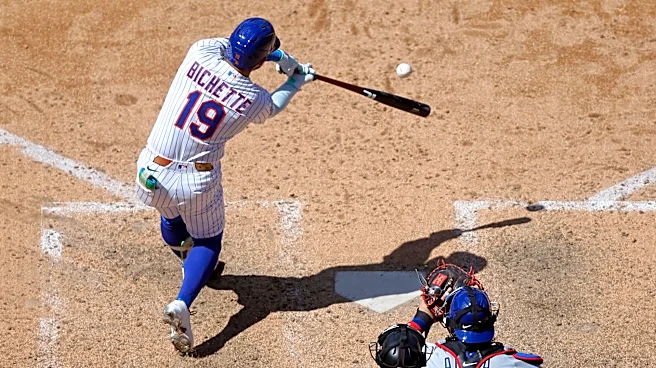
Bichette, on the other hand, is quite possible the linchpin of this entire discussion. A 93 wRC+, a looming $55.3M payday in 2027, and another potential shot at free agency in 2028 are all compelling reasons for Bo to opt-in. On the other hand, next year’s free agent class is extraordinarily weak on the position player side, and he’s looked more like his usual self during his recent hot streak. If that continues maybe he rolls the dice and opts out, which suddenly makes this whole operation cost-cutting venture much more tenable.
The one wild card
Yeah, so about Francisco Lindor. You likely expected him to be listed alongside Juan Soto as someone that wouldn’t make any sense to move. In reality, he’s a 32-year-old shortstop with declining athletic metrics, a significant injury, and poor play to his name in 2026. Smart teams likely view the remaining body of his contract as underwater at this point. It also seems there may be some friction involved in pushing him off shortstop, something the team would likely want to do at some point in the next couple years.
Is his name enough to get a couple of less-disciplined teams interested? Maybe. Is this a move that’s tenable from a fanbase management / organizational reputation standpoint? Perhaps not. There’s a longer, more nuanced conversation that’s worth having here which merits an article unto itself. Suffice it to say that moving Lindor is an option that should be on the table, and which would clearly help the Mets duck continued penalties.
Conclusion
If the Mets get a little lucky and make some aggressive trades, they can get off of Bichette, Holmes, Weaver, Williams, and Robert for 2027, saving just over $100M against the tax. Working from a starting point of ~$172M is much more tenable; the team would have $75M to invest in the rest of the roster and still stay below the first tax level. Now, that team might not be especially good, but a reset year might not be the worst idea for the current roster.
If Bichette opts in, then this is much harder. The Mets would likely be bumping up against the first tax level even before making any external additions. Perhaps Steve Cohen is still willing to pay significant tax bills and the team could spend an additional $40M without sacrificing their draft positioning yet again, which is really the primary goal of all this. That’s still a fairly tight budget going into an offseason where the team clearly need some upgrades if they intend to be competitive.
Ultimately, none of this works without some tough decisions. You’d need to sell the fan base on a pretty aggressive sell-off followed by a fairly restrained offseason. From a team building perspective, that might make good sense given the current state of the roster. From an organizational reputation standpoint…maybe not. The team’s actions over the coming weeks leading up to the deadline should be revealing as to their plans on attacking this particular problem of the current roster and just what their pain tolerance might be.