


It’s rare for the Mike Elias-led Orioles to use a moderately high draft pick on a pitcher. But that conventional wisdom went out the window a bit in the 2025 draft, when they selected Joseph Dzierwa and JT Quinn with a pair of second round picks just 11 slots apart. Based on how the duo has performed in the pro ranks to this point, maybe it’s something the organization should consider doing a bit more often.
Dzierwa is the better known player at this point. The lefty is the highest draft pitcher of
the Elias era. His big year has vaulted him up the prospect charts, and it is possible that he could help the big league squad as soon as next summer.
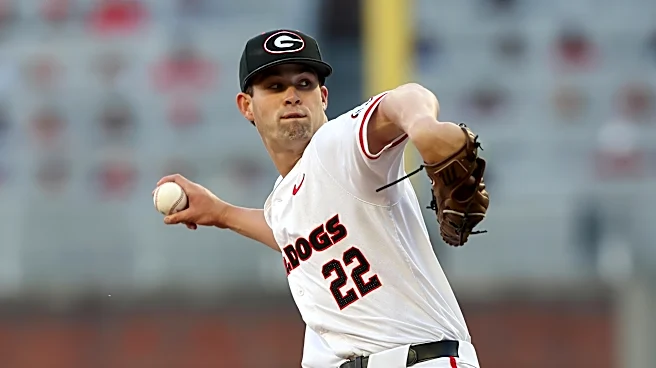
Quinn came out of the draft as something of a developmental arm. The Tampa native began his college career at Ole Miss. There, he was a starter as a freshman, then a reliever as a sophomore. The talent was evident, but the outcomes were not (6.83 ERA in 2023, 8.84 ERA in ’24). He went looking for a new home going into his crucial junior campaign, and found a spot at Georgia, where he would nestle into a swingman role.
Transferring to another SEC school unlocked something for Quinn. He maintained his high strikeout (12.3 K/9) and walk (4.3 BB/9) rates, but this time was also limiting hard contact (5.8 H/9). That created a bit of buzz for him going into the Cape Code league that summer, where he boasted a fastball that sat at 95 mph just before the draft and struck out 25 batters across 14 innings. The Orioles liked what they saw, plucking him with the 69th overall pick.
Quinn’s first professional action had to wait until this year, and boy was it a good showing. Across two levels he had a 3.39 ERA while striking out 129 over 116.2 innings. He appeared as a starter in 25 of his 26 outings and seems poised to continue his development in the rotation, for a while anyway.
The Orioles skipped Quinn right over Low-A Delmarva, and instead sent him to High-A Frederick to begin the season. That was already a sign that they expected this guy to move fast through their system, regardless of the role he eventually locks down.
Things came pretty easily to him with Frederick. His ERA by month from April through June was 2.70, 3.77, and 2.73. His batting averages against were similarly solid: .224, 220, and .185. It was in July where he hit the skids a bit. He allowed 20 runs (17 earned) across 18.1 innings. That was the result of a .321 batting average against, including six home runs.
But clearly that was a moment from which Quinn was able to grow. He bounced back to start August, allowed one earned run across 11.1 innings in his first two starts of the month. That was all the proof the Orioles needed to give him a promotion to Double-A Chesapeake for the final few weeks of the season. Quinn’s season totals with Frederick were quite good. He struck out 10.19 per nine and (crucially for him) walked just 2.69 per nine. Home runs were an issue for him at one point, but it didn’t seem to be a continual problem.
After his promotion, the 22-year-old cruised through his final five starts of the season with the Baysox, never allowing more than two runs in any one outing and pitching to a 1.96 ERA over 23 total innings. The walks did creep back up (4.70 BB/9), but he kept the ball in the park (0.78 HR/9) and laid a nice base heading into 2027.
Quinn’s repertoire is electric. He sits 95-97 with the fastball and has flirted with triple digits. His mid-80s slider is considered his best pitch, breaking hard away from right-handed hitters. There is an upper-70s curveball that isn’t particularly effective at this point, but serves to keep hitters off balance. And he has been working on a changeup throughout the season that is still in its early stages.
There are questions about whether Quinn can stick as a starter moving forward. Command was a concern for him coming out of college, and he will likely need to prove that at every level. And while his arsenal of pitches shows promise, it is still largely a fastball/slider mix where his fastball isn’t as dominant as you would expect it be given the velocity on the offering. The introduction of that changeup is a big deal for him because if he can make it into a weapon, then he becomes more viable against left-handed hitting.
The 116.2 inning workload he took on in his first pro season is a big one. It appears he came out of it healthy as well. He didn’t hit the IL at all this year and consistently made his weekly start all season long. An ability to get out to the mound with regularity is as important to his development as the pitch shaping. Recurring trips to the shelf would be another sign that his future could belong outside of the rotation.
For now, the Orioles are treating Quinn like a starter, and he has shown enough development in 2026 to keep him in that role for the time being. But there are prospect experts that believe he fits better in a relief role long term, mostly due to his lack of a third legitimate pitch and history of limited command. That decision is something the Orioles will likely hold off on for as long as possible. This is the organization that successfully turned Kyle Bradish into a starter despite some scouts thinking he fit best in the bullpen, and they also held off on moving D.L. Hall to a relief role for years before it was evident that it needed to happen. They won’t be rushed here.
Quinn is likely slotted for a return to Double-A Chesapeake to begin the 2027 campaign. He threw just 23 innings at the level in 2026, and his 1.35 WHIP would indicate that he has more work to do. If he can impress and stay healthy for a few months there, then he should be ticketed for a promotion to Triple-A Norfolk at some point. There is an outside chance that the Orioles would consider a big league debut for Quinn late in ‘27 as a reliever, similar to what they did with Luis De León this past season, but that shouldn’t be considered likely. His main goals for next season will be changeup development, improved command, and a promotion to Norfolk.