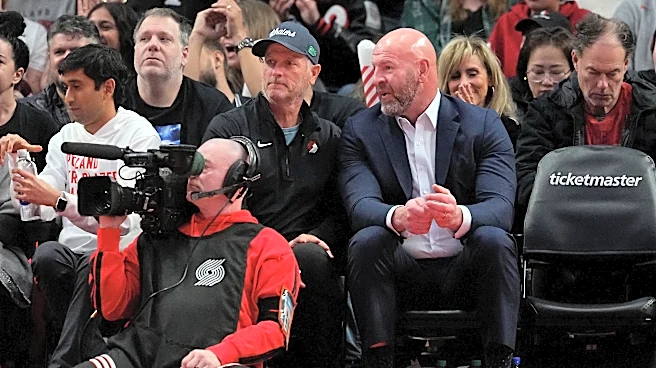




The Portland Trail Blazers have entered a time of transition rarely seen in their franchise’s history. A new ownership group, led by Texas businessman Tom Dundon, has taken over the reins, only the second ownership change since the team was established back in 1970. At the same time the condition of the Moda Center, Portland’s home arena, has come under scrutiny. Owners and politicians are negotiating terms on a renovation project, but the ultimate outcome is as yet unknown.
In the midst of this turmoil,
fan uncertainty is at a high not seen since the 1980’s, the last transition between owners. Or maybe the early 2000’s, the last time the arena became an issue. The specter of the Seattle SuperSonics, once a bustling NBA franchise, now long departed, hangs over the heads of the Portland faithful. Each report of new ownership practices leads to worry. Every day the arena project remains in doubt increases the tension. The big question: will the Blazers remain in Portland?
In the midst of all this, a submission has arrived in the Blazer’s Edge Mailbag that summarizes the situation nicely, with appropriate emotion and heart behind it. Take a look.
Dave,
Now that we’ve entered the offseason, how real is the risk that the Portland Trail Blazers could eventually relocate, given the uncertainty around funding a major Moda Center renovation and the apparent lack of alignment between ownership and the city?
From the outside, this feels like more than just a typical arena negotiation. With public support for funding appearing limited, financial feasibility in question, and ownership pushing for tax dollars without a firm long-term commitment, it seems like there’s a growing disconnect between the team and the city—something I haven’t really seen before as a fan.
Do you view this as standard high-pressure negotiation tactics, or is there a legitimate concern that ownership’s approach—particularly taking such a hard stance and risking alienating the fanbase—could be laying the groundwork for a potential relocation narrative if a deal ultimately falls through?
At what point, if any, would the NBA or the players’ union step in if cost-cutting measures begin to affect player resources, health, or working conditions? Is there a threshold where the league has to act, even if they’ve publicly expressed patience with ownership?
Financially, do you believe this reflects a calculated, cost-conscious ownership style, or is there any realistic possibility that ownership may be more constrained than expected and is being forced into aggressive cost-cutting decisions?
If this situation continues on its current path, what are the most realistic outcomes? Is a compromise—such as a scaled or phased renovation plan—the most likely solution, or are there scenarios where this becomes something more serious?
On a personal level, this goes beyond just business for me. I’m at a point in life where I finally have the stability to fully enjoy being a fan, and with a daughter on the way, it’s important to me that I get the chance to share this part of Portland’s culture with her—taking her to games and creating those memories. How should fans balance that emotional investment with the realities of how these situations typically play out?
And ultimately, based on everything you’re seeing right now—how concerned should fans actually be?
—Christian
There is so much to this question. Before we start, I want to affirm the energy and spirit you put into it…one of the reasons that I took the rare step of leaving it unedited. You pretty much covered everything and I can feel your concerns. I get it. I think somewhere inside them, most Trail Blazers fans will too.
Now let’s break it down.
Blazers vs. Portland?
The first thing you reference is an apparent rift between the team and the city. Saying this has no precedent is not entirely accurate. Moda Center issues have cropped up before. They required negotiation. Those talks had friction…maybe not quite on this scale, but Paul Allen went through hoops with the city. Like current Blazers ownership, he would not guarantee the team would remain in town until an agreement was actually signed to ensure that outcome. People were worried.
Tom Dundon’s new status as owner is probably adding tension to the current proceedings. He and local officials aren’t well-known to each other. He doesn’t have a track record in town. That always makes negotiations harder. It also makes them more secretive, as neither party knows, or reveals, all the cards in play.
That may not be intentional. It’s just human nature. When you’ve known someone 20 years, you can tell that when they say, “X” they probably mean Y. When you don’t know them well, they could mean Z, Q, or Alpha Prime. The dance is more cautious, less predictable. To human minds, that equates with danger. It makes everything seem more scary, the worst-case scenarios more likely.
New status will also entrench Blazers ownership more than the norm. If two parties have a track record together, it’s pretty certain that each side has won and lost on certain points and both have compromised. Winning or losing at that juncture brings a 5% change to the relationship, significant but not redefining the balance of power.
Since this is the first go for Dundon and company, whatever happens here will comprise 100% of the relationship as far as their personal experience. It’ll define terms for the future. They’re not going to want to come out of the box losing the argument. They won’t want to be seen as weak. They don’t know when the next inflection point will come, but when it does they’ll want to have a track record of winning resolve behind them. For those reasons, they’re going to present a strong, uncompromising front.
The other factor we have to add in is the negotiating tactics you referenced in the question.
Whenever money and politics intersect, rhetoric goes through the roof. It’s an “either end of the spectrum” affair as each side asserts and defends their power before the final agreement is reached. If the city doesn’t fear the Blazers might move, they have no incentive to cut a favorable deal with the franchise. If the Blazers don’t remember who controls civic funds, the public coffers are vulnerable to grifting. It’s likely neither side will let those extremes happen in reality, but the possibilities have to stay live before they come to an agreement in the middle.
At the end of the day, we don’t know what’s going on inside anybody’s heads. We only know what they say publicly. And what they say publicly right now will be much more attuned to, “Here are my prerogatives and demands,” than, “Let’s work this out.” Privately, it’s likely that both sides want to, and will, come to an agreement. But we won’t hear that until it happens.
It’s impossible to tell whether these are just “high-pressure negotiation tactics” or something more. But in the vast majority of cases it works out. Let’s not forget there are 30 NBA teams in existence. Relatively few of them move. It’s certainly possible the Blazers will relocate, but the bar for those decisions is so high that leaping from here to there without further, tangible evidence is probably jumping at shadows.
Possible Consequences
You ended the first part of your question by asking whether moving the team is on the table. Yup, it is. It will be until the team and the city/state agree to the 20-year lease upon which Moda Center renovation funds are contingent. Then you can exhale for a couple decades until the next time this comes up, when the franchise will no doubt want an entirely new arena.
You referenced laying groundwork for a departure narrative. That’s where we go astray. Why would they need one?
Here’s the cold reality. Tom Dundon’s main audience as a new NBA owner isn’t the fans of his franchise, but his peers and the league office. We don’t decide whether he’s suitable as an owner. They do. If Dundon were hell-bent on moving the Blazers, there’s not a damn thing Portland fans or officials could do to stop him. Only the other league governors could.
I’m guessing that right now there’s no league-acknowledged provocation to justify a unilateral move out of Portland. If Dundon said, “I want to move this team to Kansas City. It’s much closer to home for me.” the NBA and its constituent owners would probably say, “Hahaha, no. Why don’t we give it a few years first?”
One thing they do understand, though, is refusal to build or maintain a modern arena. As soon as the physical plant shuts down (or diminishes, at least), the league and its owners have been quick, sometimes adamant, about moving the whole operation. That’s a language, and a problem, NBA owners understand. It has the potential to affect their reputation, bottom line, and future negotiations with their own municipalities.
As soon as the city says, “No arena update for you!” they’ve uttered the magic words. At that point Dundon will go laterally, to fellow owners, for redress. Moving the team will not only become a live issue, but a vocal one. That will happen above the heads of Portland fans. It requires no preparatory narrative; it becomes its own.
Public opinion matters in one place only. The people elect city and state officials. As such, Trail Blazers fans will be recruited to put pressure on their elected representatives to get a deal done. Narratives will be spun to that end. Since that requires you to fear that the team will move without your action and support, it’s little surprise that the worry is being kept alive. If things get more intense, it’ll be stoked. That’s not a bug in the process, it’s a calculated mechanism of it.
That doesn’t mean your fear will do anything tangible to resolve the situation, however. It’s the worst of both worlds: being made to feel something, realizing logically that your feeling has no power to change anything. It sucks to be a fan in this situation. It brings out the icky parts of life, like knowing your spouse is contemplating a divorce or waiting for lab results to see if your diagnosis is life-changing or benign. At least in this case you can refocus: go to the beach, grab some corn chips, talk about Deni Avdija’s free-throw-to-field-goal-attempt ratio. That may be your only out for a while.
Cost Cutting?
We’ve already talked a bit about the “cost cutting” measures enacted by ownership, as reported by local and national media and referenced again by you. Let’s put some of this in perspective.
First, the stories are real. What you’re hearing from lower-level Blazers employees is actually happening. Hotel cut-off times, restricted travel…all the stuff.
Second, you can probably decouple those cost-cutting measures from the arena and/or moving issues. In their wildest dreams Portland’s owners couldn’t find enough savings in the organization to fund a $600+ million arena renovation in anything less than 32 centuries.
Cost-cutting is a business choice, pure and simple. That’s all. No more, no less.
Whether it’s a good idea is up to debate. I suspect it depends on your viewpoint. But if the Blazers had a 50-year lease and Tom Dundon was planting tree saplings in Washington Park to shade himself under someday, the organization would still be taking these measures.
Rather than signaling intent—benevolent or nefarious—measures like this are a sign of investment mentality. It’s the way of the world nowadays. Profit = Revenue – Expenses. You can increase profit by generating more revenue or reducing expenses. Most investors want to do both.
In a way, having a new, Texas-based owner purchase the team is like having a large corporation purchase your favorite restaurant chain as an investment. The good news is, your place might go big-time. The bad news is, many of the things you are accustomed to are now subject to change.
Investment leadership isn’t present on the local level, seeing customer interactions day to day. They see spreadsheets and bottom lines. The reward isn’t seeing smiles on the faces of employees and patrons, feeling like a valuable service is being rendered in organic, human terms. Efficiency, cost-control, conformity, and repetition gain traction and value.
Many people are complaining about the restaurant experience in America nowadays. Prices have skyrocketed everywhere from your fast-food joint to the ritzy steakhouse. But that’s only half the problem. The other looming reality is that the food isn’t worth it anymore. Cuts of meat have gotten cheaper. You get half the toppings at the pizza joint and the sauce tastes tinny. Don’t even talk about what they’re calling a sub sandwich. Why? Because it’s more cost- and time-efficient to mass order repeatable, frozen versions of the same ingredients, thaw them, and serve than it is to actually source food and cook it. Your local owners and chefs can still do quality, hand-made stuff. When a larger corporation buys that restaurant as an investment, the first thing they’re going to do is find inefficient, non-standardized expenses and replace them with predictable, corporately-sound alternatives. If your experience isn’t quite as good, so be it. As long as it’s good enough not to disturb the warm associations you’ve already established, you’ll probably keep patronizing the place. That’s what investors are counting on.
The Blazers aren’t cranking out pasta, but the same principle applies. Rooting out inefficiencies doesn’t mean Dundon and company are nefarious. They’re simply removed from the local process. Their priorities are different. They want to deliver a standardized product of enough quality that you’ll return (and invest your own money) for the least cost possible. Anything that looks like an unnecessary expense is anathema to their aims, cutting into the corporation’s whole purpose for being.
A Peculiar Relationship
The difference, of course, is that sports fandom is, by nature, a personal, emotional investment. Fans note True Shooting Efficiency but they don’t actually root for it. They go to games for the thrill, the community, the sense of belonging, occasionally even the feeling of success when their team wins. There is no “product” except your feeling of connection and enjoyment.
Anything that impacts your emotional feeling about a sports franchise directly changes your perception of the experience and its worth. No amount of, “We have the most scoring-efficient power forward in the conference!” is going to change that, let alone, “We run a lean corporate machine here with maximum profit!” If you feel like your franchise is incompetent—either on the floor, in the front office, or by trampling workers, ignoring you, or trying to grift a quick buck at your expense—you’re going to divorce yourself from that emotional investment pretty quickly.
Degradation of the fan experience is the equivalent of the restaurant swapping in top sirloin for your filet mignon. It may look good on the quarterly expense report, but corporate leadership and investors have to be careful not to drive away customers providing funds on the income side of the balance sheet. It’s possible to “corporate” your way out of relationship with the consumer. That’s not a pretty cycle.
At least early on, Dundon and company are trying an interesting tactic to prevent this from happening. They appear to be banking on the fan relationship with the players and visible members of the organization as central, everything else as peripheral. The noise coming out of the club is, “We’re going to invest where it matters.” That’s apparently point guards rather than assistant scouts and masseuses. Keeping the visible members of the organization happy should keep fans happy, allowing cost-savings in other, less visible areas.
In that sense, the original question about the union or the league stepping in is moot. Players have protection in most areas. Eve if they didn’t, ownership wouldn’t look to cheese off its public-facing ambassadors anyway. That would directly drive away fans.
There are a couple of problems to this approach, though.
First, some of those infrastructure employees play vital roles in supporting the players and the organization. You can paint the easily-viewable walls of a house any way you want. If the supporting woodwork that’s holding up those walls has a termite infestation or dry rot, making the walls themselves more shiny and attractive won’t help.
One of the quick ways to destroy a corporate (or franchise) culture is to demoralize and impoverish workers behind the scenes. Corporate cost-cutting is a Jenga game. You can pull out those blocks to make the tower leaner, but you have to be careful not to pull the wrong one. When the person filling your soda cup from the fountain starts throwing it at you, the franchise has a customer-relations problem.
Second, fans are often sensitive to these issues, in part because of conscience, in part because fans tend to interact more directly with low-level employees than players. It’s no fun going to a game—or consuming it on radio or TV—when everyone else besides the players is clearly miserable. (Not that it matters as much as it used to, because broadcasts and broadcasting rights have gone big-picture investor/corporate too, removing local relationships and voices from direct interaction with fans. But still…)
There is a caveat to all this, though. If ownership messes up in Portland, we can always circle back to your original worry. If fans abandon the Blazers, it’s possible they could simply pick up and start again with another fan base, fresh with the bloom of a new NBA team and ready to think well of everybody for a while.
Likely Outcomes
As we’ve just laid out, all possible outcomes are still on the table in this dynamic situation. There’s no way to predict for sure which way the story will go. We simply know the following:
- Tensions and contrary stands are likely to be amplified right now because of negotiations.
- Fan opinion is going to take a back seat to dollars and power. We don’t get a direct vote. At best we can weigh in indirectly through public representatives. We cannot directly influence the NBA.
- The people who do make the decisions on an NBA level will be concerned about the arena. No other topic or resolution will carry as much weight.
- Current cost-cutting by Blazers ownership does not indicate an anti-Portland stance. Nor does it affect the arena issues or anything that’s going to be central in keeping the Blazers in Portland long-term. It’s an investment strategy by people who are farther removed from the process than Blazers fans are used to.
- Cost-cutting may have indirect consequences though. It could negatively impact the team’s infrastructure and culture. It could also degrade fan experience. The Blazers will have to be careful to avoid the American Corporate Death Spiral wherein a company provides a worse product, so people spend less on it, so the company cuts costs more, so people spend even less on it. See also: the fate of many restaurants in this country.
- Even if that happens, the owners and league have an “out” by moving the team to a different locale and starting out with a new, presumably more affable, fan base who hasn’t experienced that degradation yet.
Having said that, the most likely outcome of all this is also the simplest. The City of Portland will probably end up finding a way to assist in the arena renovation that the state legislature and governor have already agreed to fund. The Blazers will probably sign a 20-year lease as part of that renovation pact. Portland’s ownership will probably not botch their internal or external relations enough to destroy the relationship between the team, its employees, and its fan base. But overall, the quality of the Blazers experience is likely to slip below historical standards of the past because removal of the process from local hands into corporate investment tends to do that. All of these outcomes lie in the middle of the bell curve. That’s usually what happens in the big picture.
Obviously the will and/or aims of individuals in power—ownership, local politicians, the NBA—could skew results. As of this point, there’s no evidence that those aims go beyond the bell-curve norms we just established. If and when we get those pieces of evidence, we can change our expectations accordingly. Until then, there’s no need to.
What About the Fans?
The last paragraph of the question is the most poignant. What’s a fan to do when fandom has provided comfort and stability for most of their lives, when they want to pass on the same to their children but are worried that they might not be able to?
The only practical answer is that you ride it out and hope. As we said, it’ll probably be ok. But it’s probably also ok to realize that it’s not going to be the same, at least not for the next couple generations, and to mourn that. Everyone goes through this in one way or another in their lives. It’s just our turn.
I don’t share many personal stories on here, but I’ll tell you one of the ways I had this realization lately.
Readers familiar with my work know that I sometimes compare things to the WWE. I find wrestling apt in storytelling terms, often an easily-discerned metaphor for some of the concepts we talk about.
There are deeper reasons for that too. Back in the day I used to rent VCR tapes from Blockbuster. One day I saw Wrestlemania III there. I thought I’d give it a try. I knew what wrestling was, of course. I had seen Portland Wrestling when I was young and loved it. But the WWF back then…I couldn’t afford Pay-Per-Views as a kid and I’d never ask my family to spend money on something just because I liked it. But renting a tape for a couple bucks? Sure! So I did.
That basically began some fairly-religious viewership. I understood—still understand—the moral and ethical issues with the storytelling. Nothing is perfect. But I rather liked the basics of how they did it and I appreciated many of the characters, their arcs, the action and surprises. I came to appreciate it for what it was.
I ended up having my own kids. Before they were grown, my ex and I got divorced. One day afterwards I was sitting with my son—then around 12 or so—thumbing through streaming services, looking for something to watch together. I saw Wrestlemania III. I thought, “Why not? Let’s try.”
We watched it together. He loved Hulk Hogan and Andre the Giant going at it, with dastardly Bobby “The Brain” Heenan trying to manipulate his way to victory. He asked immediately, “Can we watch more?” So we got to meet “Macho Man” Randy Savage, the Million Dollar Man, Rick Martel and Jake the Snake, and all the characters. We bonded as we watched our way through all the old Pay-per-Views. I severely edited some of the ones when we got to the Attitude Era. (We don’t need misogyny or racism creeping too much into young minds.) But we got through them. Over the course of 7+ years we ended up watching every PPV the WWE had put out. The Undertaker, Bret Hart, and Kurt Angle ended up being his favorites, with the usual suspects thrown in besides.
So anyway, my “little” boy graduates high school this year. As a graduation present, I decided to do the one, “now or never” thing that we had not done. Wrestlemania 42 was in Las Vegas. That’s not too far of a drive. If we were careful with expenses, we could go. So I bought the tickets and gave them to him as a Christmas/Graduation present. That’s how I could justify the expense. After all that time we watched, how could I not?
Those familiar with WWE will know that over the last couple years, they’ve had an ownership transition similar to the Trail Blazers. The McMahon family—the original owners—has a long and storied history, some of it very problematic. In 2023, they sold the franchise to a newly-formed corporation named TKO, a combination of WWE and the UFC.
Immediately our fan experience was impacted. Before, all of WWE’s offerings had been on the Peacock streaming service. You could see their archives, past shows…just about everything. Very soon after the purchase, the corporation did what the NBA has done: sell broadcast rights (and apparently past libraries) to multiple services, requiring a broad suite of purchases to access the same, formerly-convenient product. Fortunately, my son and I had caught up with all the Pay-per-Views by then, so it didn’t impact us too much. We just needed ESPN to see the newest ones. It was more expensive than Peacock, but fair enough.
The second thing that happened is that TKO jacked up ticket prices for live events to the moon. They pretty much got rid of local shows altogether—a cost-cutting measure—then quadrupled the prices for the remaining televised events. The only way you could see the show was paying through the nose. Ok, I guess they had that right.
After that, they started making actual wrestling more rare. Matches got shorter. Wrestlers just talked in the ring instead of performing. You paid far more to see far less action.
All of this (and more) made great corporate sense. TKO has been making money hand over foot. But it has a cost. My son and I experienced that firsthand.
After driving down to Vegas, we settled into our seats for the biggest show of the year, one of the culminating events of his childhood and our lifetime. And…there just wasn’t much wrestling to it. Matches were short, many lasting 5-8 minutes instead of the customary 13-30. There weren’t more of them either. There was almost as much time devoted to commercial spots as wrestling itself. Way bigger price, way less product. And that’s with every inch of space on the ring, on sideboards, on turnbuckles, and on the tables the wrestlers threw each other through sold with ads. People who paid for the experience walked down the ramp with WWE personalities in the introductions. More people who paid for the privilege sat in at the commentary table. We saw near-amateur celebrities being featured in matches instead of trained wrestlers.
The usual complaints about wrestling are that you don’t like the storyline narratives or that the actual abilities of the wrestlers aren’t enough to carry off the promise of the matches. Those are fair. They’re part of the process, the same way you buy tickets for a Blazers game and sometimes they lose when you wish they wouldn’t.
This was something else entirely. This wasn’t about wrestling, good or bad. This was about corporate decisions, the product, the experience and emotion. It was like paying to go to a Blazers playoff game and seeing only 4 minutes of basketball per quarter instead of 12, with fans taking the court in uniform alongside the players.
One of the golden rules of the WWE—from its family roots—was that good or bad, right or wrong, you always make the fans feel like they left with something. This corporate WWE was something different. They were doing the opposite, extracting the most possible out of the consumer (and, by extension, advertisers) while giving the least. They wanted to make sure you left them with something.
I’ve had horrible objections to WWE programming in the past. I’ve also seen great moments. I’ve experienced highs and lows, my son along with me. But in all the years and all the shows we watched, I never thought I’d utter this phrase. Yet here we are.
The WWE ripped us off.
They took our money and gave back much less, just because they could.
That’s not just about the personal pain of that experience, the disappointment of finally going to something and finding it lacking. It’s literally about the reality that in a corporate sense, this makes total sense to do. But in a real, human sense, it’s just sad.
It’s also about the realization that it’s not going to be the same from now on, not for me or my son. It wouldn’t have anyway, I know. That’s what growing up does. But there’s still something to mourn about that.
Things will be different under TKO. Even if it gets better—which it shows absolutely no signs of doing because the guys at the top of that chain are making tens of millions of dollars each from this new system—it won’t have the same aim or connection. No matter how many tickets I buy, no matter how many feelings I feel, something is gone. I wanted to pass something important on. I did, in a sense, but it won’t perpetuate. I tried to share it. At a certain point, they stopped letting me because they stopped valuing that kind of thing.
But that doesn’t mean that things won’t be good, in a sense. Even in this new reality, there are still fantastic wrestlers. CM Punk and Roman Reigns saved Wrestlemania. It wasn’t enough to make up for the rest, but it was something. They told a good story and it seemed like they cared. There are plenty of other good ones too. The art form exists. The experience is still there. How we, as fans, are experiencing it is just changing. (And what it costs. Yikes.)
This is all going to be the same for you and your kids. Realistically, you’re not going to be able to pass on what you knew, felt, and experienced with the Blazers to your children. Even if you take them, it’s going to be different…probably colder, probably more mass-produced, certainly more expensive. But it’s still possible for you to pass on something. Just because a corporation or owner fails to value something doesn’t mean you can’t value it and teach your kids to do so.
And if it doesn’t happen with the Blazers, it’ll happen with something else. Let’s be realistic. They may look at you and say, “Basketball, Dad??? Really? That’s lame.” They’re likely to do that with your music, your fashion, and a hundred other things you consider intrinsic to your life. But something is going to connect between you. Whatever that is, it will be your thing.
Even if it changes, even if that thing doesn’t last forever, it’ll still be formative, important, and real. No corporation, no ownership decisions, and no transition—not even the Blazers moving—can take that away.
Whatever it is, find your thing, live it out, and celebrate what it does. Look for the opportunities to do that, and to share those important experiences with others. That’s the only way you, as a person and a fan, can find your power in the midst of all this. It’s the only way things get passed on. In the end, it might be the only really important, enduring thing about all of it.
The fandom we celebrate here was born in a championship almost 50 years ago. The franchise has barely sniffed one since: only two real opportunities to do so, both of them unsuccessful. But that doesn’t really matter. None of it does. We still keep doing what we do, keeping community, hope, and nifty ideals alive, passing them on to, and through, each other. Whether or not the Blazers are successful—or even present—you’ll be doing that with your children and the people around you about something vital to you all. Give them that and you’ve given them everything.
Thanks for the question! You can always send yours to blazersub@gmail.com and we’ll try to answer as many as possible!