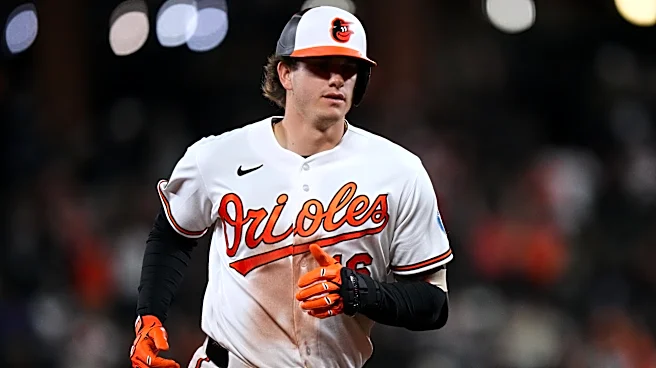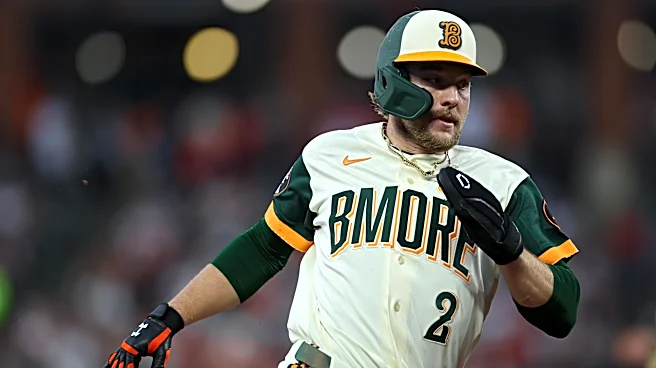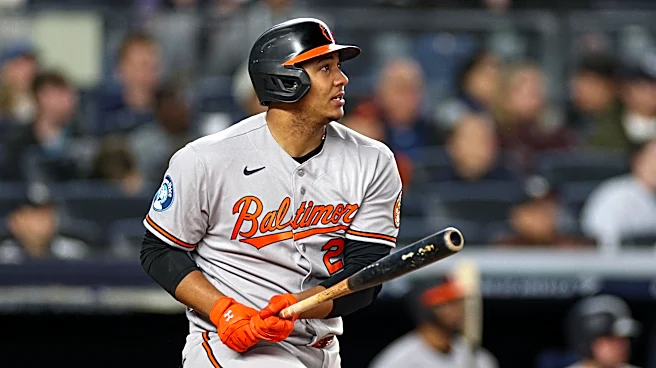






The overwhelming sentiment surrounding the Orioles’ lineup right now is one of frustration—a frustration primarily aimed at young Orioles who aren’t making the grade. Gunnar Henderson is currently enduring one of the worst cold streaks of his career. Colton Cowser and Coby Mayo both can’t get above the Mendoza line and often look lost at the plate. Dylan Beavers is doing slightly better, but is still struggling to perform at a league-average level.
All of the turmoil and despair surrounding this lineup
is what makes the evolution of Samuel Basallo so thrilling. Back on April 13th, Basallo went 0-for-4 with a strikeout in an Orioles win vs. the Diamondbacks. At that point, the 21-year-old backstop was slashing .136/.240/.273 with 15 strikeouts in 44 AB’s. Since then, Big Samuel has been a big problem for opposing pitchers.
In the 21 games since, the rookie catcher is hitting .352 with hits in 13 of his last 15 games. Basallo isn’t sacrificing power to maintain a better average, either. Throughout his hot streak, the 21-year-old is slugging .592 with six doubles, three homers and his first career triple.
It’s not shocking that Basallo is producing at the major league level. You need immense talent to be a Top 10 prospect in all of baseball and make your major league debut four days after your 21st birthday. However, what is suprising is how quickly he’s made adjustments that seasoned big league hitters often struggle to make.
Basallo’s profile—a towering power hitter with a willingness to chase pitches—is often one that takes time to adjust to the big leagues. They’re the type of bats that are used to clobbering fastballs against minor league pitchers, and often can’t lay off good changeups and breaking balls or handle the higher velocities that comes from big league pitchers. Cowser has been a victim of the former pitfall, and he was supposed to have a better hit tool as a prospect than Basallo.
And that’s what Basallo was through the first 150 AB’s of his MLB career. Dating back to his debut last August, the catcher started his career hitting .157 with a near 30% strikeout rate. Sure there were the occassional fireworks—like his walk-off homer agains the Dodgers—but every time he stepped to plate, it felt like a young hitter going through real struggles for the first time in his proffesional career.
Now, Samuel Basall0 at-bats feel like hope. The changes in his approach are so evident that it not only feels like the sky is the limit for the young Dominican, but that other Orioles hitters can make similarly meaningul adjustments. Watch him hit and it becomes clear that he’s no longer trying to hit home runs on every pitch he sees. From April to May, his line-drive rate has jumped from 24.1% to 36%, while his fly ball rate has dipped from 27.6% to 20%. That increase in qualify of contact has seen his average exit velocity for the season jump to 932 mph, 16th-best in all of baseball.
The Orioles’ backstop has also become increasingly patient. His pitches per plate appearance has jumped from 3.54 throughout the first month of the season, to 3.94 since the beginning of May. His chase rate against breaking balls and off-speed pitches have all dropped significantly, from about 41% to begin the season to down to 32% the past couple weeks.
However, it’s one thing to look at his Baseball Savant page and see a bunch of graphs trending in the right direction. It’s another to see him attack a perfectly-executed back door slider and shoot it 106 mph the other way for a double. Please, watch it and then watch it again. You know you want to.
The leaps we’ve seen from Basallo has ramifications for the right now and the long term roster construction for the Orioles. Basallo’s big leap has helped this offsense stay afloat through the unexpected struggles of Henderson and the inability to get any consistent production from the bottom third of the lineup.
The rate at which he’s risen to a prominent position in the lineup also means the Orioles don’t have chase power bats as they continue to try and build a winner in Baltimore. With recent additions such as Tyler O’Neill, Taylor Ward and Peter Alsono, the O’s have made it clear how badly they wanted to add power to this batting order. With Basallo entrenching himself in the 3-4-5 part of the order, it should empower the front office to pursue players who can help raise the team’s on-base percentage instead.
It’s also not purely coincidental that Basallo’s rise has come along side the best baseball of Adley Rutschman’s career. Pairing Basallo with Rutschman allows Rutschman to assume his best role as table-setter and offensive-catalyst rather than primary run producer. It also allows the O’s to keep Rutschman well-rested without having to worry about a decline in production behind the plate. And while Basallo is not the threat to Adley’s futuer with the O’s that many assume, it still undoubtedly provides Adley a push that keeps him locked it in.
There are still players on the O’s playing at a similar level as the young catcher. Ward has exceed every expectation even while under-performing in the powere department. Rutschman and Pete Alonso are both living up to their talent levels. But this is an Orioles team that needs proof of concept that things can go wrong and turn around. Samuel Basallo is that hope.