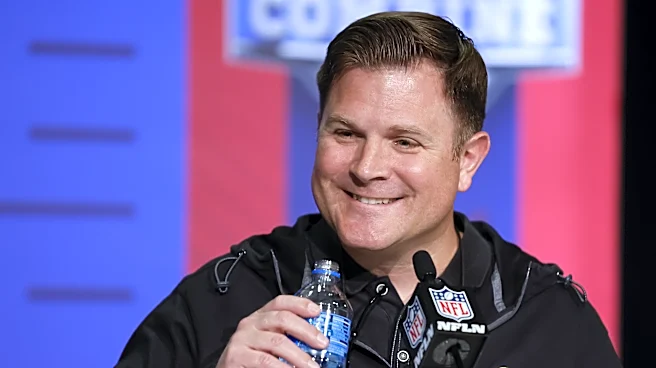




After Friday’s selections, Green Bay Packers general manager Brian Gutekunst admitted that the team tried to trade back into the end of the third round to make another draft choice. “We took some cracks at getting back at the bottom of the third round,” said Gutekunst, who doesn’t believe that the Packers need to “make picks just to make picks” with their current roster situation, unlike in previous years.
Gutekunst said that the “board is strong” and that he “wouldn’t mind moving around a bit on Saturday.”
For perspective, the draft value chart, which has been spot on for trades during the 2026 draft, gives the 100th overall pick, the final pick in the third round of this draft, similar value to the Packers’ fourth-, fifth- and sixth-round picks. To move back into the third, unless it was on a discount, Green Bay probably would have had to give up the opportunity to make a selection before the seventh round, where they have two remaining selections.
We have our post on the best players still available going into Day 3 of the draft, but one prospect who makes a lot of sense is Arkansas running back Mike Washington Jr., who is not only one of the higher-rated prospects still on the board but also visited Green Bay pre-draft, usually a sign that the Packers are going to target a player.
On the topic of cornerback Brandon Cisse, whom the Packers took in the second round with their original choice, Gutekunst said that a big selling point was his age. Cisse, still only 20 years old, will “get bigger and stronger,” said Gutekunst. He also stated that Cisse was a player the team “didn’t see being available” with the 52nd overall pick. As I mentioned in our Day 2 discussion thread, the buzz I had heard over the past day about the Packers and their second round pick boiled down to a couple of names: T.J. Parker, Christen Miller, Zion Young and Cisse. Cisse was the one player from that list who was still available when Green Bay was on the clock at #52.
After Cisse, the Packers traded up in the third round, giving up their original third-round pick and their original fifth-round pick, for Missouri defensive tackle Chris McClellan. Gutekunst said that a selling point on McClellan was that he can play nose tackle, three-technique and contribute as a pass-rusher, which some other defensive tackles in this class can’t do.
These are my words/scouting, but Florida State’s Darrell Jackson Jr., a popular defensive tackle who remains undrafted going into Saturday, is an example of a player who is strictly a run-down nose tackle. I would argue, though, that Domonique Orange, who went a couple of picks after McClellan to the Minnesota Vikings, can rush the passer and play nose tackle as well.
As Gutekunst described it, McClellan was clearly a best player available situation. “He was the one guy sticking up there” on the draft board at the time of the Packers’ trade up for McClellan, Gutekunst claimed.
This isn’t draft-related, but Gutekunst also said that the Packers can still “absolutely” afford to pay Christian Watson after the Jayden Reed extension. Watson will likely net something around the $28 million per year range after Alec Pierce signed for $114 million over four years this offseason.