




Before the Yankees were the Babe Ruth-led behemoth that took the baseball world by storm in the ‘20s, they were the laughingstock of the American League. Between 1913, their last year as the Highlanders, and 1914, their first as the Yankees, the team went 107-196. Things got bad enough that there were rumors the team might flip to the upstart Federal League, a nascent third major league that threatened the AL and NL.
Determined not to lose his New York franchise, AL president Ban Johnson worked behind
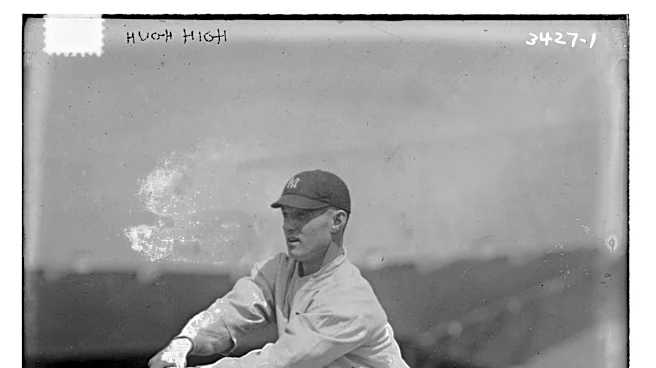
the scenes during the 1914-15 offseason to strengthen the team’s roster, making it more attractive for a prospective new ownership group. He did so by encouraging the rest of the league’s teams to sell the Yankees useful players at a reasonable price. The first team to heed his call was the Tigers, who sold New York two players: a first-base prospect named Wally Pipp and a 27-year-old outfielder named Hugh High.
Hugh Jenkins High
Born: October 24, 1887 (Pottstown, PA)
Died: November 16, 1962 (St. Louis, MO)
Yankees Tenure: 1915-18
High grew up in a family of 13 kids, three of whom would eventually play in the big leagues. The Highs were an itinerant bunch, living first in Pennsylvania, then New Jersey, then Illinois, and finally St. Louis in Hugh’s youth. He played semi-pro ball while serving as a plumber’s apprentice, making the jump to pro ball only after completing his obligation. He played well enough at Class-B Hartford of the Connecticut State League to draw the attention of several teams, including the Giants, who purchased his contract for $2,500 but ended up selling him back to Hartford for the same amount before he was able to join New York. High kept performing the next season and was once again a sought-after commodity, with the Tigers securing his services for the 1913 season.
High joined a crowded outfield picture in Detroit, with future Hall of Famers Ty Cobb and Sam Crawford as well as Bobby Veach, who’d finish a 14-year career with 2,063 hits and a .310 lifetime average. Still, he cracked the roster as a reserve outfielder and saw an expanded role early on with Cobb holding out due to a contract dispute and Veach on the shelf with an ankle injury. High played well enough that, when the roster returned to full strength, both Cobb and Crawford were briefly moved to the infield in separate stints to keep the rookie in the everyday lineup. While his raw stats never wowed, High was valued for his situational hitting and defense and developed a close relationship with the team’s manager, another future Hall of Famer named Hughie Jennings.
High improved in his second campaign, getting on base at a .363 clip while continuing to impress with his glove. The following offseason, the Tigers sold the talented youngster to New York to assuage Johnson’s concerns. His first season in pinstripes would be a career year. Finally given a full-time opportunity, he played in a career-high 119 games and showed some more pop, notching 27 extra-base hits after hitting 15 in the previous two years combined. High also swiped 22 bags, showcasing an all-around skill set that was an asset to a Yankees team still searching for an identity.
Prior to the start of the 1916 campaign, the Yankees continued to beef up their roster, headlined by the addition of future Hall of Famer Frank “Home Run” Baker. They put up their first winning season since their days as the Highlanders with High firmly entrenched in left, continuing to get on base consistently and play fundamentally sound baseball. He dealt with an ankle injury for much of the year, though, a harbinger for what was ahead.
The next offseason, High dealt with blood poisoning from an infected blister in his foot that set him back in spring training. He missed more time during the year as he dealt with boils on his neck. He ended up getting replaced in the lineup in September and would never regain his starting role. After the ‘17 season, the Yankees shopped High extensively, nearly reaching deals with the Senators, Dodgers, Red Sox, and Cardinals. They finally reached an accord with the Athletics a few weeks into the season but High refused to report to his new club. The Yankees suspended the outfielder and he walked away from the game, taking a job at a Maryland shipyard rather than shipping off to Philadelphia.
It was the start of an odyssey for High. The Red Sox tried again to trade for him; when High demanded back pay for the time he was suspended, the Yankees balked and he instead returned to the shipyard. The league reinstated High in 1919, but when the Yankees attempted to option him to the minors, he once again chose his job in Maryland. In May of that year, he finally accepted his sale, this time to the Vernon Tigers of the Double-A Pacific Coast League. High spent five seasons there, followed by another with Double-A Columbus and a final season with the International League’s Reading Keystones at the age of 37. Throughout this seven-year wilderness period, he showcased the consistent bat and slick fielding which had made him a valuable big leaguer in his youth.
After his baseball career, High returned to St. Louis, resuming the plumbing career he had put on hold in his early 20s. He died on November 16, 1962 at the age of 75. While never a star, Hugh High was a ballplayer’s ballplayer who helped shore up the Yankees franchise in its early, uncertain days and, through his long journey in minor-league baseball, demonstrated a love of the game few can match.
See more of the “Yankees Birthday of the Day” series here.