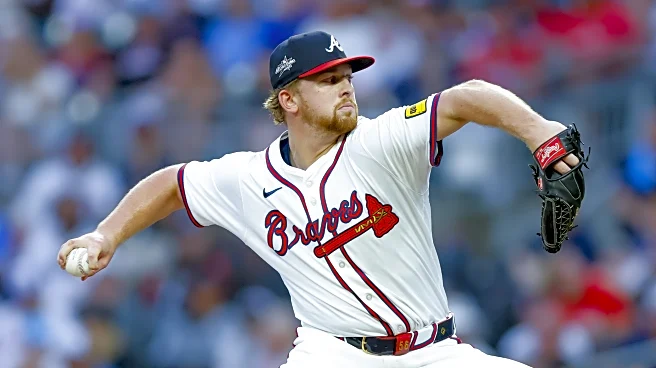

25-year-old starting pitcher Spencer Schwellenbach was in the midst of a great follow-up to his breakout rookie 2024 season by looking like an emerging ace… until a fractured bone in his pitching elbow ended the right-hander’s season at the end of June.
How acquired
Schwellenbach was a second-round pick by the Braves in the 2021 MLB Draft. The Braves drafted him as a starting pitcher despite Schwellenbach fitting in as a two-way player at the University of Nebraska, where he pitched just 18 games,
all as the Cornhuskers’ closer, during his pre-draft college campaign.
What were the expectations?
Although he didn’t earn any votes in the 2024 National League Rookie of the Year tally, Schwellenbach’s debut season was awesome. Called up in late May, it took a tiny bit of time to settle in, but then he unleashed an incredible run in July and August before fading down the stretch a bit. On the season, he tallied 2.7 fWAR with an 81 ERA-, 83 FIP-, and 83 xFIP-. Even his xERA was right in line with those other numbers, and he did it all across 21 starts and 123 2/3 innings. Nothing was fluky, and even the pitch quality models saw him as a guy with both above-average stuff and above-average command, a rare combination usually reserved for top-flight starters.
There was little doubt that he was going to be a member of the 2025 rotation. The only question is where he’d technically rank, given that it also featured Chris Sale, and two guys who were really good previously returning from injury: Spencer Strider and Reynaldo Lopez. ZiPS had little concern about anything in Schwellenbach’s profile, generally projecting him to more or less repeat his 2024 success with some slight regression to the mean: 2.6 WAR in about 147 innings (compared to 2.7 fWAR in about 124 innings in 2024).
2025 results
Well, the rotation became a shambles fairly quickly, given that Lopez was one-and-done and Strider wasn’t consistently starting until late May. Schwellenbach was the team’s best starter in April given Sale’s relatively slow (for him) start, and would’ve outperformed Sale in May, too, if not for the former’s inflated HR/FB. By the time June ended, Schwellenbach had two more starts than Sale, more than 20 innings over the veteran, and a beautiful 73/81/73 line (ERA-/FIP-/xFIP-) compared to Sale’s 60/67/78. Now, half a season does not necessarily transfer the ace title from one teammate to another, and Schwellenbach’s HR/FB rate kinda got in the way, but out-xFIPing Sale in half a season is still really something. At that point, due to the homers, Schwellenbach’s 2.4 fWAR trailed Sale’s by 0.2 for the team lead.
Schwellenbach’s 2025 largely just picked up where his 2024 left off, as his K%-BB% was almost identical (within 0.1 percentage points), and his FIP- went down by 2. That said, he substantially increased his grounder rate in 2025, such that his xFIP went down by 10.
2025 featured his first complete career game, as well as three hilariously-dominant starts, and four double-digit strikeout games. It was a pretty great run, until it unceremoniously ended.
What went right?
While he was on the field, what didn’t go right? Of the 153 starters with the most innings this season, he had the second-lowest walk rate. But, this didn’t affect his ability to get strikeouts, which ranked 33rd in that group. He pretty much did the works from a plate discipline perspective: pounded the zone (25th), got chases (third!), got whiffs in the zone (55th), got whiffs out of the zone (22nd), and avoided contact overall (23rd).
He made this happen by throwing six pitches, each of which was used at least ten percent of the time. No pitch really got lit up — the worst xwOBA against of the sextet was .342 on his sinker, while his slider and splitter were well below .300. Of those pitches, only the sinker and curve had shapes that weren’t “good; at the same time, he showed pretty much pinpoint command of his three most-used pitches (four-seamer, slider, splitter) as well as his cutter. There may be some discussion about whether Schwellenbach could potentially benefit from ditching his sinker and curve given that they’re clearly behind his other pitches, but given how well he’s pitched, it doesn’t seem like there’s a need to do anything quite so drastic.
Schwellenbach’s best outing was probably his April 4 start against the Marlins — which happened to give the Braves their first win of the year after they started with that disastrous seven-game losing streak. He went eight frames with a 10/0 K/BB ratio in the Braves’ home opener — 73 of his 99 pitches went for strikes on the night, before Aaron Bummer finished things off.

All that said, it was only the beginning of a handful of comically good starts for Schwellenbach on the year. On May 31, he struck out 11 batters and walked none in 5 1/3 innings against the Red Sox. In what ended up being his final start of the year, he dominated the Phillies with a 12/1 K/BB ratio in seven frames.
What went wrong?
That his campaign was only half as long as the actual season, pretty much. Sure, it was par for the course for the injury-ravaged Braves, and especially their rotation, but it still sucked. The timing was also brutal, as Schwellenbach likely would’ve gotten an All-Star nod if he hadn’t fractured his elbow.
If we have to go beyond injury, we can point to a somewhat-elevated HR/FB. It wasn’t as bad as, say, that of Bryce Elder or anything, but it still cost him a bit. In particular, it was near 20 percent against lefty batters, and Schwellenbach also had the unfortunate circumstance of one in three fly balls hit against him in high leverage this past season to end up clearing the fence.
That aside, he had few clunkers. Arguably his two worst starts of the year came against the eventual World Series teams, and the game against the Dodgers was a particular low-light, as he was chased in the fourth with a 4/1 K/BB ratio and a homer allowed to Shohei Ohtani. In the end, though, Schwellenbach had just three games with an xFIP- above 102, so he was pretty much consistent in pitching decently or better.
The injury, though, was absolutely brutal. It came pretty much out of nowhere — Schwellenbach finished dominating the Phillies to round out his June, mentioned something about feeling sore to the team following the outing, and blam, diagnostics indicated a small fracture that ended his year. At the time, it seemed possible that he could maybe start ramping up to get back in September or something, but it was pretty clear that the Braves weren’t going to be weathering the loss of his talented right arm or all the other issues they had, so there was not much reason to bother and run the risk of rushing Schwellenbach back too soon.
2026 outlook
If healthy, Schwellenbach should slot in the top of the team’s rotation. The fact that his elbow injury was a bone fracture and not a ligament issue lends hope that he’ll be able to start the regular season at full strength. His late start to pitching full-time, and his injury last season, may mean Atlanta will be cautious with his innings in 2026.
Steamer has him as a notably above-average arm, with 3 WAR in 167 innings. That’s a top-30 projection among starters, and well-deserved given what we’ve seen so far. ZiPS has him even better on a rate basis, but is more cautious in terms of innings total: 2.6 WAR in about 125 innings.
With Sale potentially a free agent after the 2026 season and turning 37 days after the regular season starts — and uncertainty about Strider’s ceiling after injury issues — it could be a pivotal year for Schwellenbach and his ability to entrench himself as one of the top pitchers in baseball and the ace of Atlanta’s starting staff.