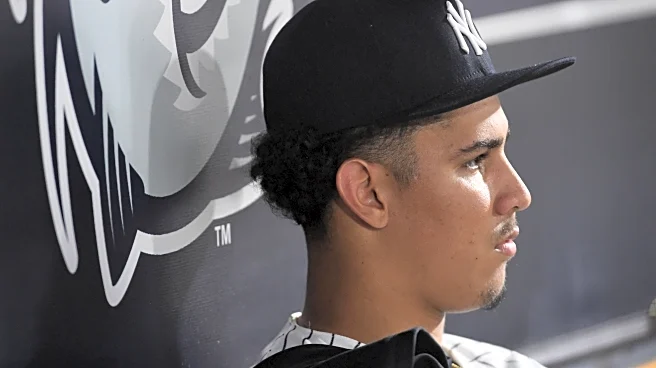



On Sunday, the New York Daily News’ Gary Phillips wrote a story about ascendent Yankees pitching prospect Carlos Lagrange which gave me pause when I read the headline. Specifically, the story was about Lagrange’s partnership with a start-up company called Finlete. Finlete is a platform of sorts which allows fans to essentially treat players like stocks—financial assets to be bought into and speculated on to grab a piece of their future earnings if their career takes off.
This isn’t a piece of artistic
license on my part: it is quite literally the pitch Finlete makes to its customers, albeit with slightly more pillowy language. “Invest in the career of a top baseball prospect,” their website invites visitors in boldfaced font. For just a $300 down payment, you can “back” a prospect and partake in the rewards if the kid reaches the pros.
So, what’s in it for the players? Well, as Phillips details in his story, the prospect gets all the money from Finlete ‘investors’ upfront and can spend it right away on whatever they need. Lagrange, who in January received over $150,000 from Finlete after signing on with them in September, confirmed that the upfront cash played a role in his decision to enter a partnership with them.
Now, I suppose most of you reading probably weren’t familiar with Finlete before. But if you’re like me and you perked up a bit at seeing that name, that’s probably because you remember their most famous client: Guardians closer Emmanuel Clase. Clase, who partnered with Finlete last year, was federally indicted last fall for his alleged role in a scheme to make money for sports bettors by intentionally spiking pitches at the start of his outings.
Phillips mentioned Finlete’s agreement with Clase in the story, and asked Finlete cofounder Rob Connelly about it—naturally, Connelly declined to comment. If your most famous client is a guy facing criminal charges for the most serious challenge to MLB’s integrity since Pete Rose, we’re already off to a bad start.
Of course, given the league’s recent actions, questions about integrity don’t seem to particularly concern them. Already heavily intertwined with the online sportsbooks which have invaded every televised sports broadcast in America, the league recently announced a partnership with Polymarket, a so-called ‘prediction market’ which allows gullible users to light money on fire by betting—sorry, investing, there’s that word again—on the possibility of just about anything taking place.
Polymarket and its competitor Kalshi are the end result of this gambling craze: open seas of speculation where the cursory limitations sportsbooks place on what what their users can ‘predict’ are further sanded down. The league has announced that they’ll be working with Polymarket to “address integrity concerns”—concerns which of course never would have existed if they didn’t take the reported $300 million-per-year bag to enter this partnership, or the myriad of sports betting sponsorships that came before.
It can be easy for people to lose sight of the fact that behind all the rush to make money off these gambling crazes is the simple truth of why gambling looks appealing to more and more people: they’re financially insecure. Full-time jobs that pay well and provide good benefits are increasingly elusive; gig work and hustling for extra income to make up the difference become increasingly obligatory. It doesn’t take much for a person in dire financial straits to plunge what little they have into bets which could in theory multiply those earnings. But gambling is addictive, and once addictive cycles of behavior around gambling emerge, it stops being about winning money to pay off your student loans or get your car serviced. It becomes about the act of staking, the endorphin rush of making a decision you know you shouldn’t make.
As the financial pressure on ordinary people increases, activities they previously engaged with for leisure start to transform into an extension of the grind. As a result, it’s no longer enough for a baseball fan to pay recurring fees to various streaming websites or MLB itself just to be able to watch all their favorite team’s games, or shell out hundreds of dollars for a ticket. They are repeatedly and obnoxiously entreated to put money down on the outcome, too.
We’ve seen what this leads to: online and in-person harassment of athletes for “losing fans’ money” on bets that didn’t work out. Phillips mentioned this ugly, extremely common side effect of gambling in his article—Lagrange appeared not to be troubled by the possibility. But in much the same way it’s easy to abstract away the money you bet with, it’s easy to abstract away threats which haven’t yet been made. People who invest in a baseball player’s potential future earnings to essentially ride their coattails likely don’t have their own ducks in a row financially. If they feel they’ve been wronged, they can resort to doing some ugly things.
Of course, you have to be in a precarious situation yourself to allow people to “invest in your future”. And that’s where I would be remiss if I didn’t mention the makeup of Finlete’s ‘roster’, as it were. Out of the ten players they list on their website, all of them are from Latin America—half, including Lagrange, from the Dominican Republic, three from Venezuela, one from Mexico, and one from Panama. For his part, Lagrange has nothing but praise, at least publicly, for the way Finlete negotiated with him, but the company still has a ton of leverage in this situation. Just as a Hispanic player is more likely to accept a team-friendly extension from their big league club for the immediacy of a major pay raise, they’re more likely to opt for a scheme like this.
Connelly describes what Finlete does as “[shifting] career risk away from athletes and onto investors”. But that’s disingenuous. These athletes are still taking all kinds of risks—chief among them trying to make it as a nonresident Hispanic man in a country with a government which is actively hostile to them. Like it or not, Lagrange is taking a very real risk every day he wakes up in the morning and travels to the Yankees’ spring training facility.
No, what Finlete is doing is simply creating risk for more people; taking the kinds of agreements which players have taken in the past (and occasionally sued over, as in the case of Fernando Tatis Jr.) and expanding them to hundreds of other people. They’re taking advantage of a loose regulatory environment and a public which has spent years being goaded into betting on as many discrete outcomes as possible. Why stop at offering players predatory loans when you can convince a bunch of impressionable strangers with bad money habits to take them too?
I think some people’s initial reaction to hearing about Lagrange’s partnership with Finlete is going to be “well, good for Lagrange. He’s having success and getting rewarded for it.” But to me, this is one of those supposedly heartwarming stories which distracts from a darker reality. Just like how a person who resorts to GoFundMe to pay their medical bills shouldn’t have that gargantuan expense foisted on them in the first place, a baseball player shouldn’t feel like he needs to enter an agreement like this to find some security as he strives to make the majors. And even if it all works out for Lagrange, Finlete just represents yet another way to financialize baseball; continuing its transformation from nation’s pastime to just another vehicle for speculation.