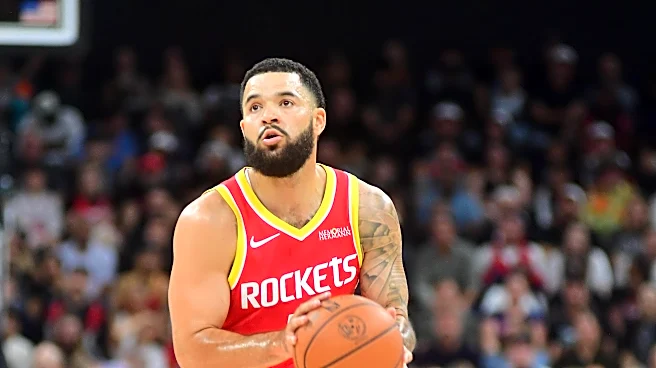




Fred VanVleet is a postmodernist.
Hear me out.
The point guard position has undergone a radical transformation over the last decade and a half or so. Like any seismic change, it’s hard to pinpoint a precise catalyst.
When Derrick Rose became the youngest MVP in NBA history in 2011, that was a watershed moment. His 7.7 assists per game were point guard-y enough, but the 25.1 points per game would have imposed a “shooting guard” label on him at any other point in league history. Rose was the new meta.
Houston Rockets fans know the change intimately. Firstly, Mike D’Antoni’s decision to run the offense almost exclusively through James Harden was another critical juncture. Fast forward, and we’re arguing ad nauseam about whether Kevin “I am obviously not a point guard” Porter Jr. is a point guard.
Here’s what makes VanVleet postmodern: He’s a throwback, in a sense. Ball security is his superpower. VanVleet facilitates in a low-risk, medium-reward way.
Yet, he’s also modern. VanVleet launches pull-up threes that would make Mark Jackson blush. It’s the only means he really has of bending defenses, and modern, starting-caliber point guards must bend defenses. At times, those shots can look a little bit absurd in the moment:
But in the bigger picture, they’re part of what makes VanVleet so impactful.
Rockets’ VanVleet is a winning player
I love when people do the work for me.
Thanks, Brad. DataBallr has VanVleet’s impact as even more positive, with a +14.1 On/Off split. I’m not sure why different outlets calculate on/off stats differently, but what matters is that the stats consistently demonstrate that VanVleet is a winner.
VanVleet’s True Shooting % (TS%) is buoyed by his combined three-point volume and efficiency. He’s hitting 39.5% of his 7.4 threes per game. For this Rockets team, that’s priceless.
Many have suggested that Alperen Sengun would thrive if paired with a more dynamic point guard. It would be easy to point out that (again, per DatalBallr) the duo is +13.8 when they share the floor, but there are solid normative explanations for their success as well.
Just as VanVleet is not Jamal Murray, Sengun is not Nikola Jokic. He’s a less natural shooter, and he’s not on Jokic’s level as a passer. That’s not a knock: Sengun is a top-ten (and closer to five) passing big man in NBA history, but Jokic is a top-ten (and closer to five, and really closer to two or three) passer in NBA history.
But Sengun is perhaps a better ball-handler (it feels ethically necessary to note that he’s a much better defender here, but it’s not relevant here). That ball-handling ability makes him one of the best isolation bigs in the NBA, but some of Sengun’s pick-and-roll finishing looks a lot like isolation basketball too. I’ve said this before, but Sengun and VanVleet run the pick-and-roll like Stockton and Malone. Often, the purpose of the set is largely to advance Sengun’s position by a few inches before he starts cooking.
It’s a job that, say, Kyrie Irving is overqualified for. That’s not to say that outright that the Rockets shouldn’t trade for him (for example, although it feels like he’s the only star guard they’re at all likely to acquire). There’s a part of me that thinks the 2026-27 team is our best window, and more pure offensive firepower is what we need.
There’s another (and ultimately, I think, stronger) part of me that thinks VanVleet’s willingness and ability to let Sengun cook is what’s best for his continuing development. The stats strongly suggest that VanVleet makes Sengun better, and the Rockets, in general, a better team:
That’s as close to an objective truth as one could possibly find.