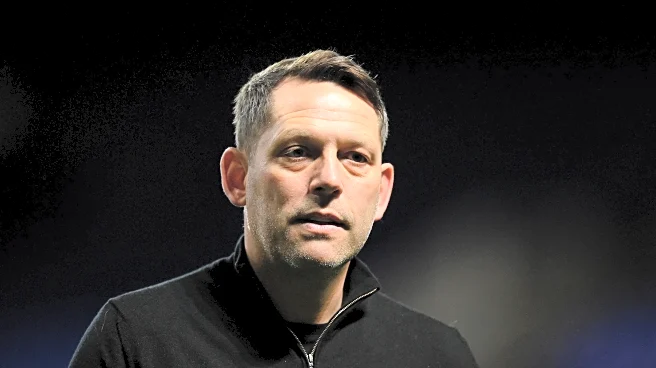


Appointed as Reading manager on October 28, Leam Richardson has now been in the role for a little over two months, overseeing 11 games in all competitions. Some good, some not so good and some… Carlisle United. By means of comparison, over a similar time span last season (October 29 until January 4), Reading had 17 games.
Being out of the cup competitions has naturally been a factor in the lighter fixture list, but the sense that we’ve had a lot more long spells without games compared to previous
years is proven correct. As such, it’s a fair question to pose whether it’s too early to make any judgements on Richardson’s tenure so far. Possibly so. Is that going to stop me? Absolutely not.
I’m going to break this down into two parts: youth development and results/performances, essentially. Starting with the former… and I’m hesitant to say it, but I’m not sure he is quite the right profile of manager for this Reading side.
Youth development
One of the few saving graces/shining lights over the last two years of penny-pinching before the takeover was the club being able to reconnect with its academy roots, and the conveyor belt has not failed to deliver a number of gems. Some have since moved onto bigger and better things, others have stayed and some have moved to Leyton Orient.
However, football never stands still and we have a shiny new batch knocking on the door to make an impression on the first team: Tyler Sackey, Shay Spencer, Ashqar Ahmed, Sean Patton, Philip Duah to name but a few. You could even include Andre Garcia in this bracket, should you wish.

However, Richardson has a clear reticence to use the younger players and he is clearly a lot more comfortable with leaning on the experience in the squad. Why?
You can argue that maybe he wants to gain a foothold at the club before introducing the younger players to get game time – however, on the occasions this is true, they are coming on with next to no minutes available on the clock. Often, they don’t come on at all. What kind of experience is that? How is that helping to develop the conveyor belt?
Even if you view this from a business perspective, it makes no sense. We are a selling club and the best way to bring in funds for us will be to get younger players in the shop window to sell them to clubs higher up the pyramid, a la Femi Azeez, to name one of many examples. But we can’t sell players for good money when they haven’t been playing.
On the topic of business as well, Richardson has made his feelings clear on wanting to bring in his own players. Again – why? Rob Couhig is famously averse to spending money – which I’m not against by the way, since a number of our best signings of recent years have been on frees – but what kind of message does this send to the current playing squad? It surely must be demoralising.
When Ruben Selles needed players, he found solutions. No left-back? Jeriel Dorsett moved there or Andre Garcia was retrained from being a winger. No left-winger? Kelvin Ehibhatiomhan was repositioned out wide instead of as a striker. These decisions still benefit the team to this day.
You look at this squad and ask where we need the extra players – we do have a lot more depth than we’ve had in recent years. Up top? But we have Jack Marriott, Mark O’Mahony and Ehibhatiomhan who can play there, and we have Sean Patton in the academy. Why not try him? Or give more minutes to O’Mahony, rather than waiting until the final five minutes of a match to bring him on.
Left-back? We can shuffle Andy Yiadom over to the left and give the minutes to Kelvin Abrefa or fellow academy graduate Ashqar Ahmed. Hell, you could even play Garcia there.
It’s things like this that don’t sit right, for me. He’s been given more support with coaching staff than any manager since… as long as I can remember, really. He’s got a big playing squad and he was even given license to bring in Randell Williams, who, while useful, wasn’t an essential signing for us, and Andy Rinomhota.
I think a lot of this could be overlooked if the performances were bringing unqualified positivity, which leads us to the second par….
Results and performances
I think I know what Richardson is trying to do with this side: he wants us to be hard to beat and a counter-attacking unit. And the signs so far are that the team have a much clearer tactical identity and are building towards this.
There are two slight concerns though: firstly, given we are one of the better sides in the division in terms of the playing squad we have, it’s unlikely many teams are going to attack us directly and will instead be happy to sit back and counter us.

The second element of this is that, despite the results we have gained, a lot of them have had the feeling that they have almost been in spite of us. Reviewing the month of December, the Peterborough United (home) and Bradford City games were poor. Against Luton Town we were better, but they did what we couldn’t do and moved the ball forward with real intent and purpose.
Away to Plymouth Argyle, we were aided by a red card and penalty which followed a 10-minute spell when the hosts were a mess and we were able to capitalise. It took a Joel Pereira penalty save to keep us in the game against 10 men. Away to Peterborough, they completely dominated us and we relied on a defensive masterclass and far too many Pereira heroics.
In January, Burton Albion was one of the most comfortable wins we’ve had in some time, but it’s hard to know whether that was owing to our dominance or the lack of any threat from the Brewers. Stockport County was a backs-to-the-wall, gritty, grind-out-a-point, smash-and-grab type of win that, realistically, could have gone either way and we were the fortunate ones to come away with something. Which, against the Reading prophecy, is unusual for us.
What’s my point here? We didn’t really dominate in these games, and our game plan simply seemed to be playing the long ball forward. There is nothing wrong with that necessarily, but when your starting forward line are all under 5ft 9, you’re already off to a bad start and are asking a lot of them all to win the headers.
But the results are there, and we are definitely scoring more goals. The fans will grumble but at least we are picking up the points. Richardson will need to prepare for when we stop picking up the points though because playing like this and getting points despite ourselves is not sustainable, and we will soon revert to the mean.
We either need to build on this to develop better attacking transitions to capitalise on our periods of dominance, or we need to find a new game plan to enhance the skills in the team and become more dominant in our performances throughout a whole 90 minutes, as opposed to just in spells.
And Richardson will likely need to do this with the resources he has at his disposal, despite his asks for further investment. January will be interesting – we either come out of the other side looking healthy with a playoff push on the horizon, or we fall back to where we were before, hovering above the relegation places.
So, where do I stand with Richardson right now?
He does retain my support. I think, or rather I hope, that he’s playing a longer game to build us up bit by bit into the team he wants us to be, in his image. However, there is some low-hanging fruit for him to pick if he wants to get myself, and possibly other supporters, more on board with his methods.
He was vocal at the start of his reign about fitness being a concern for the squad, and his point in this regard is valid. However, he’s had an unusual amount of training ground time to improve fitness, as well as tactical play. Using fitness as an excuse will no longer wash with the fans, nor will seeing players huffing and puffing after a three-game week with limited rotation.
It’s hard to get a feeling of how much we are benefitting from his leadership, or whether it is just a case of us having an actual manager who knows what they are doing, as opposed to our previous incumbent. It’s also worth noting he has a far more experienced – and larger – coaching staff to support him, so it’s reasonable to expect improvements when more resources are provided.
It’s difficult to judge success based on such a low bar to step over, though the fact he has done so, comfortably, is naturally a positive. As fans, I think we need to see more substance to the performances, more minutes to younger players – when appropriate – and also how he will respond when we do hit a set-back in form.
For now, things look positive and we should be encouraged by the start. I suspect the narrative for the success of his reign, and the season overall, will be better to judge by the time we reach May. It’s all still very much in our hands to be successful this season.
Approval rating
What do you make of the job Richardson has done in the dugout so far?
You can grade him in our approval rating poll below, with one being the lowest and five the highest. If the poll doesn’t display on your device, try this link right here.