

Pain. Anguish, even. Torment, if you will. These are but a sample of the emotional petri dish that I’ve consumed while witnessing what was supposed to be a new beginning for the Utah Jazz. A beginning of hope. Of competitive basketball. Of winning.
Yet here we are, 10 games into the regular season, with only a single Jazz victory to account for: a one-point Delta Center victory against a subpar New Orleans Pelicans team.
Their 1-9 record is tied for dead last across the entire NBA, matched only by
the worst Sacramento Kings team in years (an accomplishment that is borderline impressive, in all honesty) and the alpha release of the Giannis-less Milwaukee Bucks.
Casual observers may be unsurprised by the Jazz’s slow start. They’ve won an average of under 27 games in the last four years and have become the face of professional basketball’s tanking epidemic — few have mastered the modern art of losing quite like Utah. But the NBA enacted substantial anti-tank measures to dissuade teams from intentional losing. In turn, Utah added a multiple-time All-Star forward and a highly touted rookie point guard to their coagulating pre-existing core.
The Jazz are not losing intentionally; they’re actually this bad.
Keeping in mind the small sample size of just 10 games, Utah isn’t the victim of a string of close losses. They’re a victim of the second-worst offense in basketball, scoring just 106.2 points per game. That average lands ahead of just one team: the shockingly horrific Charlotte Hornets and their 96.3 points per game.
The Jazz offense has been ineffective and stale, but much of that can be attributed to the harsh hand of injury misfortune.
First fell Jusuf Nurkic, the projected starting center who serves a Diet Jokic role as an offensive hub in Will Hardy’s offense. Nurkic appeared in Utah’s first preseason game but has been glued to the bench, modeling this year’s autumn catalog from his courtside seat. Without Walker Kessler (who has been predictably awesome in Los Angeles), Nurkic is essential personnel, as odd as that feels to say. 1-9 is the resut in his absence.
Jaren Jackson Jr. has been out since Utah’s fourth game of the season against Memphis, and will spend at least another month or two recovering from an injured MCL.
Markkanen has been off and on with an injured shooting wrist, and playing below his standard while on the court.
But the Jazz’s issues aren’t exclusive to their frontcourt, the lack of depth at the guard line has really hurt Utah. It’s no secret that George and Collier, two ball-dominant point guards, don’t share the floor well. But besides the rookie Darryn Peterson, who else on the roster can Will Hardy trust to bring the ball down the floor?
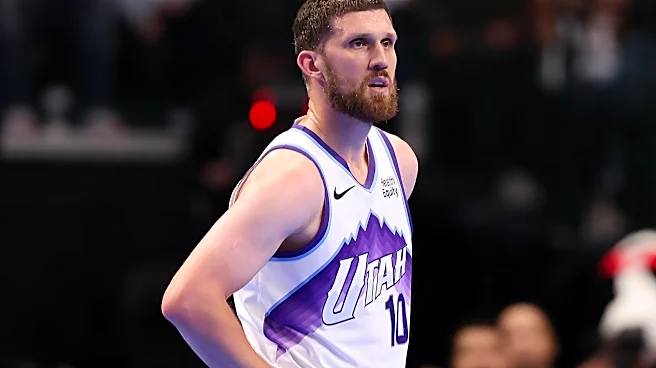
Svi Mykhailiuk is off to a nightmare start. Scoring 3.3 points on 27% from the field, Mykhailiuk hs been borderline unplayable. Brice Sensabaugh isn’t a ball-handler either, and is hardly seeing the floor anyway. Newly-acquired Kobe Bufkin was nearly out of the NBA when the Jazz signed him to a two-way deal — he’s not going to drive the bus.
Injuries are compounding a pre-existing depth issue. Under a magnifying glass, the Jazz are a deeply flawed team that needs much more time to coalesce.
It wouldn’t be honest to blame strength of schedule, either. Despite some tough competition, the Jazz have put themselves in winning position. They took early overtime leads agaisnt San Antonio and New Orleans before dissolving like sugar cubes, giving up two separate 12-0 runs and consequently picking up a pair of L’s.
There are no excuses, but that doesn’t mean there is no hope.
Darryn Peterson is finally finding his cadence, posting career-highs of 21 and 26 in back-to-back appearances. Keyonte George has played exceptionally well to back up the team’s $157 million faith in his future. Ace Bailey is maximizing his defensive upside, making it impossible for Will Hardy to keep him off the floor even as he struggles offensively. Newcomers Josh Green and Mo Bamba have flourished in their increased floor time, and have proved to be excellent offseason additions early.
The path toward playoff berth may have to be re-routed through the Play-In this year, but perhaps higher expectations weren’t realistic to begin with.
Calvin Barrett is the Associate Editor for SLC Dunk and a Utah Jazz columnist for the Standard-Examiner. Originally from Springville, Utah, he currently writes from his desk in Japan.