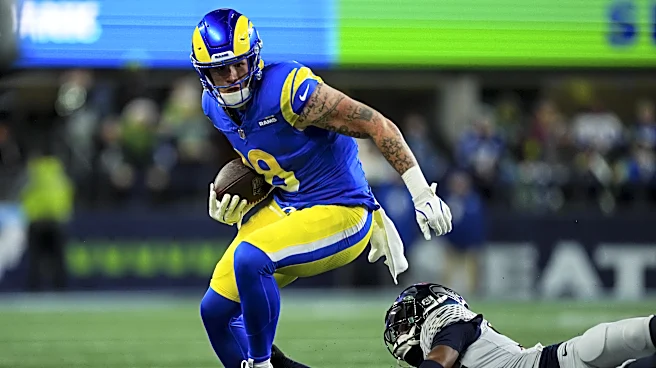




There is much debate around the Los Angeles Rams 2026 offense, the L.A. braintrust contradicted conventional thinking this offseason past, eschewing big-name wide receivers in free agency and instead, taking a tight end early in the the draft. They were effectively saying, “We were the #1 offense, since it ain’t broke, we ain’t fixing it.” All the key players return intact, quarterback, running backs, wide receivers, tight ends, and offensive linemen.
The 2026 big move will likely be schematic, with
the Rams leaning heavily on two and three tight end sets. The offense won’t necessarily be more run-based and plodding, all the intricacies of past Sean McVay offenses will still be available, play-acton, pre-snap movement, vertical routes from inside the hashes. and most importantly, the subterfuge of running multiple possible plays out of formations that appear similar.
The passing target share should move in tandem with the formations. Tight ends and to a lesser extent, running backs should trend upwards. Since it’s easier to go forward when you know where have been before, here’s how the Rams have targeted the passing game in the McVay years, 2017 through 2025.
2025 – 598 pass attempts
#1 and #2: 279 targets 46.7%
Puka Nacua 165, Davante Adams 114
#3: 87 targets 14.5%
Jordan Whittington 25, Xavier Smith 24, Konata Mumpfield 23, Tutu Atwell 15
Tight ends: 150 targets 25.1%
Colby Parkinson 56, Tyler Higbee 36, Davis Allen 33, Terrance Ferguson 25.
Running backs: 64 targets – 10.7%
Kyren Williams 50, Blake Corum 14
2024 – 559 pass attempts
#1 and #2: 206 targets – 36.9%
Nacua 106, Cooper Kupp 100
#3: 197 targets – 35.2%
Demarcus Robinson 64, Atwell 62, Tyler Johnson 41, Jordan Whittington 28, Smith 2
Tight ends: 83 targets – 14.8%
Parkinson 49, Allen 13, Higbee 12, Hunter Long 9
Running backs: 55 targets – 9.8%
Williams 40, Corum 8, Ronnie Rivers 6, Cody Schrader 1
2023 – 583 pass attempts
#1 and #2: 255 targets – 43.7%
Nacua 160, Kupp 95 targets
#3: 153 targets – 26.2%
Atwell 67, Robinson 39, Van Jefferson 15, Ben Skowronek 12, Austin Trammell 7, Johnson 3
Tight ends: 88 targets – 15.1%
Higbee 70, Allen 11, Brycen Hopkins 7
Running backs: 69 targets – 11.8%
Williams 48, Darrell Henderson 14, Rivers 5, Royce Freeman 2
2022 – 529 pass attempts
#1 and #2: 159 targets – 30.1%
Kupp 98 targets, Skowronek 61 targets
#3: 172 targets – 32.5%
Allen Robinson 52, Jefferson 44, Atwell 35, Brandon Powell 32, Lance MCutcheon 5, Trammell 4
Tight ends: 122 targets – 23.1%
Higbee 108, Hopkins 11, Kendall Blanton 2, Jacob Harris 1
Running backs: 63 targets – 12%
Henderson 22, Cam Akers 18, Williams 12, Malcom Brown 6, Rivers 5
2021 – 607 pass attempts
#1and #2: 279 targets – 46%
Kupp 191, Jefferson 89
#3: 152 targets – 25%
Robert Woods 69, Odell Beckham 48, Skowronek 20, DeSean Jackson 15
Tight ends: 94 targets – 15.5%
Higbee 85, Blanton 7, Hopkins 1, John Mundt 1
Running backs: 76 targets – 12.5%
Henderson 40, Sony Michel 33, Akers 3
2020 – 590 pass attempts
#1 and #2: 253 targets – 42.9%
Woods 129, Kupp 124
#3: 112 targets – 19%
Josh Reynolds 81, Jefferson 31
Tight ends: 126 targets – 21.4%
Gerald Everett 62, Higbee 60, Mundt 4
Running backs: 71 targets – 12%
Brown 33, Henderson 24, Akers 14
2019 – 632 pass attempts
#1 and #2: 273 targets – 43.2%
Woods 139, Kupp 134
#3: 120 targets – 19%
Brandin Cooks 72, Reynolds 43, Mike Thomas 5
Tight ends: 156 targets – 24.7%
Higbee 89, Everett 60, Mundt 7
Running backs: 61 targets – 9.7%
Todd Gurley 49, Brown 6, Henderson 6,
2018 – 568 pass attempts
#1 and #2: 247 targets – 43.5%
Woods 130, Cooks 117
#3: 115 targets – 20.2%
Kupp 55, Reynolds 53, Khadarel Hodge 3, Nick Williams 3, Pharaoh Cooper 1
Tight end: 85 targets – 15%
Everett 50, Higbee 34, Mundt 1
Running backs: 97 targets – 17%
Gurley 81, Brown 7, CJ Anderson 6, John Kelly 3
2017 – 518 pass attempts
#1 and #2 – 179 targets – 34.6%
Kupp 94, Woods 85
#3: 142 targets – 27.4%
Watkins 70, Tavon Austin 22, Reynolds 24, Cooper 19, Thomas 7
Tight ends: 88 targets – 17%
Higbee 45, Everett 32, Derek Carrier 11
Running backs: 101 targets – 19.5%
Gurley 87, Brown 11, Lance Dunbar 3
Conclusions
The McVay offense is constantly evolving, even if incrementally, but none of it is ever completely new. Last year, L.A. tight ends received 25.1 percent of targets, the most since McVay took over back in 2017. Expecting the Rams to continue looking at targeting the tight ends for 20+ percent of passing targets going forward simply harkens back to the pre-2021 offense. From 2017 through 2020, Rams tight ends were targeted a shade under 20 percent of snaps.
Since 2017, the Rams have consistently targeted their #1 and #2 receivers at a 43 percent clip (leaving out the 2022 season debacle). Last season’s jump in tight end targeting came at the expense of the WR#3 cast, their 14.5 percent target rate was the lowest in the McVay years. The simplest explanation would be the extensive use of two and three tight end sets, but the running back/tight end 35.8 percent target rate was by far the highest of the Matthew Stafford years and the highest since McVay’s maiden year. Expect the Rams 2026 offense to be akin to his early Rams years, with running backs and tight ends having a bigger piece of the offense.
Going forward
The hard fact is that the Rams returning WR#3 cast hasn’t struck fear in opposing secondaries. While they are still young and developing, it’s hard to make a case for metamorphosis. Jordan Whittington is a grinder that adds roster value in different areas, but even back to his college days, is best in a support role. Rookie CJ Daniels remains to be seen. Although Xavier Smith gives off gadget player vibes, he’s in his fourth season and hasn’t given hints of breaking out. Konata Mumpfield had 375 reps last year and was mostly invisible, he should improve, will it be enough to challenge for WR#3? Difficult to make a case for that. There’s also a handful of practice squad returnees.
Les Snead and Sean McVay have shown us fans their cards, the back-to-back season Round 2 additions of tight ends Terrance Ferguson and Max Klare portend that the three wide receiver sets the Rams offense has been known for are being delegated to the back burner. McVay’s 2026 offense is getting back to his tight end coach roots.