



It’s been a little over a month since Jonathan Kuminga made his Atlanta Hawks debut, and while the team has been red-hot since the All-Star break, it’s been a bit of a mixed bag for the former Warrior as he acclimates to his new surroundings.
In 13 games for Atlanta (25 possible appearances*), Kuminga has put up respectable ‘per game’ averages of 11.7 points, 5.3 rebounds and 2.1 assists in 21 minutes a night on a 59.7% True Shooting clip. Yet, given his sizable $24.3 million team option for next
season, it’s far from a guarantee that he’ll be back in Atlanta in 2026-27, and I’m quite fascinated to see the level of production the team gets from him going forwards, particularly as the competition level rises in the postseason.
*Kuminga has been dealing with a balky left knee since he injured it against Dallas on January 22nd, and has played in four consecutive games for the Hawks just once since being acquired at the deadline.
After a frustrating, enigmatic four-and-a-half-year stint in Golden State largely defined by Kuminga’s dismal relationship with head coach, Steve Kerr, the former seventh overall pick was in need of a fresh start in Atlanta, aiming to make good on the sky-high potential that made him a top-10 draft pick.
Kuminga took a few weeks to recover from a bone bruise in his left knee after being traded to Atlanta, but once he was cleared for action, it looked like he’d been shot out of a cannon in his first three games in a Hawks uniform, going for 27, 17, and 20 points against Washington (twice) and Portland, shooting a combined 21-for-31 from the field (5-for-9 from three) over that stretch.
However, after missing the following three games with inflammation in his left knee, he’s struggled to make a consistent impact and has failed to reach the double-digit mark in five out of his last ten appearances.
One trend that’s beginning to emerge in Kuminga’s performances with the Hawks is that he’s generally struggled against Play-In/Playoff-caliber opponents relative to his performances against lottery-bound teams. As you can see in the table below, his numbers – particularly his scoring efficiency – drop across the board against higher caliber competition.

So where does this leave us? Which version of Kuminga can we trust? It’s a difficult question given the miniscule sample size (278 minutes) of him in a Hawks uniform, yet it’s a question Atlanta’s front office is certainly trying to answer as they prepare to decide on his team option for next season.
So without further ado, let’s go through a few critiques of Kuminga’s performance in Atlanta since the All-Star break.
Thrives In Transition
I’ll start with an obvious positive: Jonathan Kuminga is an elite athlete, even by NBA standards, and these athletic gifts lend themselves nicely to an Atlanta team that likes to spread its wings on offense, ranking fifth in pace and fourth in transition frequency on the season. Kuminga thrives in early shot clock situations where he can attack the defense with a head of steam – opportunities that came around less frequently when he was in Golden State earlier this season.
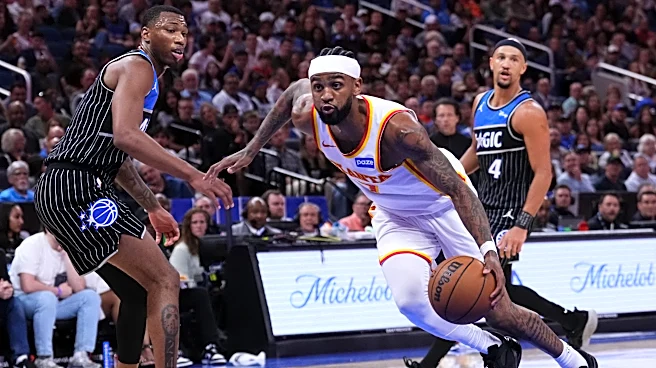
Check out this play from Wednesday’s win over Orlando. ‘JK’ is in attack mode just three seconds into the possession before Franz Wagner can get into his defensive stance, and he capitalizes for an easy two points plus the foul.
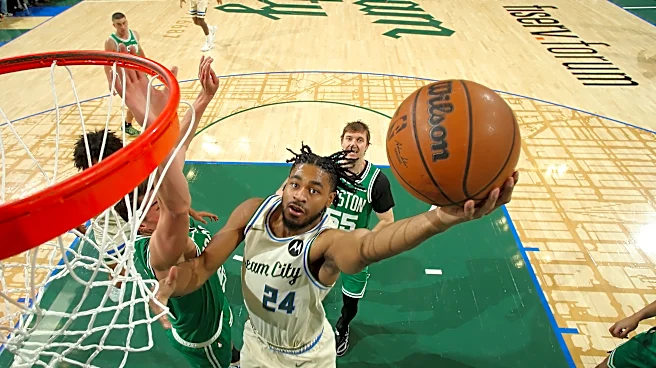
Against Boston, the Hawks force a turnover and are off to the races with a 3-on-2 advantage in transition. Kuminga receives the ball around half-court and a few seconds later he’s at the rim, dropping in a lay-up.
Against Portland, he muscles the 7’2”, 280-pound (!) Donovan Clingan out of the way, before finishing off the possession with a pretty reverse lay-in.
Per cleaningtheglass (CTG), the Hawks rank second in transition efficiency this season, scoring 1.34 points per play. With Kuminga shooting an impressive 20-for-32 (62.5%) in the first nine seconds of the shot clock, Atlanta’s transition efficiency improves to 1.39* point-per-play when he is in the game – underscoring his value in these early shot clock situations.
*92nd percentile relative to other five-man lineups this season (min. 100 possessions played)
The problem is that even for teams like the Hawks who like to run, the majority of the game is played in the halfcourt, where Kuminga has been quite inconsistent thus far.
Halfcourt Offense Is a Work In Progress
Tasked with providing a scoring punch off the pine for a defensive-minded Atlanta Hawks bench unit, it would have been rather pollyannaish to expect Kuminga to instantly mesh with his new teammates. That said, watching back a few of his misses on film, it’s clear that he needs to do a better job picking when to attack in the halfcourt.
From their recent game in Boston, Kuminga receives the ball on the wing and keeps his head down on his drive to the basket. There’s more than enough time on the shot-clock for Atlanta to get a cleaner look, and he has opportunities to pass to Zaccharie Risacher, Mo Gueye or the cutting Corey Kispert, but instead Kuminga opts to take it right at three Celtics defenders resulting in an empty possession for Atlanta.
Against Brooklyn on March 12th, Kuminga goes one-on-one against rookie forward, Danny Wolf, and either doesn’t recognize or doesn’t care that Jalen Johnson’s defender is coming over to help. Instead of kicking it out to the open Johnson, Kuminga tries to finish through contact, leading to a blocked shot and an easy transition bucket for Brooklyn.
Earlier in the quarter of the same Brooklyn game, Kuminga dominates the entire possession, taking 11 dribbles before failing to convert at the rim. Similar to the play above, he misses a wide-open Alexander-Walker in the corner before going up to shoot.
The clips above do a good job demonstrating why Kuminga is shooting just 24-for-41 (58.5%) at the rim for the Hawks – well below his career rim field goal percentage of 71%. He needs to slow down, process the defensive coverage, and do his best not to force things.
Still, that’s not to say Kuminga is a complete lost cause in these halfcourt situations. There have been signs of improvement lately.
This was a gorgeous and-one finish on Amari Williams from last week’s game against Boston.
Against Orlando, he puts his strength on display once again, taking it right at Da Silva before finishing at the rim.
Here, he recognizes he’s in a crowd, and instead of forcing up a tough mid-range attempt, kicks it out to Alexander-Walker for a triple from the top of the key. Yes!
Even when he doesn’t convert, the pressure Kuminga puts on the basket can be a positive for Atlanta – especially when he takes an opposing rebounder out of the equation, like on this possession against Detroit.
Additionally, Kuminga is a big help when it comes to generating free-throws for a Hawks team that ranks 25th in free-throw attempt rate on the season, drawing shooting fouls on 17.6% of his field goal attempts in Atlanta, a mark that ranks in the 94th percentile amongst forwards per cleaningtheglass.
Something I’d like to see the Hawks do more of is putting Kuminga in ‘obvious attack’ situations where he can use the same gifts in the halfcourt that make him such a lethal transition scorer.
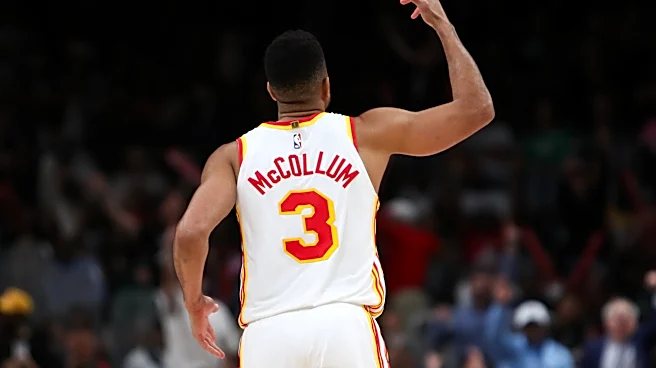
In the play below, CJ McCollum has his drive walled off by Ausar Thompson and kicks it out to Kuminga on the opposite wing. The left side is completely cleared out for ‘JK’ – just check out how much space he has when he catches the ball – and Javonte Green (my guy!) has no chance sticking with Kuminga’s drive.
I’ve really enjoyed the possessions where Atlanta uses him as a roll-man, like on this play against Memphis. McCollum makes a great pass to the rolling Kuminga and it’s an easy slam for ‘JK’ – with GG Jackson torn between helping on Kuminga and sticking to Corey Kispert in the corner.
Per cleaningtheglass, Atlanta is scoring 0.96 points-per-play in the halfcourt with Kuminga on the floor – slightly below their halfcourt efficiency on the season and a mark that ranks in just the 42nd percentile relative to other five-man lineups with at least 100 possessions played this season. I’m curious to see whether this number rises as Kuminga and his teammates develop a better understanding of each other’s games.
Impact On The Defensive Glass Has Been Elite
We’ve spent a lot of time talking about Kuminga’s scoring ability, but another area where he’s made a noticeable impact for Atlanta is on the glass. I discussed the Hawks substantial turnaround on the boards since the All-Star break in my last piece, and when he’s played, Kuminga has been a big part of this improvement – particularly on the defensive end.

Per pbpstats, Kuminga is personally snagging 18.3% of available defensive boards when he is on the floor for Atlanta – well above his career defensive rebounding percentage (DREB%) of 13% – and it’s encouraging to see that this has translated to the team-level as well, as Atlanta’s 77.9% defensive rebounding percentage with Kuminga on the floor ranks in the 99th percentile (!) relative to other five-man lineups this season per cleaningtheglass.
While it would be nice to see the Hawks turn more of these defensive rebounds into transition opportunities*, given that the defensive glass was a legitimate problem to start the season, Kuminga’s impact in this area deserves a ton of praise.
*per CTG, the Hawks are turning just 28.3% of their defensive boards into transition possessions with Kuminga on the floor – 44th percentile relative to other five-man lineups this season.
Is His Defensive Impact Sustainable?
Lastly, we need to talk about Kuminga’s impact on the defensive end – beyond the boards, of course. Per cleaningtheglass, the Hawks are posting an elite, 104.5 defensive rating with Kuminga on the floor, a mark that ranks in the 98th percentile relative to other five-man lineups this season.
While limiting their opponent’s second chance opportunities has certainly been a factor here, the Hawks are also forcing turnovers on 17% of their defensive possessions* and holding their opponents to an unfathomable 57.8% rim field goal percentage** with Kuminga on the floor – both of which are elite marks.
*92nd percentile relative to other five-man lineups per CTG
**99th percentile relative to other five-man lineups per CTG (for reference, San Antonio Spurs’ opponents are shooting 60.4% at the rim when Victor Wembanyama is in the game – albeit in a much larger sample size)
Kuminga has been a more active defender since joining the Hawks, posting more steals per 100 possessions in Atlanta (1.9) than he did in any season with the Warriors.
Against his former team, he picks off Poziemski’s skip pass to the corner, sparking an offensive possession that results in a Risacher triple.
Kuminga is also a legitimate deterrent around the hoop – as on display in these two plays from Atlanta’s win over Boston on March 30th.
Below, he does a good job sticking with Pritchard’s drive before forcing a miss.
Here, he and Okongwu cause Jaylen Brown to adjust mid-air on his drive to the hoop, resulting in another Boston miss.
Now, it has to be said that these defensive numbers are almost certainly inflated by the competition-level Kuminga has faced – with Atlanta playing lottery-bound opponents in six out of the 13 games he’s appeared in – but even so, you only play the teams on your schedule, and it’s been good to see Kuminga and the Hawks taking care of business on the defensive end.
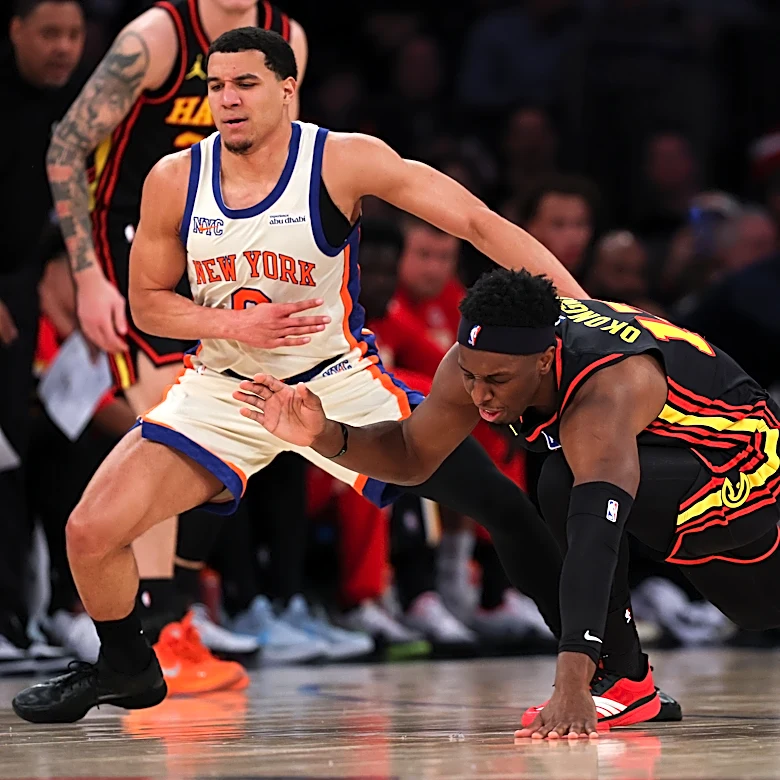
Kuminga’s next opportunity to impress comes at home tonight against the New York Knicks (7-3 in their last ten games), who currently occupy the 3-seed in the Eastern Conference.
Each game provides another data point and I’ll be keeping an eye on his scoring efficiency against a Playoff-caliber opponent, as well as how the team performs on the glass when he is on the floor – with New York ranking sixth in offensive rebounding rate and third in defensive rebounding rate on the season
Tip-off is at 7:00pm EST on FanDuel Sports!