





The Portland Trail Blazers brought Damian Lillard home to Oregon almost 12 months ago, allowing him to recuperate and reignite his career with the NBA franchise closest to his heart. Fans are now counting down the days until he returns to the court this October, but what if he was to be joined by an old friend?
One of the first things General Manager Joe Cronin did after taking over the front office was move CJ McCollum to the New Orleans Pelicans at the 2022 NBA Trade Deadline. A necessary first step
parting with the franchise’s then-second highest-paid player on a roster that wasn’t cutting it.
No one ever said McCollum wasn’t an above-average NBA guard or someone who couldn’t contribute to winning, but earning $30 million as Lillard’s backcourt partner was hindering that incarnation of the team.
In the nine years he spent in Portland, McCollum averaged 19.0 points, 39.6 percent from three, 45.3 percent from the field, 3.4 boards, 3.4 assists and 0.9 assists. These numbers become even more impressive when you consider McCollum averaged fewer than 16 minutes a game through his first two seasons.
To further highlight his third-season rise, McCollum won the 2015-16 NBA’s Most Improved Player after lifting his averages from 6.8 points in 15.7 minutes a game to 20.8 points in 34.8 minutes.
For years, McCollum, with Lillard, operated as one of the league’s most offensively productive backcourts, much of the time bested only by the Golden State Warriors’ Steph Curry and Klay Thompson when it came to scoring.
But unlike the Warriors, and Thompson specifically, McCollum was and is still nowhere near the defensive player needed to play in a backcourt alongside another defensively deficient point guard, if a team has title aspirations.
Yes, they made it to the Western Conference Finals in 2019, but a Lillard-McCollum starting backcourt was always going to be too flawed to be a serious player in June.
Somehow, this summer will be the first time McCollum enters any form of free agency after previously signing two extensions with the Blazers and one with the Pelicans.
Today, we ask whether the Blazers should offer McCollum the $15 million non-taxpayer Mid-Level Exception to re-join Lillard and the Blazers for 2026-27. Not as Lillard’s backcourt teammate but as an offensive-first guard off the bench who can score at all three levels. Something this team needs in spades.
McCollum since Portland
McCollum has gone through good and bad years in his four and a half campaigns since the Blazers. That stretch includes three and a half seasons with the Pelicans, half a season with the Washington Wizards and another half with the Atlanta Hawks.
The initial three months he spent with the Pelicans after the 2021 trade deadline were his best, averaging 24.3 points on 39.4 percent from three, 49.3 percent from the field, 5.8 assists, 4.5 boards and 1.3 steals.
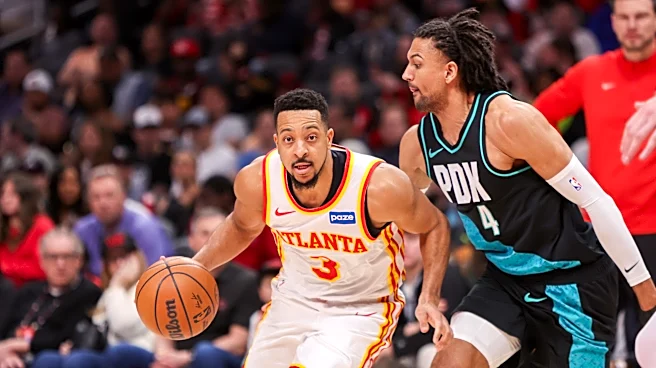
But the 34-year-old may have actually enjoyed his most notable stretch with the Hawks during the first round of this year’s NBA Playoffs, just months after he and Corey Kispert were traded for Trae Young. He played key roles in the Hawks’ two wins against the team holding a 2-0 NBA Finals lead.
Though he may not be able to do it as frequently as he did with the Blazers, McCollum has made it to the status of savvy veteran scorer, something the Blazers are now in dire need of in order to take the next step next season.
Roster balance
If the rumors are to be believed, the Blazers roster is expected to look markedly difference next season, which suggests at least one, if not two, trades in the offing. Before we start re-affixing McCollum’s name and number to Blazers jerseys, the front office needs to make a decision.
There’s no way you can add McCollum to the current roster as is. Damian Lillard and Scoot Henderson can only really play minutes at point guard. We’ve also got 13 years of data, proving McCollum is in the same boat.
If the Blazers were to approach McCollum, I’m positing that Henderson would need to be moved and that the former Lehigh standout would need to share the court with Lillard sparingly. Don’t worry about Jrue Holiday, he can play the two, three or four given his size and natural defensive instincts.
With Henderson playing elsewhere, McCollum would come off the bench playing 20-to-22 minutes a night, serving off ball with Holiday and Deni Avdija taking the facilitation duties. In this example, McCollum would be used in catch-and-shoot and limited isolation opportunities, giving this team some offensive punch. Fortunately, unlike McCollum’s Blazers years after 2015, this roster boasts playmaking from outside the guard spots.
The Blazers owned the third worst three-point shooting rate in the league last season. In Lillard and McCollum’s last full season together, they were fifth, and while the pair have aged six years since that number, their long range shooting hasn’t suffered.
Conversely, unlike his first tenure in Portland, McCollum would be the microwave scorer he was born to be. If he did return there could very well be end-of-game situations where both he and Lillard would be on the court. But this time, there’s an appropriate level of offensive and defensive support around them.
Conclusion
The Blazers are looking for competitive edges as it moves from rebuilding franchise into feisty Western Conference competitor. Adding veteran talent with real offensive punch is exactly what this franchise is looking for.
This team can’t afford to have all three of Lillard, Henderson and McCollum on the same roster. But if Henderson was moved, bringing back McCollum as a pure bench scorer, alongside Jrue Holiday and Deni Avdija as facilitators, makes a lot of sense for a team starving for scoring.
McCollum would obviously have to agree to his lowest non-rookie pay day, half the $30.7 million he earned this season. Considering how he performed in the first round of the NBA Playoffs, there may be more out there for him. But if he’s content earning similar money to his former partner in crime, then a return to the state where he already owns his winery could be a success, both on and off the court.
There’d also be something romantic about seeing Lillard and McCollum finally making a deep run together in Portland, even if they’re not the starting backcourt.