


Special thanks to Jake Singer, emeritus of Maize N Brew, for joining me to discuss Michigan’s roster on this week’s podcast:
Offense

Michigan has switched quarterbacks and fired their offensive coordinator, is on the verge of missing a bowl game, every game they’ve won except one of their two G6 opponents has been by a single score, and the other G6 opponent was only the most recent of Michigan’s notorious asterisks. The season has been quite a surprise to those who celebrated Coach Whittingham’s arrival
to set the Wolverines on a more stable footing after years of scandal, though readers of Addicted to Quack knew months in advancethis was a deeply problematic staff change from the Summer preview and podcast conversation Jake and I had.
The firing of OC Jason Beck, whom Whittingham had brought over from Utah but without the QB who was essential to Beck’s offense the previous two years, was in my estimation 11 months overdue. The only thing that surprises me about it is that any professional in this industry ever thought Beck’s offense and analytically inept 3rd down playcalling would work.
There are significant challenges in predicting what kind of offense and which personnel interim OC Jim Harding, Whittingham’s longtime OL coach, will field on Saturday and for the rest of the regular season, due to the fog of war. As Jake and I discussed, up until now the team has been making several obviously — and easily demonstrable from prior stats — irrational choices which artificially suppressed their production, so they’re poised to make some kind of bounceback, potentially a major one. But while Jake and I didn’t find it too difficult to design a better hypothetical version of the offense given Michigan’s available personnel, there’s no way of knowing which components if any Harding will actually implement, or even if he’ll avoid doubling down on some of Beck’s worst habits and make a bad situation worse.
It’s also probable that even if Harding makes all the most rational changes to the offense, there’s a cap on how much better Michigan can get, with significant bottlenecks at the offensive line, wide receiver depth, some troubling injuries on this week’s availability report, and QB accuracy. To keep the length of this article manageable, I’ll limit the discussion to best case / worst case for each aspect of the offense, and trust the reader’s imagination to fill in the permutations in between.
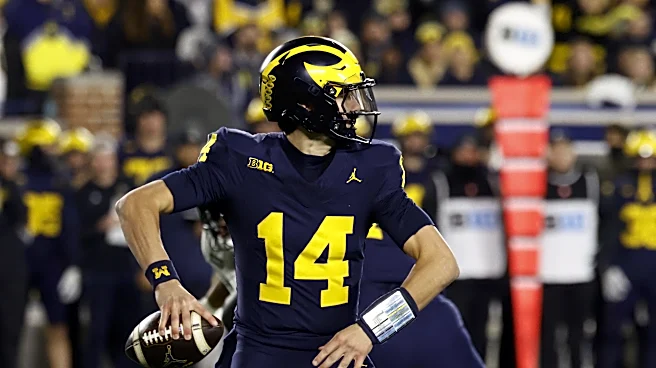
At quarterback, Michigan made a change at halftime in week 7 against Penn State, switching from the starter for the last year and a half, 5-star sophomore #19 QB Underwood, to the low 4-star true freshman #14 QB T. Carr (younger brother of Notre Dame’s starter CJ and grandson of former coach Lloyd). I’ve been critical of the decision to start Underwood as a true freshman and the previous staff’s failure to provide him a proper QB coach to resolve significant open-hips and footwork problems with his throwing motion, and when he threw four interceptions over nine meaningful possessions I certainly understood why Jake and many others were calling for Carr.
However, with three and a half meaningful games’ worth of sample, the data from that experiment are clear: Carr provides no actual benefit vs Underwood, and because he doesn’t have the same arm strength, loses his one benefit: about four extra percentage points worth of explosive passing. Otherwise, their passing efficiency, turnover, and negative play (sack/failed scramble) rate per dropback are all virtually identical, and they provide equivalent value enhancement to the run game:

The access journalists for On3 and ESPN have both reported this week that they believe Michigan will continue to start Carr. Given Whittingham’s treatment of the Salt Lake City press that I observed over a decade, I think any rational opposing coach should assume those reporters are polezniye duraki and plan for both quarterbacks.
While it’s clear that there’s an overall reduction in the ability to push the ball deep downfield with Carr in, which is why Jake came to the same conclusion about going back to Underwood, there’s also a particular effect between the QBs regarding the receiver selection which is harder to tease apart, complicated by Michigan’s lack of functional wide receiver depth: both QBs effectively have had only two wideouts to throw to, with the rest of the room sidelined or treated only as blockers, and the tight ends — shockingly — diminished as well. Underwood had a relatively even split between those two receivers, but Carr’s targets for one of them fell off steeply, by over 15.5 percentage points, while the other receiver only fell a couple of points (Carr’s leftover share of reps went to broken plays and short checkdowns, which is the explosiveness problem).
We can’t know at this point whether this was an adaptation Beck was making for Carr (and Harding might make a different choice, if he continues with Carr), or if Carr on his own prefers one receiver to another regardless of the playcaller. Here’s the wideout list:
Wide Receivers

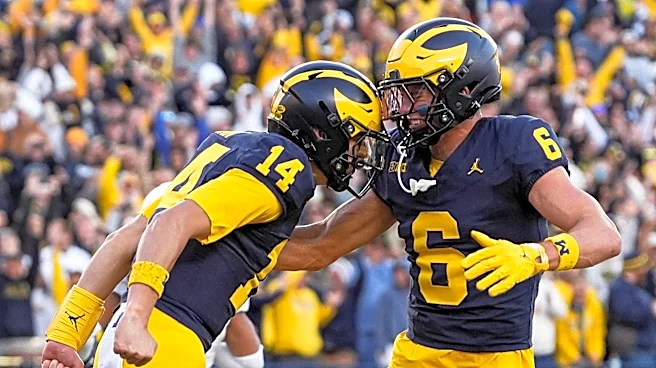
For both QBs, #6 WR Buchanan, formerly a TE and now being used as a Y-receiver, is the bigger play receiver, both on longer air yard throws (more rare, and Underwood makes up the majority of these), and on wheel routes and the like where Buchanan catches a short-to-intermediate ball in-stride and continues downfield to pick up 10-20 yard gains. Both QBs have tried to target Buchanan on about a quarter of all dropbacks. Buchanan bails out his QB — especially Carr — a lot by stopping his route and going vertical to pull down an inaccurately placed ball, though this basically kills any extra yards he might have gotten.
The most productive returner from last year, #3 WR Marsh, is the receiver with the big split in his numbers. In 2025, he had excellent per-target efficiency numbers with Underwood throwing it to him: a 66.1% success rate and 10.8 adjusted YPT. Jake and I were both baffled that this year, Beck turned him into Michigan’s short pass receiver, instead of using him as another deep threat and having one of the TEs or half-dozen other WRs play that role instead. In 2026, Underwood continued to target him at a high success rate, 62.8%, but below FBS average YPT at 6.57. However when Carr came in, Marsh’s production went from average to terrible: he was being targeted far less often, and when he was it was for even shorter throws at a much worse success, 49.8% for 5.28 YPT which constitutes wasted plays.
The two freshmen, #13 WR T. Johnson and #12 S. Moa, each have a couple of intriguing catches, but they’re in the single digits in terms of targets combined, and it’s harder still to project them for individual QBs. Cumulatively their success rate is under 40%, with almost all of their yards coming from one big catch against Rutgers.
#9 WR Goodwin has almost no receiving production this year, and in 2025 he had underwater per-target numbers when Underwood was throwing it to him. But I’d describe him as the starter in the X position both seasons nonetheless, because he plays a significant downfield and crackback blocking role. This week he went from questionable to doubtful on the availability report. If he can’t play there is — as macabre and unpleasant as this to say — an opportunity to re-evaluate the offense and find a more productive use for a receiving position. Though it’s rarely Goodwin’s fault, having charted Michigan’s 2026 playbook, I can say that none of the play designs for which Goodwin is a key blocker are above water in success rate or have much utility to Michigan’s offense.
Here’s a representative sample of Underwood vs Carr on unsuccessful passing plays:
Analytically, the best version of the passing offense comes on 2nd & short / medium, with Underwood in, when they can leverage defenses attacking the possibility of the run to throw the ball deep against lighter defensive backfields. That would mean playing out of 11-personnel and ditching the worthless 6-OL sets, keeping one of the TE or RB in to block while the other releases as the outlet receiver (either this year or last year every one has proven capable of catching ~6 yard passes for conversions). Then they would be able to put all three of Buchanan, Marsh, and a third WR — be it Johnson, Moa, or one of the as-yet unseen but talented sophomores #81 WR Browder, #10 WR Ffrench, or #84 WR Washington, so five potential options to find just one pair of working hands — well past the sticks.
Here’s a representative sample of Underwood vs Carr on successful passing plays:
Tight Ends

This is the most incredible unit to me, given the history at Michigan and Whittingham’s at Utah. First, they had the wrong TE get drafted last year as Marlin Klein had done nothing to merit a 2nd round draft pick and had far below FBS median productivity, while #83 TE Z. Marshall as a backup with half the targets had double the success rate over baseline, nearly double the YPT at 9.2, and more than double the explosiveness rate at 30%. Then Beck effectively benched him, giving Marshall no targets and barely any playing time.
This is perplexing because it can’t be due to Marshall being a poor blocker – the TE who was chosen as starter, #80 TE Hansen, is a very poor blocker as Jake readily acknowledged, and the other starter is a fullback, #42 TE Hoffman (who does not block nearly as well as his predecessor Max Bredeson). Hansen’s per-target productivity isn’t bad, he has comparable efficiency to Marshall last year though much lower explosiveness, but he’s being targeted much less often as a starter, just 15 times total this year.
In October it came out that Marshall had sent text messages griping about his lack of playing time, which were leaked, and he was made to apologize for. For two weeks he was suddenly changed on the availability report from uninjured to out and he didn’t play, a blatant act of retaliation because Marshall was right about Beck’s playcalling before Whittingham could see it. On the podcast, Jake and I discussed Marshall’s final year of eligibility and what other schools might treat him appropriately.
Hansen and Hoffmen are both listed as questionable on this week’s availability report. I asked Jake whether he thought that, with Beck out, they’d put Marshall back on the field. Jake said he didn’t think so, that Whittingham still carried the grudge and retained his loyalty to Beck, and was too proud to let the student win.
Running Backs

The clearest evidence of artificial suppression from Beck’s playcalling comes in the running game, where Beck attempted to turn Underwood into a smashmouth runner and got a miserable 43.2% efficiency and 4.1 adjusted YPT on 44 completely wasted designed carries (excluding sacks and scrambles on called passing plays), and had a group of offensive linemen trying to execute an East-West scheme they lacked the mobility for. Even more clear than the falloff in per-play production in charting metrics for the returning QB, WRs, and TEs in the passing game behind functionally the same offensive line with a comparable schedule, is the staggering collapse in rush efficiency for two of the returning running backs. Those are #23 RB J. Marshall, one of the top two backs last year, and #24 RB Kuzdzal, a former walk-on and a backup last year with a comparable share of the carries as in 2026.
Marshall went from 52.5% efficiency, 5.4 adjusted YPC, and 12.7% explosiveness in 2025 — not actually fantastic numbers, kind of mediocre really, as has been typical of Michigan’s RBs for the last five seasons — to 41.7% efficiency, 3.5 YPC, and 4.7% explosiveness in 2026. Kuzdzall’s falloff was essentially by the same factor: 56%, 4.0, 10.6% in 2025 to 29.6%, 3.2, 7.4%.
The addition to the room is true freshman 5-star #5 RB Hiter. As Jake and I discussed over the Summer, he’s a very exciting prospect and it was clear he was ready to play right away … and Michigan needed him to be, as they had no other depth options. It is somewhat difficult to evaluate Hiter because we’ve only seen him in Beck’s offense, but Jake and I both think he’s been getting equal reps to the more experienced Marshall because Hiter’s build is more likely to get more out of the explosive play potential if Beck’s style of rushing plays to the perimeter succeed.
But that’s not happening, and it’s very clear on tape that rushing plays only succeed despite the playcall and blocking, not because of it. While Marshall is underwater this year, Hiter is even more so at an atrocious 33.3% efficiency and 3.31 YPC, with the lowest explosive play percentage on the entire team at 2.2%.
Here’s a representative sample of unsuccessful rushing plays:
With these figures, the state of the offensive line, and the relative strength lying in the explosive passing potential, optimizing the offense would mean re-focusing the run game around efficiency — setting up 2nd & short shot opportunities and converting 3rd & short if they miss — which means switching to North-South running that the o-line can at least lean forward a few yards to pick up. In turn that would require re-arranging the RB order to give Marshall the lion’s share of the carries, while using Hiter only as a change of pace and Kuzdzal as relief.
Here’s a representative sample of successful rushing plays:
Offensive Line

A complete rundown is on the podcast but suffice it to say this offensive line has been beset by three issues: first, Beck’s scheme is foreign to them, this core lineup has essentially been together for the last three or four years in the same Michigan scheme which has been handed down for the better part of two decades, and they don’t have the skillset for it. Second, they’ve been shuffling constantly, with their best tackle (in Jake and my opinion both) out since week 2, another tackle missing a couple weeks, their right guard in and out over this last month, and several other players missing time or moving positions to cover for absences. Third, I don’t think any of them are very good to begin with, and assessment by Harding has been poor, which I’ve been writing about his Utah lines for years.
Michigan has the highest negative play rate on a per-snap basis in the conference, 16.56%, which is a full standard deviation above FBS median. That is the answer that Coach Whittingham didn’t have as to why his team couldn’t score against Michigan State – you can’t move the ball if a sixth of your plays go backwards. On the year Michigan’s offense, prior to garbage time, has committed 13 procedural penalties, 10 holds, 26 TFLs, 17 sacks, 6 fumbles, and 9 interceptions.
Other than the center, #53 C Guarnera, who’s been fine and hasn’t missed a play, the most confidence has gone to the least effective players. Their solution to every problem is #71 OL Link, who is perhaps the weakest offensive linemen I’ve seen past Pop Warner. They’ve played a third of reps in a 6-OL set (Jake told me it’s called the “Rhino”) which has negative efficacy and the starter has the lowest grades on the team. The right guard, #70 RG Norton, has been the biggest reason they can’t run, they had an opportunity to replace him with the backup Rhino #89 OL Gach who played better, then they went back to Norton.
Jake has been telling me that the hope for the line is the highly rated sophomore #65 OL Babalola, we finally got to see him at the end of last week. I think it’s telling that they’ve played five tackles, including a true freshman, ahead of him. If #77 RT Frazier is out, then they’ll either replace him directly with that freshman, #78 OT Walbridge, or move Link over from left tackle and have Babalola replace Link. Given the playing time so far, I think Walbridge is more likely.
Jake thinks they’ll stick with Norton at right guard if he’s healthy, I thought Gach played better in relief.
Defense

The defense is competently coached within a very similar 4-2-5 scheme to what Michigan has been running for years, they’re aggressive in the front and deep at their best positions, and punish offenses for getting behind the chains.
Where the defense’s statistical profile has changed recently from a couple of years ago is that, rather than stuffing the run and preventing any efficiency gains on early downs as they were doing in 2021-24, they now look much more like Phil Parker’s defense at Iowa – allowing a certain amount of yardage on early downs and pretty consistently giving up short yardage rushing, but putting a hard cap on how many yards those runs will get and taking away explosive rushing. This creates something of a trap where offenses convince themselves to try and run four yards at a time all the way down the field and eventually run out of gas, or better yet for the defense, fool themselves into running in adverse situations like 2nd & long and doom themselves even earlier. The defense is very aggressive in long yardage and forces the issue to get off the field.
The defensive paradox is that while they’re pretty effective on 1st & 10 against the pass, a 61.7% success rate, they really fall off in on 2nd down, to just 50/50 on 2nd & long and the same on 3rd & short, with a massive 20-point differential between short and long yardage pass defense rates. That’s the classic indicator that it’s the pass rush, not the coverage, which is the strength of the defense, because when the front has to worry about the run in short yardage and the secondary has to cover on their own, they get lit up comparably far more often.
The situational numbers imply a strategy of rushing on 1st down to take advantage of Michigan’s underwater defensive efficiency rate against the run and avoid their strong 1st down pass defense, setting up 2nd & managable. Offenses should avoid rushing on 2nd & short, that’s the trap, instead they should take their shots against a secondary prone to give up massive passing gains. If they miss their options are open on 3rd & short or medium, since Michigan’s rush defense is poor on 3rd down and their pass defense is open to even bigger plays than on 2nd down. Calculated risks to set up 4th down tries given appropriate field position are also worthwhile. What should be avoided is getting behind the chains and facing Michigan’s ferocious pass rush, by staying away from excessive 1st down passing, especially screen passes, and 2nd & long rushing.
It’s difficult to control and plan for, but worth being aware of: Michigan’s defense has a massive penalty problem, and a bizarre one because it’s much worse than Michigan did in recent years or which Utah did in the years I was watching that team. They’re averaging a little over one personal foul (roughness/facemask) and one advantage foul (pass interference/holding) for two automatic 1st downs and a little over 30 penalty yards per game. Only 4 have been on 1st down, and only 2 have been on 2nd & short, meaning the vast majority have been in situations when the defense was very nearly off the field but for the big penalty. It’s a defense-wide problem, which Jake put down to coaching, and pressing – some players have more fouls than others but no unit is exempt and certain units have surprising fouls, like DBs with unnecessary roughness and facemask fouls. Here’s a quick sample, one from each game:
Defensive Tackles

There are two clear top guys who are products of the Michigan pipeline, #17 DT Etta and #95 DT Pierce, the seniors have been part of the rotation with an increasing part of the production for the each of the last several years. Etta is much more of the penetrator, in fact when I first saw him in a Spring game as a freshman he was playing at end. Pierce, despite being lighter, is build more stoutly because of his height and is more of the gap-filler. Both are very effective on their own and let the linebackers and edges play back and wide – a big reason why the defense tends to give up a little rush yardage often, but a lot of rush yardage rarely.
The depth has settled into place after trying out some different options, and it’s not a lot. #91 DT Lea’ea who came over from Utah is something of a tweener between 1-tech and 3-tech, he can do both decently but isn’t built ideally for either, and at this point I think is best understood as the backup for both Etta and Pierce, while nobody else gets any serious reps. The rest of the room got tryouts for the first few weeks, #99 DT Kanka and #54 DT Palepale wound up as the most acceptable of the depth options, but I think Jake was right that the staff isn’t going to play them unless they’re forced to by an injury.
Defensive Ends

This unit has played eight guys, it’s clearly deep, and its effectiveness is the heart of the defense, yet it also took quite a while for us to get through on the podcast because the ins and outs of who played when this year have been perplexing.
One player is very clear, the Utah player #90 DE Daley, who’s got a great frame and powerful motor, and generates by far the most havoc. I haven’t seen an offensive tackle this year consistently stand up to him. However, the team tends to overuse him, and there’s a falloff in his performance in 4th quarters (and this team has been in 4th quarter games every week). Daley is listed as questionable on this week’s availability report.
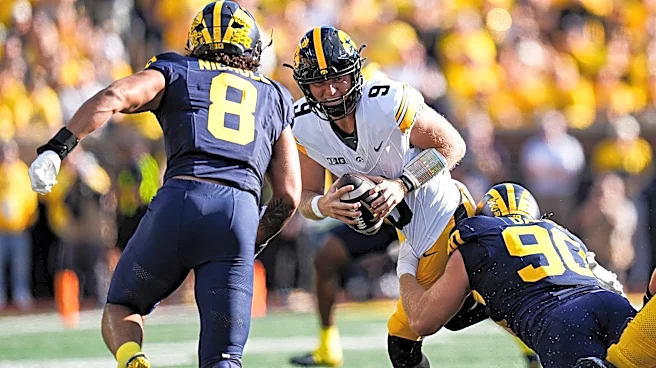
Figuring out who the preference is for the other starting defensive end has been tricky. After talking with Jake, I think the answer is that if he’s fully healthy and they’re not playing a weird team that wants to run all the time, it’s #8 DE Nichols – he’s built like an edge rusher and his usage pattern fits the bill once you take injuries and running vs passing teams into account. Like Daley, Nichols is also listed as questionable this week.
This is where it gets really tricky. The next two most frequently played ends — #93 DE Patterson and #41 DE Boney — are not built like edge rushers, are very young, jumped established and more highly recruited players, and don’t seem like they’re one-for-one backups to Daley and Nichols. In fact they were barely playing at all at the beginning of the year. Jake unknotted the problem for me when he suggested that they were run-stopping specialists – that fits the pattern and their builds pretty well. But it also implies that, if Daley and/or Nichols were unavailable against a passing-oriented offense, Patterson and Boney might not be the staff’s picks to replace those starters.
The remaining four are more built to be edge rushers against a passing team, but they’ve had peculiar seasons. #9 DE Brandt and #88 DE Edokpayi are upperclassmen who haven’t ever put it together for a very impressive performance. #14 DE Meadows is a true freshman and stuck on the bottom of the list, which I wouldn’t say is a big deal, except Boney is also a freshman and has ten times his rep count. #94 DE Marshall might be best situated, he was actually alongside Daley at the beginning of the year, but he’s been sidelined for reasons I don’t really understand.
Given six options to replace Daley and/or Nichols if they’re unavailable, Michigan shouldn’t have a problem, even if they have to do it in the aggregate. They might miss out on the plus value that Daley and Nichols have brought specific to getting to the passer, which no one else in the room has really replicated except as part of jailhouse blitzes.
Linebackers

This unit proved to be a curiosity as something seemed fishy about the players the staff was and was not high on during the offseason, and it turned out that they blended those groups after all. They’re now starting one talented power conference player, the former Georgia transfer #18 LB Bowles, and one stud of an FCS transfer, #44 LB Staehling. Both are grading out very well, with Bowles generating a lot of havoc when he’s brought in as the extra rusher on blitz packages, and Staehling better than most at play diagnosis. The backup and SAM role is a returning sophomore who was a backup last year, #4 LB Taylor, and Michigan State transfer #13 LB A. Moa (brother of the wideout, they have a funny rivalry school history) is playing a similar role to his position with the Spartans where he’s mostly a specialist up on the line of scrimmage for extra personnel packages rather than being in the main, three-man rotation with Bowles, Staehling, and Taylor.
I notice specific and different qualities for Bowles and Staehling – Bowles is much faster and can cover sideline-to-sideline better, but he’s easier to get moving the wrong way with misdirection plays. Staehling is enormous, most of the negative grades on my tally sheet show him having the right idea of where to go on a play but he would have needed a quicker first step to get there in time.
Here’s a representative sample of successfully defended rushing plays:
And unsuccessfully defended rushing plays:
Secondary

This unit had more rotation at the beginning of the year, but has really consolidated in the last few weeks. In my Summer preview I rated the depth of this unit highly, even though I wasn’t wild about the individual play of several starters for quite some time, because I thought if there were problems that new DC Hill would have the opportunity to re-evaluate with more, and greater talent.
Instead it’s gone the other way – they’ve doubled down on the same goofballs I’ve been seeing give up massive plays for years, sat down or chased out five new DBs Jake and I had a lengthy discussion about challenging for jobs over the Summer, brought in a favored nickelback from Utah who’s just been god awful and stubbornly protected him, and now, lamenting the lack of depth situation they’ve created, fought a court battle to get immediate eligibility for a midseason transfer of quite possibly the least effective cornerback I have ever graded at both Cal and Boise State. It’s like Michigan’s DB coach Stockton and the World Cup were racing in 2026 to set an own-goal record.
Suffice it to say, the secondary requires the pass rush to get home to be effective. If they don’t, they’re liable to grab a jersey or a facemask, or just get blown past for a massive play.
Here’s a representative sample of successfully defended passing plays:
And unsuccessfully defended passes: