



What is up, people of the internet? So, you may know that the World Cup is just around the corner and we here at BFW are putting together a series of articles about Germany in the build-up to the tournament itself. Teddy is already working on the top 10 goals that Germany has scored in World Cup history, so I proposed an idea that we should relive the best wins that Die Mannschaft has experienced. Which is why I’m here to introduce my top 10 Germany wins at the World Cup.
For this, I’m going to include
matches that I know and watched in person (live, on the TV, haven’t got the facilities to watch Germany live in the stadium yet) and I will also rank each match based on how special the match is to me.
8. Germany 1-0 Argentina, 1990 World Cup Final
From the 1970s onward, West Germany was one of the most powerful footballing nations. It had won the Euros in 1972 followed by the 1974 World Cup but lost out in the final of Euro 1976. From 1980 to 1992, it had been a finalist of both the Euros and the World Cup across multiple editions of each (apart from Euro 1984) but only won Euro 1980, they had lost two World Cup finals to Italy and Argentina and two Euros finals to bitter rivals Netherlands and Denmark (who weren’t even supposed to be in the tournament).
In 1990, the Germans produced strong performances at the World Cup held in Italy. They were undefeated for their entire run and only failed to win once: a draw in the group stage against Colombia in Milan. Otherwise, they beat Yugoslavia and the United Arab Emirates in Group D, then conquered the Netherlands, Czechoslovakia, and England on penalties to reach the final.

For defending champs Argentina, they lost their opening game against Cameroon then beat the Soviet Union and then drawing with Romania and advanced to the knockouts by being one of the best third-placed teams in the group stage. La Albiceleste then narrowly beat Brazil in the last 16, before overcoming Yugoslavia and Italy on penalties.
The Germans thus had the chance to exact revenge upon their opponents in the final, who beat them in the previous final four years ago. The Argentines made four changes due to suspensions, but nevertheless put together a solid team that would surely trouble the runners-up from 1986…or were they?

The holders kicked off the match, and it started off relatively calm until the third minute when Andreas Brehme spotted Rudi Völler on the left wing. Völler was then knocked over by José Serrizuela and free kick was given to West Germany. Brehme takes it and Völler in the box tried to poke it past Sergio Goycochea, but his toe punt went well over. The first sign of danger for Argentina, and will they do something about it?
Not yet, because it’s the Germans who went on the attack again where Thomas Häßler played Pierre Littbarski in who was taken down by Roberto Sensini inside the “D”. Five minutes in and the Argentines were already surrounding Mexican referee Edgardo Codesal, protesting his decision. A yellow card was thus brandished for Gustavo Dezotti for dissent. Littbarski tipped it off to Brehme shoots straight at the wall while Klaus Augenthaler smashed the follow-up but takes a deflection which allowed Goycochea to collect the ball.

A few minutes later, Thomas Berthold played the ball down to Jürgen Klinsmann on the right wing. Oscar Ruggeri did his best to take the ball off Klinsmann, but he couldn’t stop the German attacker from crossing it into the box. Völler is there again but he couldn’t direct his powerful header on target, due to him being pressured by Néstor Lorenzo.
West Germany then put together a string of passes that the Argentines couldn’t disrupt, culminating in Littbarski finessing the ball over the crossbar. The former European and World Champions were dominating, by a lot. Why isn’t Argentina doing anything? Well, they did, but it was an apparent handball by Ruggeri which Codesal didn’t award a penalty for. Alright, finally, the Argentines have an attacking opportunity with Lorenzo on the left flank. He crosses it in, but Littbarski is there to head it away which allowed West Germany to go on the counter. The chance was killed when Lothar Matthäus clipped José Basualdo who ran back to defend.

Diego Maradona, who was quiet during the match, sends the free kick in which meets a German defender’s head and the ball is cleared away. The Germans later get a corner kick which is volleyed by Brehme after bounces on the heads of Berthold and Argentine Pedro Troglio. Dezotti is there to block the shot and after which Argentina…sent the cavalry forward? Never knew they had it in them to do that. They won a free kick after Basualdo was bodied by Guido Buchwald just outside the German box. Maradona took charge of the freekick but like his successor Leo Messi in 2014, the free kick ballooned over the goal. Argentina would get one more chance before the halftime whistle was blown.
To be fair to Argentina, they tried to attack in the second half, but it was snuffed out by the Germans who launched another counterattack. Littbarski skips past three blue shirts before firing a shot that went wide of the diving Goycochea’s far post. Berthold later ghosted behind everyone during a free kick much later, but his headed effort goes over. What will it take for Argentina to realize that they WILL concede a goal if they don’t do something about the rampant Germans?
Argentina gave up a free kick after Pedro Monzón fouled Völler. Brehme sends it in and Völler is unmarked at the back post. However, the shot goes agonizingly off target. Maradona, amidst a chorus of jeers from the Italian crowd, tried to get past Buchwald and Völler but they combined to take him down; Maradona made disparaging comments about the country prior to the final. Völler was booked because of the foul.

Littbarski later had another chance that went begging, then Klinsmann and Matthäus went down after challenges with the latter finally called. Not long after that, Augenthaler found himself one-on-one with Goycochea who clips his leg—no penalty, says Codesal—and Monzón was there to clear the ball off the line. A later chance saw Brehme’s shot off a free kick saved by Goycochea.
The Germans were evidently hungry for a goal, when Häßler played Berthold’s cross first time for Klinsmann who fires it over. Then, something that never happened in a World Cup final happened: a straight red card. In the 65th minute, Monzón slid in on Klinsmann during another German attack: a studs-up tackle which went nowhere near the ball, enough for Codesal to issue the first ever red card at a World Cup final. Argentina went down to 10 men against a West Germany side who were out for blood, their blood to be precise.

A distraught Monzón walks off the pitch, but the show goes on. The ensuing free kick came to nothing, but Argentina got a corner later in the 78th minute. Apparently, the corner kick shouldn’t have been given, but so too was a foul for the trip on Gabriel Calderón by Matthäus as far as referee Codesal is concerned. Häßler later got a double chance, which ended up getting blocked and then saved by Goycochea.
West Germany attacked furiously in the closing stages of the match, and Argentina couldn’t keep up. Every time they tried to clear the ball, it would end up in a white shirt who would pass the ball forward in the hope of getting into the Argentine box. La Albiceleste ran out of luck as Sensini’s foul on Völler ended up in a penalty to West Germany. The incensed Argentines surrounded Codesal appealing the decision, but he stood by his call and gave a yellow card to Troglio for good measure. Matthäus normally took the penalties, but he had to change his boots at halftime and didn’t feel the greatest in his new pair. Instead, the task of dispatching the penalty went to the ambidextrous Brehme who sent the ball past a diving Goycochea with his right foot despite being left-footed.

Just before the penalty, I mentioned Argentina running out of luck. How so? It’s because they won on penalties against Yugoslavia and Italy in the last two rounds of the tournament. They believed that holding out for a draw all the way to 120 minutes is the best course of action because they had the advantage when it came to shootouts. Against a relentless attacking West Germany? Plan B is needed, but it looked like they didn’t have it. This penalty might as well have served as a preview: if Goycochea saved it, Argentina might’ve had a chance on penalties. Well, with 11 men they might’ve had a chance. With 10 men? That’s tough. With nine men? Game over.
A handball was called on Maradona, but elsewhere on the pitch Dezotti had lost all composure and dragged an innocent Jürgen Kohler to the ground after he didn’t give the ball, a move perceived as time wasting. Codesal didn’t give a second yellow to Dezotti, but rather a straight red for his misdeeds. Maradona was also booked for dissent. A final chance went to Klinsmann who blasted it over the bar, before Edgardo Codesal whistled the end of an ill-tempered final.

Argentina set several unwelcome firsts at the pinnacle of international football: the first team to fail to score in a World Cup final, the first defending champions to lose the final, the first red cards ever given in a final, and the first time in six attempts that a European nation won the World Cup against South American opposition.
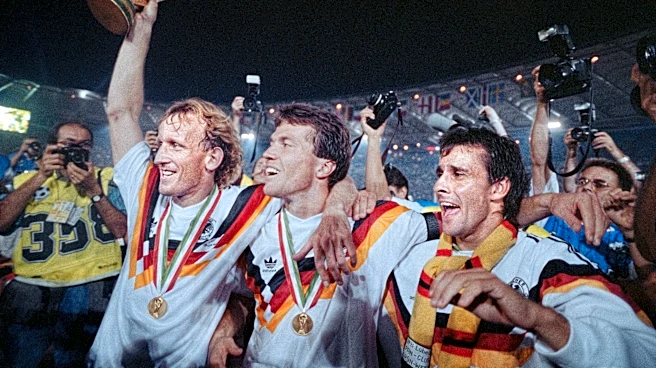
For West Germany, it was third time’s the charm as it won the World Cup after three attempts. After falling short in 1982 and 1986, they finally managed to get their hands on the World Cup trophy. A tearful Maradona shifted the blame to referee Codesal, but he simply won’t admit that he and his side were bested for the first time in a while.
For both countries, however, it would also be a long wait for their next World Cup triumphs; one of them would even cease to exist.
Join the conversation!
Sign up for a user account and get:
- New, improved notifications system!
- Fewer ads
- Create community posts
- Comment on articles, community posts
- Rec comments, community posts