

Baseball careers are often remembered for a single moment. Sometimes it’s a walk-off hit or a championship performance. Other times, it’s even more strange. Like a game stopped by controversy, resumed weeks later in an empty stadium, and remembered forever for a bat covered in pine tar and a player charging like a bull out of the dugout.
Mike Armstrong was the winning pitcher in one of the most famous games in baseball history.
That moment of notoriety did little to help him once he arrived in New
York, where his Yankees tenure became defined less by what happened on the field and more by a public feud with both his owner and his manager. Perhaps it was the memory of that one game or perhaps he was just an unfortunate victim of the Steinbrenner and Martin feud.
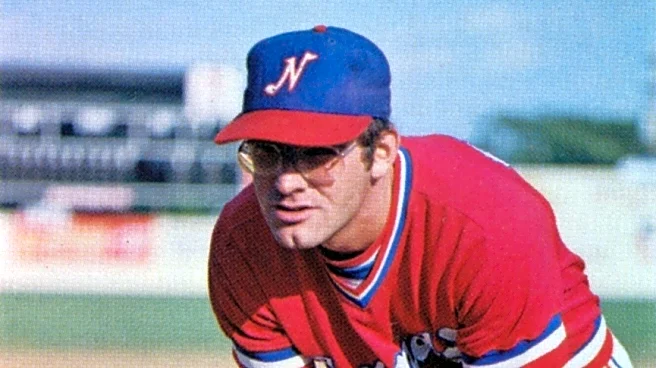
Michael Dennis Armstrong
Born: March 7, 1954 (Glen Cove, NY)
Yankees Tenure: 1984–86
A native of Glen Cove on Long Island, Armstrong’s path to the majors was anything but direct. Drafted out of high school in 1972, he chose instead to attend the University of Miami before becoming a first-round selection of the Reds in the 1974 MLB Draft. Years of minor-league development followed before he finally got a cup of coffee in the majors with the Padres in 1980.
Armstrong was never a flamethrower. He built his career as a reliever through durability and adaptability, pitching wherever managers needed a few innings grinded out rather than dominating with overpowering stuff. After early seasons spent moving between the majors and minors, he found stability with the Kansas City Royals in 1982 and 1983.
That stability produced perhaps the best season of his career. In 1983, Armstrong appeared in 58 games, won 10 contests, and logged more than 100 innings out of the bullpen with a 3.86 ERA. More importantly, he found himself at the center of baseball history.
On July 24, 1983, the Yankees and Royals played what would become known simply as the “Pine Tar Game.” George Brett appeared to hit a go-ahead home run off Goose Gossage before Yankees manager Billy Martin argued that Brett’s bat contained excessive pine tar. Home-plate umpire Tim McClelland’s ruling erased the homer, chaos followed, and Brett famously stormed onto the field in protest. The game ended in confusion and was later ordered resumed by American League president Lee MacPhail nearly a month afterward, with only four outs left to play in an empty Yankee Stadium.
Armstrong, who had pitched earlier in the original contest, was ultimately credited with the victory (retiring a young, pinch-hitting Don Mattingly as part of his two innings of work). Few pitchers have ever earned a win under stranger circumstances.
“It was wild,” Armstrong later recalled, describing returning to finish a major-league game in complete silence, dressed in uniform with no fans present. The bizarre victory became the defining highlight of his career. And within months, he was actually traded to New York.
In December 1983, the Yankees acquired Armstrong from Kansas City in a deal that sent slugging first baseman Steve Balboni to the Royals, a move that quickly began to unravel. Armstrong arrived at spring training in 1984 with arm soreness, prompting owner George Steinbrenner to publicly complain that the Yankees had received “damaged goods.” Steinbrenner even appealed to commissioner Bowie Kuhn in an attempt to void the trade.
The appeal failed, but the damage was already done. Before Armstrong threw a meaningful pitch for the Yankees, his owner had openly questioned whether he belonged on the roster at all. He did not make his Yankees debut until June 16, 1984 (which happened to be Lou Piniella Day and the end of the Yankee great’s playing career).
When Armstrong finally took the mound, he performed reasonably well — especially after shaking off the jitters of the two-run debut above. Across 36 relief appearances that season, he recorded a 3.48 ERA and a 4.06 FIP, numbers that suggested a useful bullpen arm capable of contributing to a competitive club. It would also prove to be the high point of his Yankees career.
Over the next two seasons, Armstrong bounced repeatedly between Triple-A Columbus and the Bronx. Roles shifted, opportunities became inconsistent, and any sense of stability proved difficult to maintain. Complicating matters further was his relationship with on-again/off-again Yankees skipper manager Billy Martin.
Martin publicly criticized Armstrong in the press, stating he had never liked him dating back to his Kansas City days and openly questioning his ability to retire left-handed hitters. For a reliever already fighting for innings, the comments created an uphill battle.
“You feel like you’re working against your own manager,” Armstrong later said, capturing the frustration of trying to succeed while lacking organizational support.
The Yankees of the mid-1980s were defined by volatility, constant roster churn, and public criticism from ownership. Armstrong found himself squarely in the middle of that environment. Demotions followed, appearances became sporadic, and at one point he openly requested his release, believing the organization had mishandled his development from the start.
By April 1987, after refusing a minor-league assignment, the Yankees released him. He finished his MLB career later that season with Cleveland, closing an eight-year run in the big leagues.
Armstrong’s career totals — a 19–17 record with a 4.10 ERA — do not immediately stand out on paper. But statistics rarely capture context. He remains forever linked to one of baseball’s most famous controversies, credited with perhaps the most unusual victory a pitcher has ever earned, and remembered as one of the many players who experienced firsthand the intensity of the George Steinbrenner years.
For a hometown pitcher returning to New York, the story never unfolded the way anyone expected or would have hoped. Baseball history often remembers its stars, but just as often it remembers moments and the players caught inside them. Happy 72nd birthday, Mike.
See more of the “Yankees Birthday of the Day” series here.