



The Boston Celtics missed the playoffs in 1970.
They did not glide smoothly down from the Russell years; they fell off a cliff.
They wrapped up the 1969/70 season with a 34-48 record under rookie coach Tommy Heinsohn.
Playoffs? The Celtics missed them for the first time in twenty years.
The following year, Boston improved to 44-38, but still missed the playoffs.
Things were looking up, however.
By the third year of the Post-Russell era, the Celtics were 56 game winners, and they advanced as far as the Eastern
Conference Finals on the back of second year players Dave Cowens and JoJo White, third year player Don Chaney, and veteran players John Havlicek and Don Nelson.
The Celtics lost the Eastern Conference Finals to the Knicks in a gentleman’s sweep of five games in 1972.
In 1973, the Celtics won a franchise record 68 games and added another veteran contributor in Paul Silas, but lost to the Knicks in a seven game affair that saw the green and white claw their way back from a 3-1 deficit, only to fall, at home, to the eventual champs.
Regular Season

1974 saw the Celtics win 56 games again, but, tellingly, their longest losing streak during the regular season was just two games. They started the season hot, running out to a 16-3 record, and were on pace for 60+ wins at the All-Star break. Things slowed down a bit in the second half of the season, but Boston’s record was still good enough for first place in the Atlantic Division and the top seed in the Eastern Conference.
Looking at the season-long tallies, the Celtics were good, but not elite—they didn’t lead the league in points per game, points per 100 possessions, or, on the opposite end of the court, points allowed per game or per 100 possessions. Despite having a reputation for running the court under Heinsohn, the Celtics were only 5th of 17 in terms of pace. Their net rating was only the third best in the league; behind the Detroit Pistons and the Milwaukee Bucks, who were playing in the absolutely stacked Midwestern Division—the NBA had four 50 game winning teams in the 1973/74 season, and three of them were in the four team Midwestern division.
Any prognosticator with a decent head on his shoulders would’ve given the title to the Milwaukee Bucks, who came out of the league’s toughest division, bar none, and were led a young center who was already an absolute force to be reckoned with: Kareem Abdul-Jabbar.
Eastern Playoffs
Boston’s first round opponent was the Buffalo Braves, a recent expansion franchise led by Bob McAdoo, whose 30.6 points per game average was the best in the league. The team also had Ernie DiGregorio, who would win Rookie of the Year honors and a future Hall-of-Famer in Jack Ramsey calling shots from the bench. All of which suggested that, despite their 42-40 record, the Braves were going to be a ‘tough out’
At this time, playoffs within the conference alternated home and road, and through the first five games, home court held sway. Buffalo was playing to a packed house in the cavernous Buffalo Memorial Auditorium, where they won game two by ten points and game four by two.
Buffalo outscored Boston by three in the second quarter of game four to take a 51-48 halftime lead. Boston won the third by five points, setting up a barn-burner of a fourth quarter, with each team recording game-high point totals.
Buffalo was clinging to a two point lead with just 15 seconds to go when Jim McMillan lost the ball to Havlicek and Cowens; Cowens converted the steal into a game-tying basket with just nine seconds left. In a dog’s breakfast of a play that was drawn up by Ramsey and blown up by Hondo attempting to draw a charge, the ball bounced out to Bob McAdoo who had scored 15 of the Braves 30 points thus far in the quarter. His fifteen footer missed, but Jim McMillan was there to tip it in as time expired. The game was a classic with 28 ties and nine lead changes, but it went the wrong way for the Celtics and their fans. Bob McAdoo’s 44 points was almost as high as the 46 points notched by Boston’s two leading scorers, Havlicek and Don Nelson (22 and 24 respectively).

Game five saw Boston hold on for a three point win, giving them a 3-2 advantage that they brought home with a game six win. That game six win was a nailbiter that probably shouldn’t have been. Legendary Globe reporter and columnist Bob Ryan called it “another one of those Celtics down-the-stretch specials,” adding, “the Bostonians build up a lead in the fourth quarter and try to protect it by giving the other team 437 chances to get back in the game.”
The Celtics nearly squandered a nine point lead in the closeout game. With a 104-100 lead and twenty seconds on the clock the Celtics had two clumsy turnovers turn into four points by Bob McAdoo, tying the game. Unfortunately for McAdoo on the final possession of the game, he blocked a Havlicek shot, but fell victim to a pump fake by JoJo White that sent him to the line where he calmly delivered the winning margin with two free throws.
From this point, it might have been expected that the Celtics would face an extreme test in the next round, as they faced off against the defending champs and the team which had eliminated them in the conference finals each of the past two years.
As it turned out, the Knicks were no match for the Celtics. Boston outscored the Knicks by 50 in a five game matchup where their closest margin of victory was seven points.
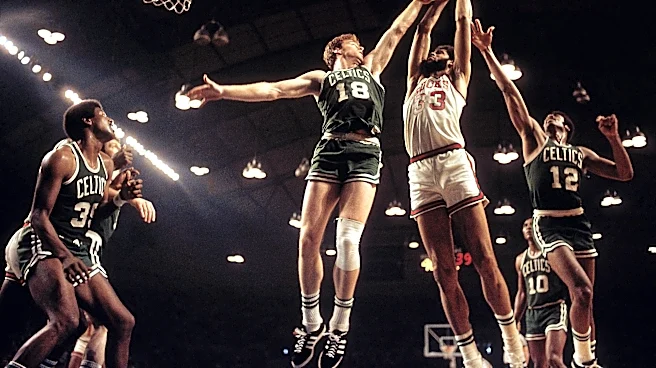
That set up a Finals contest against, to no one’s surprise, the Milwaukee Bucks.
NBA Finals

The Bucks had cruised to the Finals with an 8-1 record over the first two rounds, and an average margin of victory of 14.67 points.
The Celtics were not the odds-on favorite to win this matchup. Heck, even Bill Russell, by then the head coach of the Seattle Supersonics, picked the Bucks to win.
But Bob Ryan saw things a bit differently. Before the series started, Ryan noted that the Bucks were pretty much a one-man show, and predicted that the Celtics would win in six.
Ryan noted that the Celtics were excellent at applying full-court pressure to the other team’s ballhandler, and with the Bucks relying on an aging Oscar Robertson, the Celtics figured to take him out of the picture, leaving everything on the shoulders of Kareem.
And Kareem was so good at this point in his career, that they dang near pulled it off.
Game one was a cakewalk, as the Celtics cruised to a 16 point first quarter lead and spent the rest of the game playing keep away from the Bucks, with the final score coming to 98-83. Kareem scored 35 points, which was almost as much as the Bucks’ next four highest scoring players combined (12, 12, 6, 6), as the Celtics strategy of putting everything on Kareem’s shoulders paid off in the opener.
Game two was an overtime classic. Boston came into the fourth quarter with an eleven point deficit. They closed it and had two chances to steal two games from the Bucks in their home arena, only to have a shot by Cowens blocked by Jabbar with eleven seconds to go. Hondo’s shot with three seconds to go off the rebound of Kareem’s block, missed the mark as well.
In overtime, the Celtics, exhausted by the effort required to come back, were outscored 15-6 as the Bucks ran away with it.

Game three went to Boston, as the Celtics once again notched a double-digit victory with a 95-83 final score. Cowens stopped trying to challenge Kareem in the paint and used his skills as an outside shooter to tally 30 points. Boston’s full court press, as predicted by the Globe’s Bob Ryan, was crucial, with the Celtics forcing eleven turnovers in the first quarter alone and 27 for the game.
Game four went Milwaukee’s way as Kareem scored 34 points and the Bucks tied the series 2-2 off an 89-97 final score.
While the Bucks may have been dismayed that they were tied with the Celtics, they at least held home court advantage for the remainder of the series.
That advantage lasted right up until the tipoff of game five. Kareem scored 37 points in the contest, which was a series high for both teams, but Boston held a 20-15 advantage after the first quarter, and they won every succeeding quarter except the second, on their way to a 96-87 victory. The Celtics now had a chance to close out the heavily favored Bucks at home in game six.
Things didn’t quite work out that way, but the game was an instant classic just the same.
As had happened earlier in the series, Cowens got into foul trouble, picking up three early in the game, and the Bucks built a lead that was as high as twelve points in the first half. The C’s entered the fourth quarter down six, but Boston fought their way back, with Hondo hitting a jumper from the right side that tied the game at 86 and less than a minute to go. When Boston forced a 24 second violation on the following possession, the game headed into overtime.
Overtime was tight, with both teams scoring just four points apiece. Milwaukee was up two, 88-90, when a Don Chaney steal led to Havlicek missing a shot and then making another after he snagged his own rebound.
The second overtime was as loose as the first overtime was tight. Over just four minutes of play, the two teams combined for 23 points. Havlicek, who had been instrumental in getting the Celtics this far scored nine of the team’s eleven points in this period.
It was almost enough.
Dave Cowens fouled out and the Bucks pushed to a 100-99 lead. With less than 24 seconds left and Heinsohn desperately trying to get a time out called, Havlicek came through again, arcing a jump shot through the net for a 101-100 lead. But there was still a little bit of game left. Just enough for Kareem to turn a skyhook into a 102-101 advantage. It was good enough, and the Celtics were headed back to Milwaukee and a do-or-die game seven.
In the decisive game of the series, Tommy Heinsohn made a major adjustment to his defensive strategy.
This was no longer a seven game series in which it would be difficult for Kareem to carry the Bucks to victory.
This was a single 48 minute contest, and one which could hinge on the play of just one man.
Heinsohn’s solution was to throw the kitchen sink at him.
With Cowens getting into foul trouble twice in the series already, Heinsohn wanted anyone and everyone within hooting distance of Kareem’s height to cover him—and Kareem found himself double and even triple-teamed during the course of the game.
The result was a 26 point outing from Kareem, which was more than offset by Cowens’ 28 points, as the Boston center, relieved of some of his defensive duties by the heavy Celtics coverage of his counterpart, was able to play with more energy on offense.
The Celtics were never challenged in game seven, as they cruised to a 15 point victory on Milwaukee’s home court.
Turning Point
The turning point was Heinsohn’s strategy of concentrating nearly all the team’s defensive effort on Kareem in game seven. Kareem was held to a series low with 26 points, and looked, if not exactly human, closer to human than he’d looked up to that point. Bob Ryan’s take on the Bucks as a one-man team was more or less justified, as the rest of the Bucks struggled to score. The next leading scorers after Kareem were Mickey Davis with 15 and Bob Dandridge with 14. In fact, the difference between the two teams basically came down to the Celtics putting one more player in double figures than Milwaukee.
It Wasn’t Over Until…
The Celtics continued their tradition of winning game sevens. Russell was, famously, 10-0 in these games, and the Celtics proudly carried on the tradition of playing up to the moment in these winner-take-all contests.
When the dust settled, the Celtics had won their first championship since Russell had hung up his sneakers, and the first of Tommy Heinsohn’s career as a coach.
Banner Years continues tomorrow with the Greatest Game and the Celtics’ path to Banner 13.