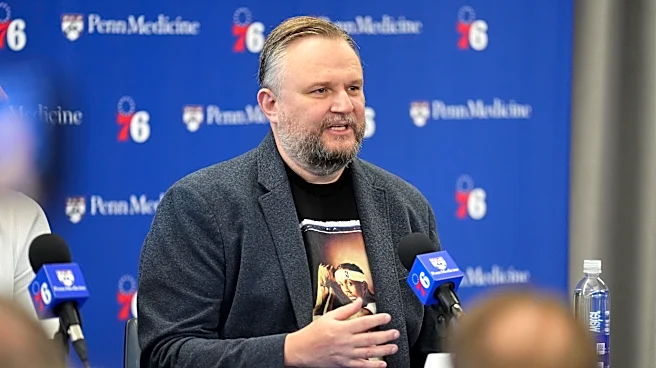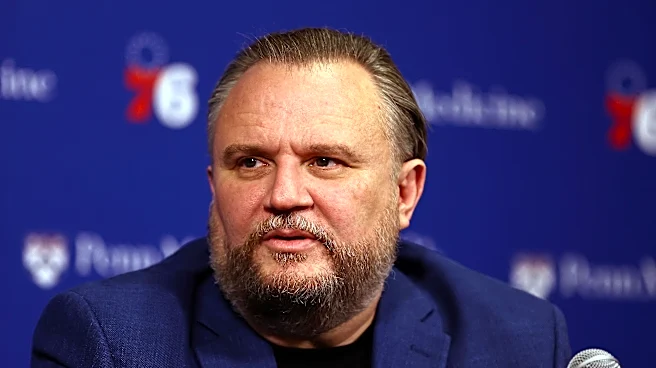






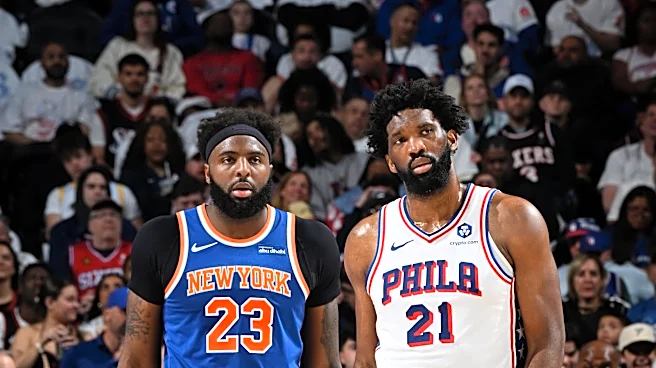
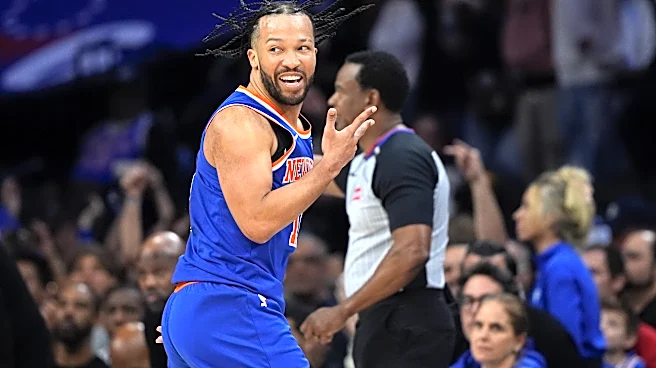
When Daryl Morey was hired by the Sixers as president of basketball operations immediately following the NBA bubble in 2020, Philadelphia fans rejoiced. It felt like a savior was joining the front office to right the ship and deliver the championship Morey’s former colleague Sam Hinkie longed for when facilitating The Process.
Morey was handed a starting five of Ben Simmons, Josh Richardson, Tobias Harris, Al Horford and Joel Embiid, a group designed to compete in the early 2000s, not the three-point
and space-heavy offense the league was trending towards at the turn of the decade.
Fast forward to 2026, Embiid and Morey were the only two remaining from that original group, and the Sixers have still not made it out of the second round of the playoffs.
And now, Morey is gone. The team announced on Tuesday they’ve parted ways with the long-time executive after six seasons.
Unfortunately, the Sixers find themselves in a dire cap situation that leaves very few doors open in terms of drastically changing the roster for next season — in large part thanks to Morey and ownership.
But first, the things that Morey could not control that led us here:
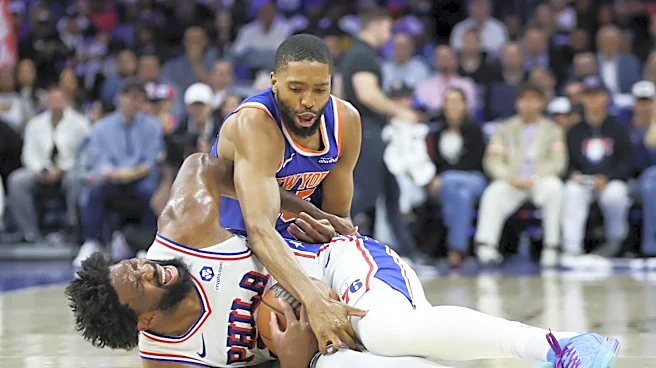
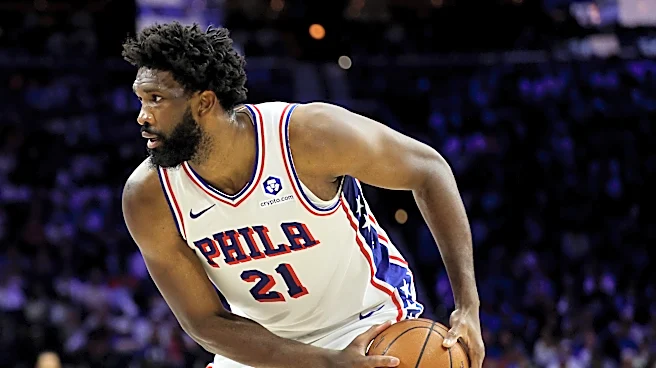
- Embiid’s health was perhaps the biggest factor into yet another unsuccessful season in 2025-26. The center missed 44 games during the regular season and three games in the playoffs. Even with the unlucky nature of the injuries, having your highest-earning player’s status be so unpredictable on a game-to-game basis makes the job for any executive more difficult.
- Paul George was suspended 25 games during the middle of the season for violating the terms of the NBA/NBPA Anti-Drug Program. Yes, the rest might have led him to perform at a high level during the playoffs. But who knows how helpful George would have been during those games to earn a higher seed in the East, perhaps avoid the Play-In and tougher side of the bracket altogether? The Sixers went 13-12 in the games he missed, where four losses were within a 15-point margin.
- Tyrese Maxey injured his right pinky finger on March 7 against the Hawks late in the game after a collision with Adem Bona. He missed 10 games and the Sixers went 6-4 without him thanks to a relatively light schedule during that stretch. Although he put on strong performances after returning, it appeared to bother him and affect his shot selection in round two against the New York Knicks.
With regards to these uncontrollable factors, almost every other failure from the Sixers season can be attributed to Morey’s actions — or inactions — when constructing the roster.
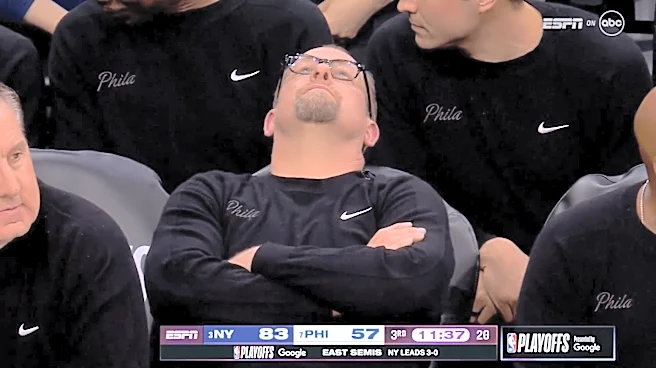
It was hard to ignore the team’s most glaring issue this playoff run — depth. Between both the Celtics and Knicks series, the Sixers’ bench got outscored 394-224. No one on the bench scored more than eight points in any game against New York, as Nick Nurse heavily relied on his starters.
The issue for Morey is when you canvass the league and spot a full playoff-caliber bench unit of former Sixers that he let go for one reason or another, and think what a series of miscalculations and misevaluations he made.
Julian Champagnie was on a two-way deal with the Sixers in 2022-23, spent most of the season with the Delaware Blue Coats and averaged 14.3 points, 5.7 rebounds, 2.5 threes, 1.9 assists, 0.9 blocks and 0.6 steals in 18 appearances. He also showed in two games for the Sixers, not making a shot on two attempts. He was waived on Feb. 14, 2023.
Although the numbers don’t necessarily pop, it’s the motive behind his release which draws ire with the front office’s decision-making.
It would have taken some optimistic projecting from Morey to foresee just how valuable Champagnie is to the Spurs’ current day team, but no GM in the league would have given Mac McClung (a 6-foot-2 guard who can’t shoot) a higher chance to stick in the NBA over Champagnie (a 6-foot-7 wing who can rebound and had shooting potential). McClung won the Slam Dunk contest in a Sixers jersey that season, but has played in 15 NBA games in the years since. Champagnie started 68 games for a 62-win team in 2025-26.
Champagnie was signed by the Spurs on a two-way contract just two days after he was waived by the Sixers. In this year’s playoffs, he has been one of the best shooters in the league and has been the second-leading rebounder on the team behind Victor Wembanyama, naturally.
Isaiah Joe was drafted in the second round by the Sixers in 2020, Morey’s first draft in Philadelphia. He signed a three-year deal and was instantly one of the best shooters on the roster. He played 41 games his rookie season, shooting 36% from three. His second year, he played 55 games and shot 33% from three, but saw only 11 minutes per game under Doc Rivers.
Morey chose to cut Joe before the 2023-24 season for roster flexibility amidst a crowded depth chart, and likely as a way to get under the luxury tax. Tyrese Maxey, De’Anthony Melton and Danuel House Jr. were the guards rostered at the time. Morey spent three second-round picks to acquire Buddy Hield at the trade deadline that season, a player with a very similar skillset to Joe. Hield had mixed results as a Sixer, to say the least.
Joe got picked up by the Oklahoma City Thunder and immediately saw a jump in playing time and his shooting splits from deep. Joe has always been undersized, but he flashed potential and always gave effort defensively. Playing in a system like the Thunder’s has allowed him to blossom into a lethal bench weapon that we are seeing in this year’s playoffs.
Paul Reed (aka Bball Paul) was drafted by Morey late in the second of the 2020 draft. Thanks to Rivers, we did not see many minutes of Reed until the end of the 2022-23 regular season and playoffs, where we saw real flashes of his extreme athleticism. Eventually, he morphed into a reliable backup big man for Embiid the following season, playing all 82 games in 2023-24 and having a strong playoff run as Embiid recovered from a sprained LCL.
By no means was Reed a perfect player as he was susceptible to some questionable decision making, but his physical presence on the glass and in the paint could not be denied and he flashed plenty of skill.
The Sixers waived him in the summer of 2024 for … cap flexibility. The $7.7 million Reed was slated to earn that year from the Sixers was non-guaranteed, so the Sixers used part of that money to help them sign Caleb Martin. The following trade deadline, Morey traded Martin to the Dallas Mavericks for Quentin Grimes.
Reed is now a valuable member of the Detroit Pistons, who earned the No. 1 seed in the Eastern Conference this season. Despite spot minutes in the playoffs, the Pistons have outscored their opponents by 11 when he is on the court.
Jared McCain, the 16th overall selection in the 2024 draft, was traded to the Thunder before the deadline for the 22nd overall pick in the 2026 draft and three second-rounders. As a rookie in 2024-25, McCain exploded in the regular season for 15.3 points, 2.6 assists and 2.4 rebounds per game on 38% shooting from deep before tearing his meniscus in December.
As he recovered, fans were enticed by the idea of seeing McCain with a healthy and regrouped roster after the doldrums of the 2024-25 season in Philadelphia. Unfortunately, McCain tore the UCL in his right thumb during training camp, leading to minimal playing time and trust amongst the coaching staff once he recovered and required time to shake off the rust.
McCain is now thriving with the Thunder, creating runs on his own with a scorching microwave scoring ability in the playoffs. He is leading the NBA in playoff three-point percentage amongst remaining teams at 54.2%. Hindsight is obviously 20/20, but McCain’s performance is making Morey’s decision look worse:
“I’m quite confident we were selling high,” Morey said. “Obviously, time will tell. We weren’t looking to sell. I’ll be frank. Teams came to us with aggressive offers for him. You could say, ‘Yeah, that’s because he’s a good player.’ I agree with that. We thought this return was above, for the future value of our franchise, what we could get. The only higher point would’ve been during his run last season. Otherwise, we feel like we did time this well.” (click here for more)
Whether you agree with each decision given the context is one thing, but to ignore the idea that if even two of these four playoff-level role players were still on the Sixers, there’s a chance this year’s playoff run — and future outlook of the team — looks much better from a depth perspective.
Instead, Morey has shackled the Sixers from a cap standpoint, signing George to a max contract through the 2027-28 season, then extending Embiid on a max deal with a player option for 2028-29. This means the Sixers now have almost 90% of their cap space tied to three players; the aforementioned two and Maxey.
They are $14 million under the luxury tax, meaning they will likely be able to only re-sign one of their three outgoing unrestricted free agents — Quentin Grimes, Kelly Oubre Jr. or Andre Drummond. Outside of that, the team will have to work around the margins with the non-taxpayer mid-level exception (if they still below the tax), worth $15 million, and minimum contracts. That does not sound like a path towards bringing in a playoff-caliber bench unit, at least not through free agency.
The new executive in charge should not trade Embiid, as doing so could include attaching draft assets, which could randomly end up in the top five given the new draft lottery odds. Barring an obscene act of desperation, this seems unlikely according to many reports.
Trading George might not be an awful idea, as long as it does not jeopardize the team-building capabilities down the line, especially for when Maxey and VJ Edgecombe are both in their primes concurrently. Finding a trade partner with a salary close to George’s might be worth another post in its entirety.
The new front office should have its sights on the draft, where Morey had a strong history running the war room for the Sixers. Click here to see some prospects Harrison Grimm has circled for the Sixers at pick 22.
For the mess Morey seemingly saved the Sixers from in 2020, he has thrown them right back in it for the 2026 offseason. Even with Morey gone, it’s worth noting the issues in front of the Sixers will be there no matter the man or woman tasked in captaining the ship. The question becomes which direction Josh Harris wants to go?
There could be a repeated run-it-back strategy with two of the riskiest players in the NBA from a health standpoint for as long as their talent sustains. With Harris deciding to start fresh, it could suggest a shift to the younger portion of the roster, building around Maxey and Edgecombe, without pressure to contend. Or maybe the dual timeline continues … for now.
Daryl Morey didn’t turn out to be the savior who got the Sixers back to the Eastern Conference Finals for the first time since 2001.
And now his successor has a lot to clean up.