
One of the least popular opinions that I’ve shared on Turf Show Times was that the Los Angeles Rams might regret not going for a tie against the San Francisco 49ers in Week 5 . My argument was simple:
If it was Week 18 instead and you knew that a tie would win you the NFC West division, would it make sense then? If your answer is yes, as it obviously should be, then the value of ties should be considered through the entirety of a season. Not just when it’s obvious.
Well, you can’t know if a tie will play that big of a role that early in the season, but coaches should still consider the possibility that it might, especially against a division rival in a race that you know will be close all season. And now here we are facing the consequences of losing to the 49ers instead of tying:
If the Rams had tied the 49ers in Week 5, they would still be in the running to get the Number One seed in the NFC.
Instead, L.A. is locked into either the 5 or the 6 and they’re letting the 49ers and Seahawks decide who gets to win the division and be in a power position of a bye week and homefield advantage throughout the playoffs.
A tie, which McVay said was never going to be a consideration, would have not only avoided a costly loss for the Rams, it would have also prevented the 49ers from getting a valuable win over a division opponent. And that’s the reason that L.A. has very little to play for relative to San Francisco and Seattle.

Despite arguably being the best team in the division, if not the NFL, the Rams are stuck in third place and that’s where they could stay going into the playoffs.
But if the Rams had tied the 49ers in Week 5 and everything else stays the same, then they would only need to beat the Falcons and Cardinals, plus a 49ers win over the Seahawks on Saturday, and L.A. would be the number one seed in the conference. The standings would then instead look like this:
- Rams, 13-3-1
- 49ers, 13-4
- Seahawks 13-4
No other team in the conference can win more than 12 games. The Rams would be the number one seed.
Instead of that happening though, the Rams can’t do better than a 5-seed and probably going on the road for the entirety of their playoff run.
How probably was a tie — or a win — if the Rams had elected to kick a field goal in overtime against the 49ers instead of McVay’s self-admittedly bad 4th-and-1 play call?
First, the Rams had 4th-and-1 at the SF11 with 3:41 remaining in overtime.
Any claims that even Josh Karty couldn’t have made that 28-yard field goal is just coping. The Rams make that field goal 98% of the time.
So then the Rams and 49ers would be tied 26-26 with under 4 minutes left.
Second, the Rams would need to stop the 49ers from getting into FG range.
Clock wasn’t an issue. But remember that Mac Jones was the quarterback and the 49ers had punted on four of their last eight drives, with the other four drives ending in a FG; one of those FGs was from 59 yards.
It’s probably a 50/50 proposition that the 49ers even get into FG range and then maybe Pineiro needs to make another kick beyond 50 or 55 yards. It’s not a guarantee that the 49ers don’t win the game, but that only matters if the actual outcome of the game had been different:
The 49ers DID win the game. It’s not like the Rams could have done any worse than losing the game. They already lost the game in deciding to call a Kyren Williams run instead of going for the tie. What does it matter if they lose under different circumstances? It’s still a loss. Going for the tie gives the Rams a chance to make a stop (as they had been doing half of the time since Mac Jones went off script) and either win the game or tie.
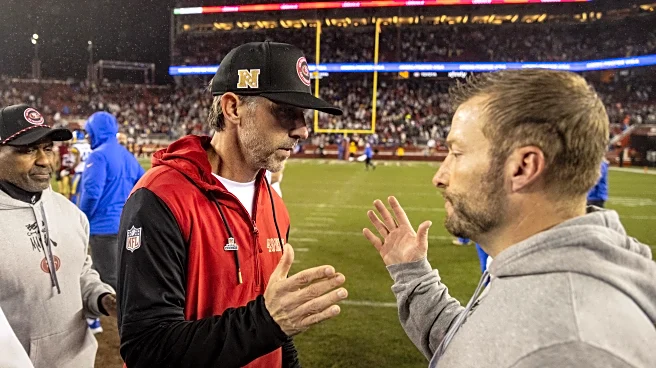
The Rams could have kicked the field goal and still won. They could have kicked the field goal and tied. Either of those outcomes would mean that the Rams are still alive for the 1-seed today. The only outcome that eliminates them is a loss. But McVay was clear after the game that the Rams refused to tie the 49ers:
“We came here to win the football game. (Going for a tie) wasn’t even a thought. The play selection was very poor.”
Not even a thought?
How can it not even be a thought?
It’s easy to have thoughts that you then reject. Just reject it. But at least consider what the outcomes might bring. As I wrote back on October 3rd, plenty of teams in recent history could have made the playoffs or improved their playoff position with a tie instead of a loss. To not consider the possible outcomes of a tie is not just a poor strategy, it’s a lack of strategy. It’s avoiding strategy.
Yes, you should play to win the game. But you should also play to win the division.
By not even considering a tie against a division rival that you know could win the division, it’s not just a fourth-and-1 call to win the battle. It’s potentially a fourth-and-1 call to lose the war.