

In training camp of 1968, the Bears’ brass decided that the team’s steady increase in Black players necessitated a new team captain who was Black. Three club leaders made the call to name veteran cornerback Bennie McRae a captain: team president and GM George “Mugs” Halas Jr., head coach Jim Dooley and Paul Patterson.
And you’re likely wondering: who is Paul Patterson?
“I’m honored that someone has taken the time to bring Paul into the light to do a story on him,” Bears great Jim Osborne says today.
“I thought he served such an important role during the time but was never given the fanfare.”
Paul Patterson worked for the Bears from 1967 to 1974, garnering respect and fondness from everyone in the organization from George Halas on down. Yet despite his friendship with Halas, Patterson does not appear in Halas’s 1979 autobiography nor in Jeff Davis’s Halas biography Papa Bear. He isn’t in any of Richard Wittingham’s excellent Bears history books, nor is he in the Chicago Bears Centennial Scrapbook, the team-produced history book published for the 100th season in 2019.
He pops up in Gale Sayers’s 1970 autobiography I Am Third, Dick Butkus’s 1997 autobiography and Jeannie Morris’s 1971 biography of Brian Piccolo, but seemingly nothing more recent. He was never in the team photo.
He was unlisted in the team’s media guide in 1967 and 1968, listed as “Player Relations” for four years and “Traveling Secretary” for the next two. Simply put, from 1967 to at least 1974, Patterson served as the team’s Director of Player Relations, and was often called a team scout. The connection between those roles was the biggest reason why he was hired: to serve as the liaison between management and the team’s rising population of Black players, from six in 1960 training camp to 16 in 1967 when Patterson came to the Bears to 25 in 1973, over 50% of the roster.
“A Black player comes up to the big city — he’s never been anyplace, maybe, except one small college, and he’s lost,” McRae said in August of 1968. “He doesn’t know where to go, where to live. He’s not white. It’s different. Maybe he’s got a family. And it’s hard.”
“Paul had a great relationship with all the guys on the team but he had a unique relationship with the guys of color, especially with someone like myself coming to Chicago and growing up in Hollywood, Florida, and going to school at Southern University,” says Osborne, who was drafted by the Bears in 1972 and spent his entire 13-year NFL career in the Navy and Orange. “I had never really been to the big city. So when I was drafted and ended up making the team, you would have a small conversation with Paul, and Paul would let you know some of the things that you didn’t want to be caught up in.”
“He was a very important part of the Bears,” says Patrick McCaskey, Bears secretary and board member. “The players knew that they could come to him and talk about anything and he would counsel them.”
Patterson, who died in 1982, has been largely lost in Bears history. But during an era of great change in professional football, Patterson was a central figure, a person whose contributions to the Bears were part of a larger trend of racial evolution in the NFL.
“I felt comfortable that if there was something going awry, if I could get in touch with Paul, I felt it would be okay,” Osborne says. “If a guy found himself in a pickle, he needed to call Paul.”

The historic friendship of Paul Patterson and Buddy Young
There’s a great photo from a Chicago New Year’s party showing five men ringing in 1971, a photo that defines the gap between being known and being famous.
The photo shows Jesse Owens and Gale Sayers, so famous that you only need their names. Ralph Metcalfe is there, the famed Olympic sprinter who won a gold with Owens in the historic 4×100 relay in Berlin in 1936 and was days away from being sworn into the U.S. House of Representatives. On the right side of the photo is Dr. G. LaMar Harrison, whose 20-year term as president of Langston University was then the school’s longest.
The fifth man in the photo is Patterson, widely known in his own circles and much less known elsewhere.
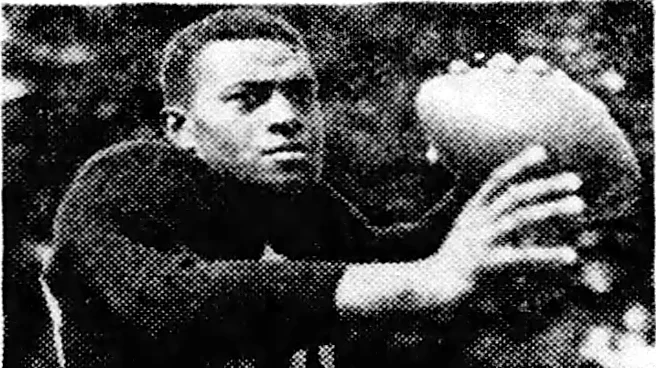
Born in Aurora, Illinois, on Feb. 16, 1927, Patterson’s life story hit upon one Illinois or Chicago hallmark after another. He starred at East Aurora High School as a passing and punting halfback, was a guard on the basketball team and a track-and-field champion in the discus throw and shot put. He joined the University of Illinois football team in the fall of 1944 and paired in the backfield with the one and only Claude “Buddy” Young.
The partnership with Young illustrated how Patterson so often excelled while remaining under the radar. Before he reached Champaign, Buddy Young was not just a Chicago legend but a national sensation in both track and football whose electric play at Wendell Phillips High School garnered banner headlines in the Tribune and Defender and once made him the gate attraction at Soldier Field.
Young would be described throughout his football career as the “fastest human,” “most dangerous runner” and “greatest ball carrier of all-time.” So it is no small feat that Patterson was gifted enough to be known with Young as The Touchdown Twins. In 1945, both men enlisted in the Navy and were stationed at the Fleet City, California, Naval Training Station, leading the Fleet City Bluejackets to an 11-0-1 record, the 5’11 Patterson a bruising lead blocker for the 5’5 Young.
The two returned to U. of I. for 1946, leading the Illini to the school’s first ever Rose Bowl appearance and a 45-14 thrashing of UCLA. While Young’s two touchdowns earned him co-MVP honors, Patterson scored too and gained 56 yards on 11 carries.

The two diverged after the Rose Bowl — at least on the field. Patterson played two more years for the Illini and then one year of pro ball with the Chicago Hornets of the new All-America Football Conference in 1949. The AAFC folded and Patterson was drafted by the juggernaut Cleveland Browns in the dispersal draft. He instead returned to U. of I. and earned his bachelor of science degree.
Young’s football career, meanwhile, was only just beginning. He turned pro after the Rose Bowl and went to the AAFC, the start of a celebrated nine-year career across both leagues. He played in the AAFC championship game in ‘47, earned an NFL All Pro selection in ‘51 and a Pro Bowl berth in ‘54 with his final team, the Baltimore Colts. Young retired before the 1956 season and moved into the Colts front office in public relations and as a part-time scout.
“Teams started to hire former players as scouts,” says NFL historian Ken Crippen, author of a forthcoming book on the history of scouting in professional football. “They would be listed as scouts, but usually had other responsibilities such as public relations. This way, the teams not only could get a foot in the door at HBCUs but also have them in front of the media.”
By 1958, the NFL had its first full-time Black scout — Lowell Perry of the Steelers — and was down to only one all-white team. Then the AFL launched in 1960 and did to the NFL what the AAFC did in the 40s: created an arm’s race for players that vastly increased the number of roster spots for Black players.
Yet the AFL did something else: it increased the number of Black scouts and team executives. In 1965, Pete Rozelle hired Buddy Young into the league office. Among his roles would be to help the NFL beat the AFL in battles to sign top rookies, something he did in a big way in the fall of ‘64 when he convinced University of Kansas superstar Gale Sayers to join the NFL’s Bears over the AFL’s Chiefs.
Upon delivering the Kansas Comet to the Monsters of the Midway, Young plugged Gale and Linda Sayers into the Chicago community through a dear friend: Paul Patterson.
“Buddy introduced us to Paul and Shirley Patterson the day I signed my contract,” Sayers wrote in I Am Third. “They were really the first people we met when we moved to Chicago. They got us settled in an apartment and they’ve been our closest friends ever since.”

Director of Player Relations: Paul Patterson comes to the Bears
Gale Sayers entered a vastly different NFL from the one that Buddy Young left. In Young’s final playing season of 1955, 14.3% of players were Black. Ten years later, in Sayers’s rookie year, that figure was 24.5%. With that demographic shift in mind, Young wrote a memo in August of 1966 that would further alter the NFL — and ultimately contribute to the Bears hiring Patterson.
Titled “Some Observations on the NFL and Negro players,” Young’s five-page memo delivered a seven-point plan for NFL teams to build internal programs “with regard to Negro players in order that maximum benefits may accrue to all concerned.” Young’s first recommendation was that every team should have “at least one full-time front-office man, perhaps the assistant player personnel director, who is a Negro.”
Commissioner Rozelle delivered the memo to all 14 teams with this note: “Enclosed is a memorandum prepared by Claude (Buddy) Young of the Commissioner’s office. Please give it your careful consideration.”
Among the franchises that appear to have done so are the Bears. The team hired Patterson on February 20, 1967; the AP reported that Patterson would “assist in scouting college players as well as work on job placement, counseling of new members of the team and general personnel relations.”
This made Patterson the first longstanding Black employee, and first Black executive, in Chicago Bears history.
“Paul Patterson behind the scenes played a larger role in all aspects than he was ever given credit for,” says Don Pierson, dean of Bears history, who first covered Bears games for the Tribune in 1969. “He was a very friendly guy. Very erudite guy. He gave them some kind of cachet among the players for sure, because he would have been the only Black face in the whole organization outside the players.”
“You would look up after practice and he was there,” Osborne says. “All of the (social events) you went to, he was there. He was kind of in the shadows but you knew you could get in touch with him.”
In this burgeoning world of NFL player relations, Patterson was perfect. His Illini career meant that players knew he understood them, and his business career meant they knew he could help them. He joined Anheuser-Busch in the mid-1960s as a sales rep and seemingly ensured that any position of influence he held facilitated community service. Over Christmas of 1965, Patterson was part of a team of Anheuser-Busch executives who distributed meals and Christmas baskets to over 50 families.
“He always had a suit on — I never saw him without a suit,” Pierson says. “He was very immaculately dressed and groomed. I think he carried a briefcase a lot of places. He looked like an executive from Anheuser-Busch, not a football coach or a scout. But he was very athletic — a well built guy. Very friendly.”
“One day I did something right, and Paul said, ‘You’re finally earning the money,’” McCaskey says with a laugh. “So yes, I remember Paul Patterson.”

Patterson’s wife Shirley was similarly active. Theirs was a marriage that seemed to believe not just in community participation but leadership. Shirley was president of the Chicago chapter of the Moles, president of the Women’s Fellowship, chair of the Chicago unit of the American Cancer Society and benefit chairperson of the United Negro College Fund (UNCF) Women’s Division in Chicago. Paul was president of the Varsity Club of Chicago in the late 1960s and would later serve as chairman of the Illinois State Athletic Board and as a member of the board of directors of the University of Illinois Athletic Association.
These connections made Patterson invaluable to Bears players. During his first year with the team, Patterson paired with Ed McCaskey to find offseason jobs for players.
“He kind of did (his Bears job) on the side but had enough time to do whatever he wanted to because he had relationships with all the important people,” Osborne says.
“He told me to be careful with my money, not to be extravagant,” Sayers wrote. “I remember I had invested part of my bonus in some stocks. And one day I got my first dividend check and didn’t know what to do with it.” Sayers’s solution was simple: go find Paul Patterson. Useful advice in all situations, especially for a young family man new to the city.
“Shirley loves to cook, and she used to invite us over every week for dinner,” Sayers wrote. “They just made us feel at home until we got to know the town. It was especially helpful for Linda, because she really didn’t know anybody and I was away all day at practice or doing something and she was by herself all the time.”
Having a Black scout in the 1960s mattered for all NFL teams, but in Chicago, having a Black guide to the big city mattered just as much. The city’s segregation became a national headline in 1959 when the Report of the United States Commission on Civil Rights concluded that “all the evidence indicates that in terms of racial residential patterns, Chicago is the most segregated city of more than 500,000 in the country.” In Sayers’s rookie year of 1965, Dr. Martin Luther King further reinforced the point, stating that “Chicago is one of the most segregated cities in the U.S.A.”
“I don’t remember the white players having any issue with (Patterson), but I think maybe Halas felt that he needed someone who could go to the West Side, the South Side, and have access to areas where maybe someone not of color would have had more issues,” Osborne says. “I think it was probably smart of Halas to be able to have someone on the team who could keep eyes in a way he wasn’t able to.”

Paul Patterson and the new world of NFL scouting
The scouting history of Pro Football Hall of Famer Bill Nunn of the Steelers and fellow legend Lloyd Wells of the Chiefs is defined by each man’s contributions to championship teams. Wells is credited for scouting future Pro Football Hall of Famers Buck Buchanan, Willie Lanier and Emmitt Thomas, as well as superstar receiver Otis Taylor. All four were members of the 1969 AFL champion Chiefs team that won Super Bowl IV.
Nunn led Pittsburgh’s HBCU scouting that brought 11 members of their first Super Bowl champion, including future Hall of Famers Mel Blount, Donnie Shell and John Stallworth.
Though neither documentation nor memory ties Patterson to any specific Bears draft picks, he was part of the same wave that brought Wells and Nunn to pro football as the NFL prioritized not just scouting Black players but Black schools. In 1968, for instance, Patterson was part of a huge group of pro scouts, Black and white, who traveled to Grambling State to evaluate star quarterback James Harris.
“He was the Director of Player Relations, mainly, and was a scout for the Bears,” Patrick McCaskey says. “My uncle (Mugs Halas) sent him into the deep South, which he questioned doing, but he did it.”
If Patterson is not remembered at the heights of Nunn and Wells, team success is part of the reason. A bafflingly diffuse front office is another. Incredibly, 1968 was both the first year that the Bears hired a standalone player personnel leader — Director of Player Personnel Bobby Walston — and the beginning of its splintered front office. It was Patterson’s bad luck that he was part of the 1969 Bears draft brain trust that debated their first-round pick long enough to blow the timer and drop from 13th to 14th in the first round.
“I remember Dooley telling me that all the coaches and all the scouts had a vote, and they started arguing and went beyond their 15-minute time limit and missed their draft choice,” Pierson says. “It was just chaos.”
Even while Patterson’s title remained “Player Relations,” he was widely involved in scouting and drafting. In 1970, Patterson was one of 11 members of the Bears staff who scouted college players in a mix of bowl games and all-star games. In 1973, he was among the gaggle of Bears administrators at the BLESTO scouting combine, including Mugs Halas, Ed McCaskey, Walston, head coach Abe Gibron and six others.
In 1974, the last draft before the team hired Jim Finks, Patterson and business manager Rudy Custer represented the Bears at Madison Square Garden, passing along the team’s picks from Walston and Gibron at a headquarters in Philadelphia to Rozelle at MSG. The Bears hired Finks that September, and he re-tooled the entire staff, starting with the personnel and scouting departments. Patterson seems to have stayed with the organization a bit longer but was no longer in the media guide. If he was still with the team under Finks, his role was vague.
“He was kind of in the background, and then he kind of faded out,” Osborne says. “I wouldn’t be able to pinpoint exactly his last year. You just looked up one day and you didn’t see him around.”

“He was a great man” — reflections on Paul Patterson
How exactly did Paul Patterson get lost to history?
“Isn’t that something, that we wouldn’t have written anything about him at the time?” Pierson says. “Today, they would have feature stories all the time about Paul Patterson, being the first this or first that, what he did and so forth. Back then, it just wasn’t covered.”
Osborne has strong memories associating Patterson with the Gibron years and less of them under Finks. The Tribune was still crediting Patterson as being part of the staff in 1976 and 1977, but it’s possible that the paper’s staff simply did not realize that the man who worked in the shadows was no longer even in the shadows.
“I don’t know if you know this, but the newspapers didn’t even cover the Bears every day,” Pierson says. “The sports editors considered the Bears their beat, and they played once a week, so they would go to all the games, and they would go to some practices, and they would send young guys like me out to get a couple quotes. But it wasn’t like covering the team.”
Whenever he actually left the Bears, Patterson’s connection with the Halas-McCaskey family continued the rest of his life. In 1978, Paul’s Budweiser and Shirley’s UNCF teamed up to start the Scholarship Golf Tournament in Chicago to support the UNCF and send kids to college; the second annual tournament included celebrity Bears golfers Allan Ellis, Roland Harper and Revie Sorey, and guest tourney chairman Walter Payton. In 1981, the Inner City Liquor Association awarded Patterson “Industry Man of the Year.” George Halas attended the ceremony — a joyful day for both.
“The old man was a very loyal guy,” Pierson says. “I’m guessing he recognized the contribution that Paul made to the team.”
“I thought Paul did a great job,” Osborne says. “He really did well by me and directed me in the right direction that I was able to hang around for 13 years.”
Following an illness, Patterson died June 11, 1982, at the Mayo Clinic in Minnesota. He was buried in Chicago, with services held at Park Manor Congressional Church, 7000 S. King Drive. Halas was among the speakers. Patrick McCaskey attended with his family.
Months after her husband’s death, Shirley Patterson hosted the 5th annual Scholarship Golf Tournament for UNCF in his memory.
“No cause was as dear to Paul as the education of our young people,” she said. “We’re encouraging all of Paul’s many friends in the community to come out and participate in this worthy event.”
In Jim Osborne’s final season, 1984, the team hired Rod Graves as a regional scout. A decade later, Graves would ascend to Bears Director of Player Personnel, making him the de facto GM and the team’s first Black head of personnel. Today, Graves is executive director of the Fritz Pollard Alliance Foundation, leading its mission to promote diversity initiatives throughout the NFL. It’s a legacy that stretches back to Buddy Young. And Lowell Perry. And Lloyd Wells. And Bill Nunn.
And Paul Patterson.
“I thought he served a really great role for the young, Black players coming to Chicago,” Osborne says.
Adds McCaskey: “He was a great man.”

–
–
–
Jack M Silverstein is Chicago’s Sports Historian, Bears historian at Windy City Gridiron, a Pro Football Hall of Fame analyst and author of WHY WE ROOT: Mad Obsessions of a Chicago Sports Fan. Follow his 90s Chicago Bulls book research at readjack.substack.com.
Thank you to the staffs at Ebony Magazine, Jet Magazine, the Chicago Defender and the Chicago Tribune, and the late Gale Sayers, for reporting on Paul Patterson’s life during the 1960s, 70s and 80s. Thank you to Newspapers.com. Thank you to Ken Crippen.
This piece is dedicated to the memory of Rev. Jesse Jackson. Rest in peace.