

Generally speaking, I only deal with offensive skill position players come draft time because they have the largest number of publicly available metrics cataloguing their exploits. However, the Green Bay Packers don’t really need any receivers or tight ends, and if you need a quarterback this year, well, good luck with that. The Packers do need corners, defensive linemen, and edge rushers, and while this appears to be a weak draft class overall, it’s actually pretty deep in those areas. This may
explain why the Packers haven’t done much this offseason (other than signing Javon Hargrave) to shore up the defense.
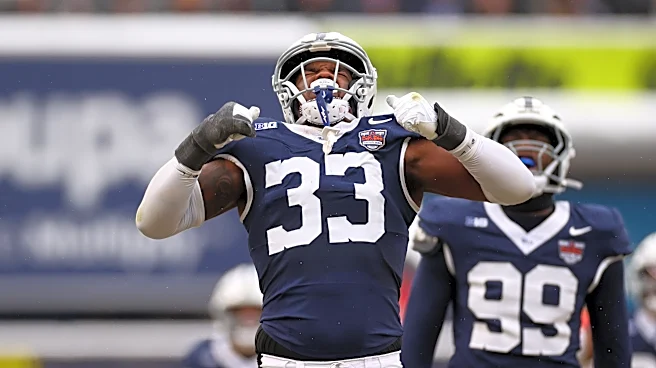
Green Bay has no first-round pick in the 2026 NFL Draft due to the Parsons trade, and so their earliest picks are 52nd overall in the 2nd round, and 84th overall in the third. As a result, I’ve been trying to dig up some undervalued talent that may be available in that general area. I now have a huge favorite who, in all fairness, came to my attention by Tyler Brooke and Justis Mosqueda in their recent Draft Talk episode on the edge rusher class. You should give it a listen as this seems like one of the deeper edge rusher classes I can remember and there’s a pretty decent chance one of them ends up in Green Bay. I hope that player is Dani Dennis-Sutton of Penn State. Even with their second rounder, he would be a steal.
On the NFL Mock Draft Database consensus board he is currently 69th, and in The Beast, Dane Brugler has him as the 13th ranked edge rusher and 60th player overall. He is 67th on the PFF Big Board. It seems that conventional wisdom has him going in the late second or early third, and here I am confused. I just cannot square his production, and athletic profile, and what I’ve seen of him so far with what is almost a third round grade. Pass rushers with this resume almost NEVER last anywhere close to the third round. And the big thing for me is that I don’t disagree with any of Dane Brugler’s criticisms of DDS (New Rule: If you have a hyphenated last name you automatically get the initials treatment). I think Dane is spot on, pointing out that DDS can be too upright and sacrifices leverage, and that he has some trouble shedding blocks. Where I disagree a ton is with his conclusion that “He will be more appealing to teams looking for a ‘high-floor’ role player, as opposed to a “high-ceiling” pass rusher.” I think that’s a weird conclusion for many reasons, so let’s get into them.
DDS is a truly elite athlete
Athleticism isn’t everything, but it’s more important at edge than just about anywhere else, and an elite number contributes to a player’s ceiling. More importantly, DDS’ athleticism pops on tape, especially in space. His acceleration and closing speed is great, and while he occasionally does get stymied, once he does get into the clear he’s on you in a second. He’s also very tall at close to 6-6, with a pretty good wingspan, which helps him close the gap more quickly. His 9.96 RAS shows up on tape.

Penn State is great at creating athletes, but often leaves some room to grow as players

Look at all those 9+ RAS scores since 2022.
That’s 14 total! I don’t know if that’s the most in college football, but over that same time period, Alabama has 9 (and only 4 above a 9.06), Oregon has 9. Even vaunted Ohio State only has 12. (After an extensive search, I believe Georgia has the most with a whopping 25. Goodness.) Anyway, Penn State produces a huge number of elite athletes but there is often still projectability left in the tank in terms of development.
Most of what’s wrong with DDS is coachable
Sometimes you will find a guy with advanced technique and limited athletic ability who can work in the NFL, but there’s usually a ceiling on such players because you can’t coach a guy to be faster, more agile, etc, as much as you can coach technique. Kingsley Enagbare is kind of that guy. In his 2021 season at South Carolina he actually had one of the best pressure rates in college football, but he was working with a 6.21 RAS, and in the pros he settled into a role as a rotational backup. He’s a good, useful player, but strictly a depth player.
Not everyone is great at developing technique, but I’ll happily take a guy from a program that only managed to get 5 sacks out of Micah Parsons in his final season, on the theory that maybe there is still some potential locked in there with better coaching, rather than a less athletic, fully formed player.
Missed Tackles
Back in the 1980s and before, the way that people judged baseball players’ defense was strictly by errors. Errors are a weird stat in the first place, as they require a judgement call from the official scorer, but the big thing about errors is that during the Bill James/Moneyball revolution, a bunch of nerds realized that great shortstops actually tended to make more errors than bad shortstops. The reason this happened is that great shortstops would get to more balls, and therefore more difficult balls, in the first place, often turning them into outs but occasionally making a poor throw or not fielding it completely cleanly, getting dinged with an error as a result. Slower shortstops (some with names that rhyme with “cleric eater”) wouldn’t even get close to the ball, and so a play was instead ruled a hit.
If you look at the DDS PFF grade profile you’ll see that he is dinged pretty hard for missing tackles, with a 49.6 Tackling grade and a 22.9% missed tackle percentage. That’s pretty high, and once again, this actually seems to be pretty true. The thing is, a lot of those missed tackles are similar to this.

This is a pretty fast gif, so here’s a still. Note the outstretched arm.

He’s a long player, and he frequently manages to grab guys over and around his blocker, and sometimes they do manage to get away, but it’s still better than not grabbing them at all! They absolutely are missed tackles, but they’re sort of weird, selection-biasy missed tackles.
The Bad
I think the two worst DDS games last season came on a loss to UCLA (although he did block one of his three punts in that game) and in a win against Nebraska. The problem against UCLA was the mobility of quarterback Nico Iamaleava. DDS lost the edge a few times, giving up huge runs to the UCLA quarterback, and he adjusted by curtailing his aggressiveness. Except on this awesomeness here.

Nebraska did a nice job of double and triple teaming him, and by the end of the game he just looked worn down. I like to watch the worst games as an antidote to the fact that when you google a guy, highlights always come first, and to remind myself that everyone, including guys I like, have plenty to work on. But even in the bad games he still managed to show up in big moments (see above).
The Best
I’m not sure if his performance against Rutgers in a hard-fought 40-36 win was his best game, but it was my favorite. His actual best game may have been a two-sack performance against Michigan State, and he played great in their bowl game against Clemson, but the Rutgers game was absolutely bonkers. And you won’t see it in the box score, but he made the single biggest play of the day after setting it up with a campaign of terror early on.
Rutgers QB Athan Kaliakmanis played a great game, making a ton of clutch deep throws on well-designed shot plays. However, on conventional passing downs, DDS was routinely getting in his face, though rarely getting home. (He only registered half a sack, and I think that was a pretty generous half sack if it’s the play I think it was.) However, all of that pressure eventually paid off.
With 7:27 remaining and Penn State trailing by 3, Kaliakmanis dropped back on a play-action pass, but DDS was not fooled at all. In fact the only person who would end up surprised was Kaliakmanis himself, who was so surprised to see the enormous, speedy number 33 bearing down on him, that he just up and dropped the ball.

Linebacker Amare Campbell would recover the fumble and take it all the way back for a 61-yard scoop-and-score for the game-winning points.
Conclusion
It’s not like Dani Dennis-Sutton was unproductive in college. He recorded 8.5 sacks in each of his final two seasons to go with 25 TFLs. He forced 7 fumbles over his career, blocked 3 punts, and because of his length and speed, he was even useful when dropping into coverage. Those numbers may not be eye-popping, but they’re very good.
He’s one of the best athletes ever to play the position. He was a 5-star out of high school. And finally, Dane Brugler captured a quote from DDS, who was asked why he played in Penn State’s Bowl game when so many players destined for the NFL bow out. He responded:
“I love football. I don’t understand not playing.”