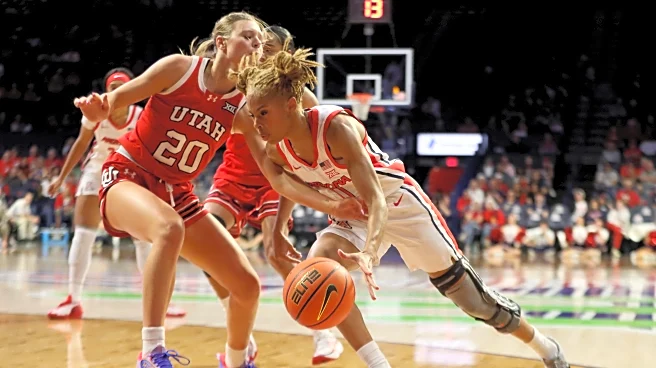





It’s an unfortunate year for Arizona women’s basketball to be in a rebuilding phase with the 2026 Women’s Final Four being held in Phoenix. The event began in 1982. It has been held in the West just five times in its 42 occurrences. It has never been in the state of Arizona.
While the Wildcats won’t be in the midst of talk for the home-state Final Four, there are things to look forward to. The opening weekend of Big 12 play suggests that Arizona might have a shot at more conference wins than anticipated.
That might get them a place in the WNIT or even the WBIT if they can eke out a few surprising wins over the next few months.
UA went into its first conference game under Becky Burke as one of just four Big 12 teams outside the top 100 of the NET. At No. 140, it was looking up at 13 of its 16 conference foes. Only Cincinnati (145) and Houston (180) were behind Arizona. The effort the Wildcats had on the court suggests that they may have a shot to sneak a few wins against those teams above them, though.
With 12 teams in the top 100 of the NET, just playing Big 12 competition should help the Wildcats’ NET. The league is currently the No. 3 conference according to NET, sitting below the SEC and Big Ten but above the ACC. Even the home loss to the Utah Utes helped push Arizona up two spots to No. 138. That’s still 14th in the Big 12, but it improves the Wildcats’ profile relative to the rest of the country.
There were also some interesting results around the conference that give clues about whom the Wildcats might have a shot at beating this year.
Defense makes the difference
The biggest positive that came out of Arizona’s first league game was the obvious willingness and ability to fight back when things went wrong. The Wildcats also showed that when they lock in on defense, things go their way.
Nothing could have gone more wrong than the game’s second quarter. The Wildcats didn’t score until there was just 3:18 left in the half, and they only scored two buckets in the second period. They gave up 24 points on the other end.
The team won the other three quarters, scoring right around 20 points each time. It was especially tough down the stretch when it put up 19 points and allowed just 10.
The defense was the difference. Arizona forced four turnovers over the final 3:04 of the game. That was 27 percent of Utah’s total turnovers.
Utah didn’t score as Arizona put up seven straight points. The Utes’ lead went from eight to just one.
The scoring run at the end of the game was a bookend for a 7-0 run over the first 1:41 of the second half. In that run, Arizona’s offense ran extremely smoothly. The Utes settled for 3-point shots on a night they went 5 for 21 from outside.
Utah committed two fouls, missed two shots from beyond the arc, and had a turnover during that initial 7-0 run. The Wildcats moved the ball well, hitting both shots they took off Lani Cornfield assists. They also hit both of their free throws, which is something they have not always been able to do this season.
Those 14 points made up for almost the entire 16-point deficit that Arizona faced at halftime. The positive was that the Wildcats could make up that ground in a total of 4:45 of game time. The negative was that those spurts of topnotch play didn’t come often enough.
A pattern emerges
The defensive pressure that Arizona showed at the end of the game has been effective for them this season. The Wildcats have used it to cut into other big deficits. In some, they emerged with the win after trailing, but all three of their losses have come after falling behind by double digits.
Against Southern, Arizona trailed by 16 in the first half and went on to lose by six. Against New Mexico, the deficit was 11 in the fourth quarter of a three-point loss.
The Wildcats went on a 9-0 run at the end of the first half of the game against Southern. That cut the lead to seven going into the locker room. They forced five missed shots and a turnover while grabbing six rebounds in the final 4:10 of the half.
They continued to shut Southern down to begin the second half. SU had three missed shots and two turnovers before hitting its first shot of the third with 6:58 left in the period. In the meantime, Arizona took a one-point lead.
Southern regrouped and Arizona became less effective. The final tie was at 37 points each with 3:46 left in the third. Arizona couldn’t shut down Southern’s 3-point shooters and the Wildcats trailed by five at the beginning of the fourth.
New Mexico took its 11-point lead with 4:58 left in the game. Arizona forced five turnovers over the final five minutes to cut that lead to three. That was 25 percent of the Lobos’ turnovers in the game. They spurred an 11-3 run that came up just short.
The challenge for Arizona is how to keep the defensive intensity up. The rash of turnovers comes in spurts, generally by deploying a press and trapping. Those methods are generally only used once the Wildcats’ backs are against the wall, though.
Big 12 possibilities
If Arizona can find a way to keep the defensive intensity up for longer periods of time, there’s a solid chance it could steal a few games that might have looked unwinnable back when DII West Texas A&M came in and won an exhibition game in McKale Center.
There was already a good chance that the Wildcats could defeat UCF, Cincinnati, and Houston. The Cougars are especially vulnerable to a team that can pressure the ballhandlers. Both the Knights and the Cougars come to Tucson, giving UA an edge.
Could the Wildcats sneak out two or three more wins to end with an overall record near .500 this year? If so, where might those wins come from?
Kansas State has been extremely inconsistent this season. The other Wildcats go through scoring droughts and could be vulnerable to a team that locks in on defense. They also have to come to Tucson this season.
The Big 12 opening loss to TCU doesn’t say much about K-State since it’s TCU. The Horned Frogs were always going to win that game, especially in Fort Worth. The ups and downs before that show that those Wildcats could fall victim to a strong defensive effort.
Colorado definitely showed some weaknesses in nonconference play when it dropped a home game to Montana State in CU Events Center. The Bobcats are 7-4 on their schedule. The NCAA considers them 5-4 since they played Division II Minot State and Division III Carroll College. Neither of those games count for the official record, but the win over the Buffaloes certainly does.
CU showed some other things in Tempe when they opened conference play. First, they showed that ASU might be pretty good this year. Then, they showed that they can be prone to turnovers.
The Sun Devils turned the Buffaloes over 19 times on Sunday. ASU turned those into 25 points.
CU may be more sure-handed when Arizona goes to Boulder on New Year’s Eve, but the Buffs also have to come to Tucson. Maybe they’ll have trouble in the desert for the second time.
Speaking of ASU, the Wildcats will get the Sun Devils in Tucson late in the season. That might give UA enough time to get acclimated against Power 4 opponents that they’re ready to take the back half of the rivalry.
Colorado was not the only one turning the ball over like crazy in Desert Financial Arena last Sunday, after all. ASU gave it away 22 times. The Buffs scored 28 points off those turnovers. That’s 44 percent of their 63 points.