


One of the only good things about watching a tanking team is seeing players develop from definite L’s in the loss column to becoming real assets on a playoff team. The 2025-26 Utah Jazz team had its fair share of young talent improve over the course of 82 games, as well as surprising vets that stepped up big time.
Let’s take a look at the three players that improved the most from last season.
Note: I will only be using players who also played for the Jazz in 2024-25, so while Jusuf Nurkic was somebody
that definitely upped his stock, he will not be on this list.
No. 3: Lauri Markkanen
2024-25 stats: 19.0 ppg, 5.9 rpg, 1.5 apg, 57.1% TS
2025-26 stats: 26.7 ppg, 6.9 rpg, 2.1 apg, 60.1% TS
This might come as a shock to some, but in the thick of the Jazz’s (purposeful) worst season in franchise history, Markkanen had a very bad season. I though this year was massive for him to prove that he can be the player on a Jazz playoff team that everybody thought he could one day be.

When Markkanen arrived in Utah, he was this seven-foot beast that could knock down threes, but would also drive and dunk with incredible efficiency. He was an all star starter in year one and was named the league’s most improved player, but by year three it seemed like that version of Lauri might be gone. He averaged six less points a game, shot five percent worse from deep, took more threes and less twos. His game was reduced to catch-and-shoot, which was frustrating knowing that he could be an efficient paint scorer.
But this season, all my faith in Markkanen has been restored. His shot selection was a lot more diverse, taking five more 2-point attempts per game while still being knockdown from 3-point range. There were times this season before the Jazz went full-fledged tank mode, where I looked at the duo of Lauri Markkanen and Keyonte George and thought, “Hey, this is real.” Combine his play with the fact that Utah kept its first round pick, and the decision to not trade Lauri paid off tenfold.
No. 2: Cody Williams
2024-25 stats: 4.4 ppg, 2.3 rpg, 1.2 apg, 41.9% TS
2025-26 stats: 8.8 ppg, 3.0 rpg, 2.0 apg, 52.4% TS
We were in dangerous territory with Cody Williams early in the season. Like maybe “worst player in the league” territory. Maybe, dare I say, “worst Jazz draft pick ever” territory. But patience proved powerful, as Williams now seems like he can be a real player in the NBA, which can’t be said for many of his 2024 draft peers.

His overall season stats don’t jump off, but after New Year’s, he became an impact player in Utah. In 21 starts in March and April he averaged 15.4 points, 4.1 rebounds and 4.4 assists per game. Now, you can chalk that up to garbage, late-season stat inflation, but what fun would that be?
Even NBA insider Zach Lowe made it a point to talk about Williams’ play on his podcast.
“I think Cody Williams — who looked like an epic bust of a top-10 pick… has shown enough in the last couple of months that I think there’s a world in which he’s a functional eighth to tenth guy on a good Utah Jazz team. His defense is really improved. He’s a solid defender. He knows how to close out on guys short, he knows how to run guys off the arc, he’s extremely well balanced,“
So while Williams might not be on the same level as the other two players on this list, his improvement from year one to year two should be seen as a resounding success.
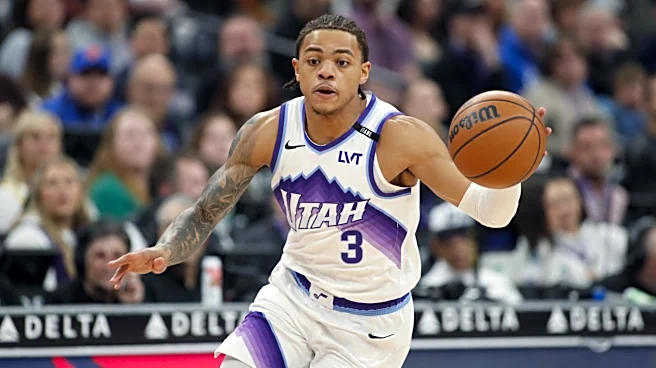
No. 1: Keyonte George
2024-25 stats: 16. 8 ppg, 3.8 rpg, 5.6 apg, 53.9% TS
2025-26 stats: 23.6 ppg, 3.7 rpg, 6.1 apg, 60.9% TS
Keyonte George was benched for Isaiah Collier last season. Let that sink in.
In the offseason, George was probably the most polarizing player on the Jazz, with (from my perspective) more people being out on the once inefficient point guard from Baylor
In just one year he has made himself a franchise cornerstone, and had it not been for a stacked western conference, he would have made an all star team. No doubt about it. The Jazz do not make the franchise-altering trade for Jaren Jackson Jr. if George had not taken this step in year three.

His shot selection in 2025-26 was drastically better than that of his sophomore campaign. He shot less threes per game, 3.5 more 2-point attempts per game, and got to the line 2.7 more times as well. A big knock on George going into the season was his lack of finishing and his lack of creating contact in the paint, even though he was able to get there with ease. This season, the perceived “fear” he had of the paint greatly diminished.
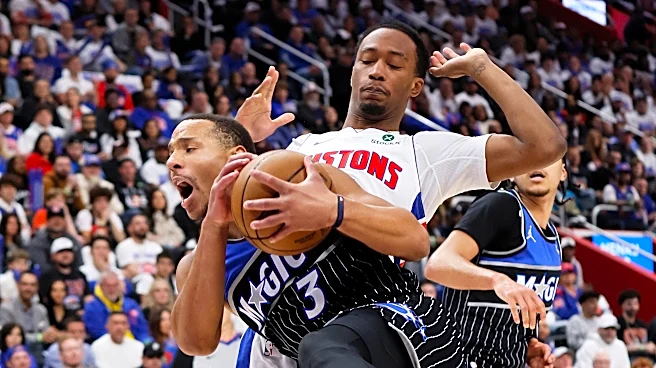
What I think can best sum up George’s rise in the NBA’s hierarchy this season was his two-game stretch against the Pistons and Spurs in December, a stretch in which the Jazz won both games. In these two games, George averaged 29.5 points, 6.0 rebounds and 7.0 assists, and against the Pistons he hit the game-winning floater over the outstretched arms of Jalen Duren. In two games against Cade Cunningham and Victor Wembanyama, it was George who came out on top. It was George who was the best player on the court.
I foresee a Tyrese Maxey level ascension for George in the near future. Maybe it won’t be this very next season, but George is the real deal, and can 100% be an all-NBA guy in his career. That is not something that I thought in September.