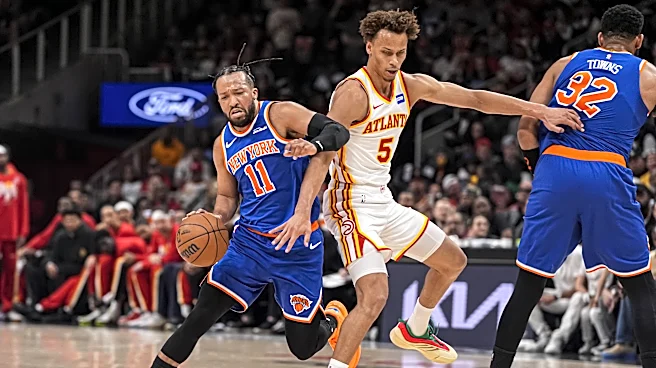




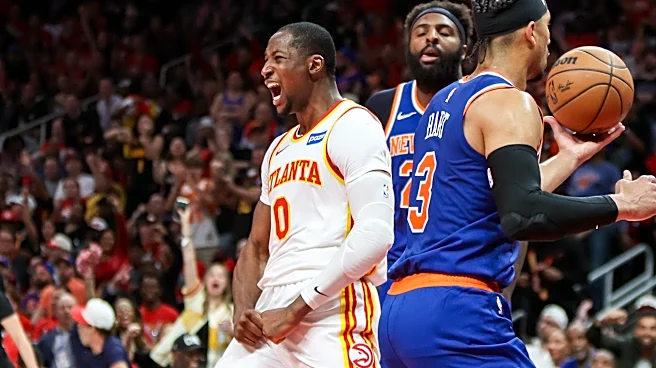
The Hawks (2-2) had a listless Game 4 loss on Saturday meaning they’ve now squandered the home court advantage they picked up with their clutch win in Game 2.
Certainly, there have been some disappointing performances from an individual player perspective. But let’s zoom out a tad and focus on a trio of tactics the Hawks as a team could (and in my opinion should) address.
These three adjustments could be instrumental if the Hawks are to go at least 2-1 in the next two or three games and advance.
Punish New York for going under screens
The
Knicks have consistently soft switched or bump switched most screen actions all series long. But even when they have fought through screens, they have pointedly navigated under a majority of these actions no matter the ball handler.
Their biggest goal has been to cut off drives into the paint at all costs.
One solution: take what the defense gives you. Empower your better three-point shooters into taking step back threes.
It may seem like keeping the ball moving and putting the defense in rotation is the move, but in reality, their usual offense hasn’t generated enough good looks in the halfcourt to this point.
The Hawks were 11th in the NBA in the 2025-26 season in three-point attempt rate (3PAr) — with 42.9% of their field goal attempts coming from behind the arc. Little has changed in the playoffs — fifth among the 16 teams at a 41.8% 3PAr.
Of course, they hit 37.1% of attempts from deep in the regular season, but that mark is down to 32.6% through four playoff games.
I will admit self-creating three-point attempts at volume is a bit of uncharted territory for these Hawks. In the regular season, they were 27th in the percent of unassisted threes made (9.1%), but they’ve had to double that rate in the playoffs. Of course, adding CJ McCollum — still one of the best self-creators around — for this late season run obviously altered that distribution some.
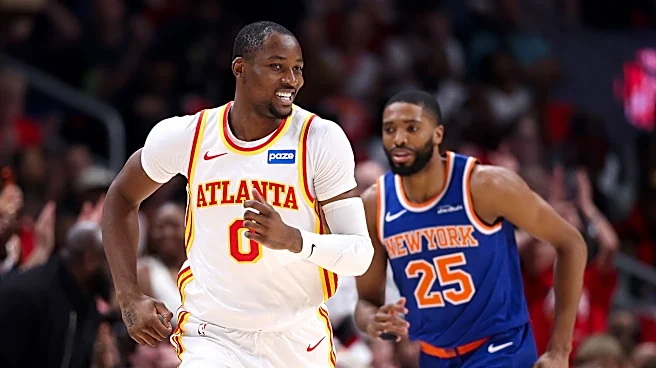
It may sound silly, but the unassisted three-point rate still isn’t high enough. Beyond McCollum, you would of course trust Alexander-Walker (who is largely scuffling, alas) and Vincent with those sorts of attempts.
But the elephant in the room is how disappointing Jalen Johnson has been this series. He could really benefit from launching instead of driving into traffic.
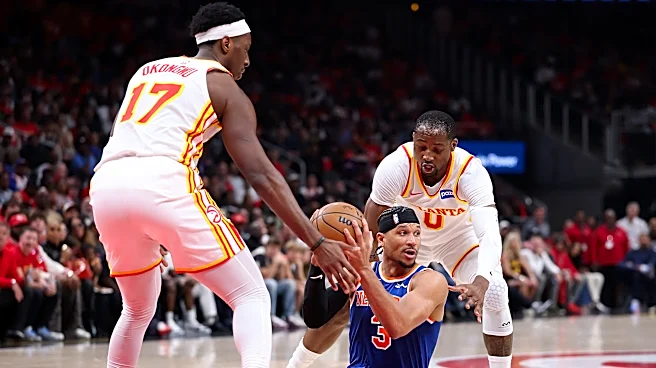
Here’s what it should like — an example from Game 3. After the screen-the-screener action, Josh Hart’s first instinct is to dive under the Onyeka Okongwu screen. Three points for Jalen Johnson:
But on this possession, despite Dyson Daniels sealing off both defenders to the inside for an open wing step back or sidestep attempt, Johnson tries to beat all-world defender OG Anunoby off the dribble. He just never had the angle to get to the rim considering his All-Defensive First Team-caliber matchup:
Johnson and Alexander-Walker have to keep letting the three-ball fly as soon as they see this coverage in my mind. Otherwise, you’re playing right into New York’s hands.
Put Jalen Brunson in action from the opening tip
Clearly, Jalen Brunson provides little resistance as a defender. And yes, the Hawks have been diligent in attacking him late in close games.
But they need to step it up even more. It’s time to target Brunson relentlessly starting from 12:00 in the first quarter.
This particular line of logic is pretty straightforward. If you start wearing down Brunson from the beginning of the game, you get the benefits of both compromising New York’s defense and the exhaustion of his energy defending instead of attacking.
Overall, the Hawks have done a solid enough job on Jalen Brunson so far this series. He’s averaging 25.5 points per game but on a 52% true shooting — six points lower than his regular season mark.
After averaging 9.6 assists and 3.4 turnovers per 100 possessions in the regular season, he’s at 7.1 and 4.8 per 100 respectively during this series.
But Brunson has scored 10.5 points (on 58% true shooting) in the first quarter of these playoffs, the most of any NBA player who has played at least two postseason games. He has also played all 12 minutes in three of those first quarters.
The Hawks should expect this minutes allocation for Brunson the rest of the series and put him constant action on offense. Maybe he wears down by the end of the game. Maybe he picks up two — or even three — early fouls.
Atlanta has struggled with starting slowly so far. The Hawks have found themselves down at least six points at the end of the first quarter in three of the four playoff games so far.
No more early holes to dig out of. It’s time to take the kiddie gloves off.
Make Karl-Anthony Towns a driver
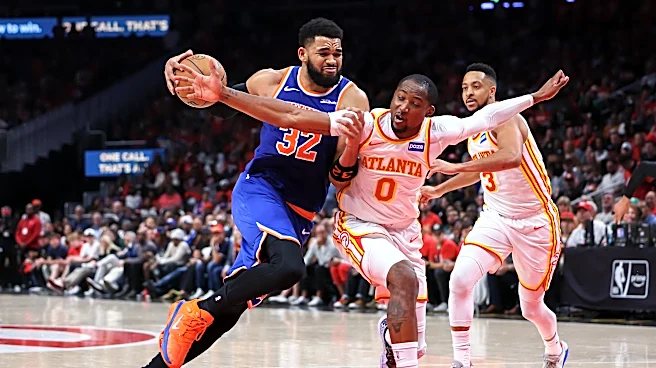
Towns is obviously a gifted big man scorer — maybe one of the most skilled ever. So far this series, Towns is cooking the Hawks to the tune of 21 points per game on a blistering 72% true shooting percentage.
The shooting range speaks for itself, and he’s also got a soft touch near the rim. But still, the Knicks have received a lot of criticism for his offensive usage during his two-year stint in New York.
Or maybe his play style is just harder to incorporate into a team setting than it seems on the surface.
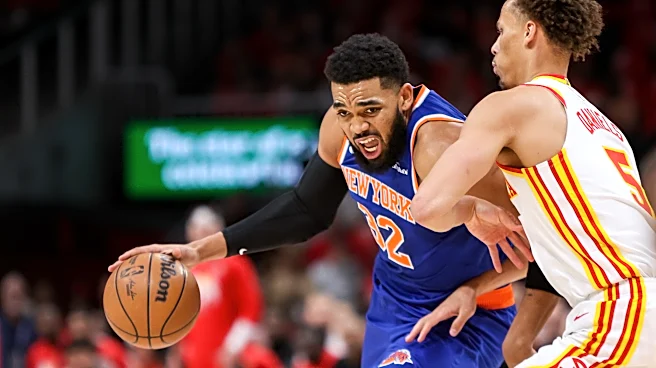
A big gap in his game is the combination of ineffective driving mixed with poor passing vision. Towns’ drives are often grindingly slow, and they rarely create significant separation to generate an uncontested look.
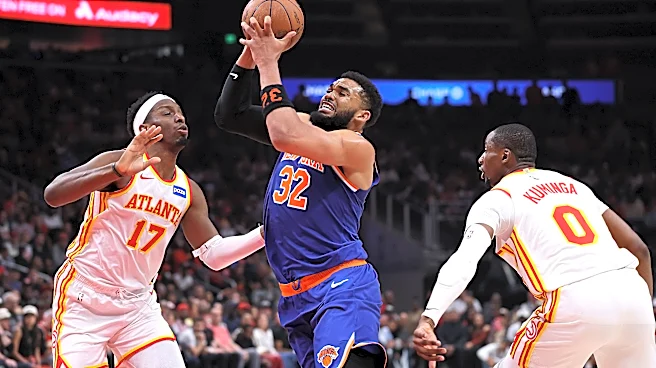
Towns not being able to get up a clean shot over Gabe Vincent, almost a full foot shorter than him, is pretty problematic:
Quite simply, he’s a poor passer out of double teams and drives. In the 2025-26 regular season he passed on just 18.8% of his 499 drives this season. And he was the league leader in offensive fouls committed — often driving straight into already set defenders.
Among the 102 players with at least 400 drives this regular season, Towns passed out of them the second-fewest percentage of driving possessions (18.8%) behind only Dillon Brooks.
So far on 20 drives this series, he has passed out of just one of them according to the NBA’s tracking stats.
The Hawks need to do their work on him both early and late. Early, in the sense that you can’t let him get low post position for easy shots and foul-drawing — especially given how few big men the Hawks have available.
But the late piece is critical.
Solutions? For one, Atlanta needs to make sure to go over inverted screen actions and trail drives when ‘KAT’ is the trigger man.
For two, close out on his pick-and-pop game as hard as humanly possible. From Game 4, Okongwu and Johnson scramble their coverage communication. After the pop to the corner, Okongwu can do a lot more to force ‘KAT’ to drive baseline towards help:
Why send him baseline? Because he has too many drives that end like this:
And finally, let Towns start his dribble before crowding him with a double team, preferably from the low man. The Knicks have been reluctant to play Towns at the four, so any pass into the restricted area behind the low man would be for a non-lob threat (so, not Mitchell Robinson).
None of these three tweaks are a panacea, of course. If the Hawks’ two leading scorers, Johnson and Alexander-Walker, don’t get it together soon, the above may not matter.
But there are still opportunities to squeeze out advantages in your favor from a Knicks team that, frankly, looks very beatable.