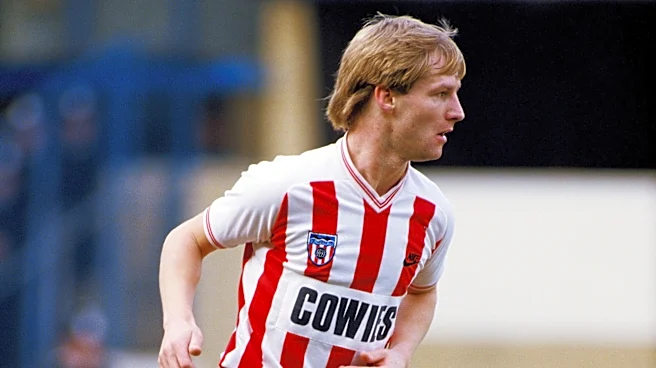


Shaun Elliott was born in Haydon Bridge in 1957 and started his football career playing for his local side, where Sunderland’s scouts soon spotted him and snapped him up. He came to a club which had not long since won the FA Cup and was one of a promising group of youngsters coming through the ranks at Roker Park, alongside the likes of Kevin Arnott and Gary Rowell.
This trio were of a similar age and, due in part to their subsequent long service to the club, Elliott and Rowell became great friends
off the pitch.

Watching on as Sunderland were finally promoted under Bob Stokoe in 1976, Shaun took a back seat as the club endured a miserable start to life back in the top flight in 1977. Bob Stokoe quit due to ill health after a couple of months and, after eventual new boss Jimmy Adamson couldn’t raise a tune from his inherited squad, he began to take a look at the young players at his disposal. Hence, Shaun made his debut in an FA Cup defeat at Wrexham in January 1977 – a game in which Gary Rowell also started and Kevin Arnott made his senior debut as a substitute.
These three were to become intertwined with each other in the following weeks, helping to form a midfield unit which first of all arrested the disastrous slump that had planted Sunderland at the foot of the First Division table and then sparked an equally spectacular revival, which saw the team score seventeen goals in four games.
Shaun was deployed as an energetic, tough-tackling midfielder in those early days, but despite the upturn in fortunes, the early-season form did for Sunderland in what turned out to be a relegation season. However, he had cemented his place as a first-team regular and, with his pace and tackling ability, he soon began to make a name for himself as a centre-half.
Partnering Jeff Clarke, he was part of the Sunderland team that won promotion again in 1980, while he also played a fair bit of the campaign in midfield when needed. With Sunderland back in the top flight, Shaun proved he was more than capable of handling the best strikers around in the First Division, with England scouts watching on.
In an era when you couldn’t move in the top flight for quality English centre-backs, Shaun was capped three times by the England B side. If he had been playing today, with a more limited number of English defenders in the Premier League, full caps would have come his way.
This was an age when players were still allowed to tackle without fear of the consequences, and few players over the last 50 years in a Sunderland shirt could put in a sliding tackle as well as Shaun Elliott. He was also as fast as any player out there and, after a spell on the sidelines because of injury, then-Sunderland manager Alan Durban brought him back into the team for a game against Liverpool at Anfield, specifically to nullify the threat posed by that fastest and deadliest of 1980s strikers – Ian Rush.
The result? Sunderland won 1-0 on 1 October 1983 in a famous victory.
Shaun played some of his football that season at left-back before taking over as club captain the following season under new manager Len Ashurst. It has been said by some that Shaun was never the same player after a bad clash with Graeme Souness in 1982 put him out with an injury for several months, but if you saw him at the start of the 1984-85 season, he looked like he was playing the best football of his career.
Len Ashurst had broken up and rebuilt Alan Durban’s team, and Shaun formed a new defensive partnership with an unknown arrival from Cardiff City – Gary Bennett. Despite their efforts, these two were probably too similar to each other: pacey, good tacklers, but both probably better suited to playing alongside a stopper centre-back such as Jeff Clarke, Rob Hindmarch or John MacPhail.
With Shaun as captain, Sunderland made a run to the Milk (League) Cup Final at Wembley. Unfortunately, he was suspended for the final and his leadership was badly missed as the team slipped to an uninspired defeat. Worse was to follow as the side slumped in the league after the final and were relegated for the second time in Shaun’s Sunderland career.

New manager Lawrie McMenemy stuck with Shaun as his captain in his disastrous first year as manager, and there was time for Shaun to have a memorable battle with a certain Billy Whitehurst of Hull at Roker Park in a 1-1 draw in October 1985. At the end of that season, for reasons unknown to man (we were skint), Shaun was sold to Norwich City, who had returned to the top flight. The move, it was said, was to pay for McMenemy’s rumoured £200,000-a-year wages – the highest for any manager in English football at that time.
For the sake of raising the £200,000, it’s not often you can say this with conviction, but the better move would have been to keep the player and let go of the manager.
He was still only 29 years old and had played 368 times in the Sunderland first team over ten years. Why wasn’t he ever given a testimonial?
He played on for Norwich for a couple of years before moving on to Blackpool and then winding down his career at Colchester and Albany Capitals.
Shaun Elliott was one of an outstanding trio, along with Gary Rowell and Kevin Arnott, that Sunderland produced in the 1970s. He could compete with the best in the top flight, and he made more top-flight appearances for Sunderland than he did in the second tier. He had a good left foot, rarely had a bad game and, for someone who was one of our best players during his time in the team, he has kind of slipped under the radar in our assessment of him and his contemporaries of that era.
He’d probably get a game today – as long as he didn’t try to put the ball and the player into the advertising hoardings in front of the zealous refs of the modern game!