
NBA history spans 80 seasons, and as CelticsBlog readers well know, the Boston Celtics have won a league-high 18 championships. This month, we are recapping each of those title years.

The 1964-65 season began on a somber note: Walter Brown, the team’s legendary founder and owner, suffered a heart attack and died a few weeks before opening night. Brown was just 59 years old.
Brown helped found the Basketball Association of America, which merged with the National Basketball League to form the NBA. He
was also instrumental in founding the Ice Capades; managed the Boston Garden; owned the Boston Bruins; was president of the International Ice Hockey Federation; and president of the Boston Athletic Association, which operates the Boston Marathon. Brown also won championships as a hockey coach.
Walter Brown is enshrined in the Hockey Hall of Fame and was inducted posthumously into the Basketball Hall of Fame in 1965. When the season opened, the Celtics retired Number 1 in his honor.
The regular season
The Boston Celtics showed no signs of slowing down as they began pursuit of their seventh straight banner. They posted a 62-18 record, the best in league history, while no other team reached 50 wins. Boston won the first 11 games on the schedule, then added win streaks of seven and 16 games.
Russell won the Most Valuable Player award for the fifth time. He averaged 14.1 points per game and led the NBA in rebounding average at 24.1. Unfortunately, Russell played before blocked shots were tracked as an official statistic and also before the introduction of the Defensive Player of the Year award. His overall status as arguably the greatest player in NBA history is shortchanged as a result.
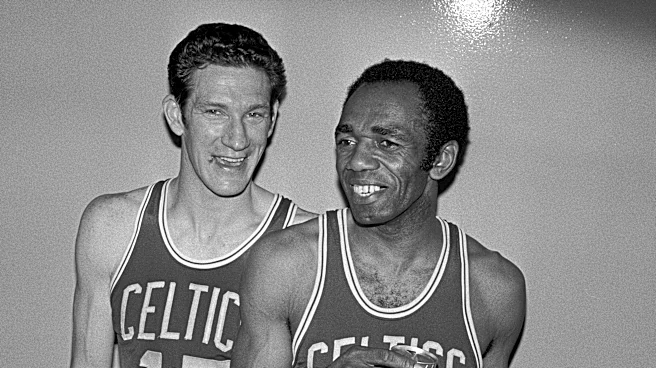
Sam Jones (see below for more about him), Tommy Heinsohn and Russell all played in the All-Star game. This would be Heinsohn’s last hurrah, retiring after nine seasons.
Among those new to the team were draft picks Mel Counts, taken in the first round with overall pick no. 9, and in the third round with pick 27, John Thompson. Counts would play 12 seasons in the NBA, win two rings with the Celtics, then be traded in a significant deal (stay tuned for more), and cross paths again with Boston in the 1969 Finals. Thompson played just two seasons as a backup big, but also won two rings. He made the Hall of Fame too, in the role he’s most known for, coach of the Georgetown Hoyas.
The first all-black starting five
The Celtics also made on-court history once again in the realm of civil rights.
In the 1964 installment of this series, we reviewed how coach Red Auerbach and the Celtics ignored the unwritten “quota rule” and put five black players on the court at the same time. On December 27, 1964, they took it to the next step. Tommy Heinsohn was injured and Willie Naulls replaced him in the starting lineup, along with regulars Bill Russell, Satch Sanders, Sam Jones and K.C. Jones. The first all-black starting five.
It was a major breakthrough in professional sports at a contentious time and bleak period in American history. And there was more to come from the Celtics on that front because, as Auerbach always stated, he simply wanted to win. And he knew what he was talking about. Together, that lineup won 12 games in a row – 10 of them on the road.
Sam Jones, the forgotten superstar

Did you know that Sam Jones – no. 24 on the retired numbers banner – won 10 NBA championships, the second most behind Bill Russell? If not, then you probably are also unaware of his five All-Star game selections, three times voted to All-NBA, and induction into the Hall of Fame (inexplicably, he had to wait 15 years for the call).
Jones was, in today’s parlance, a bucket. His signature move was an outside bank shot off the dribble. His career high was 51 points for both regular season and postseason (at Madison Square Garden, winning a closeout game versus the Knicks). Most importantly, Jones was best known for being clutch. We’ve seen it already in this Banner Year series when he scored a series winner in 1962 and 47 points in a Game 7 in 1963.
Jones’ best season was this one, 1964-65, when he played all 80 games; averaged a career-high 25.9 points per game; scored 2,070 points, which at that time was a team record; earned All-NBA second team; and was fourth in MVP voting behind Russell, Oscar Robertson and Jerry West.
It’s safe to say that most of today’s NBA fans know of those three megastars, even if they never saw them play. But no one talks about Sam Jones, the forgotten superstar.
Russell called Jones the most skilled teammate he’d ever had. He added that Jones was called upon to take a do-or-die shot in the playoffs six times, and made all six. That’s a real Mr. Clutch.
Fun fact about Sam Jones’ draft position: Jones was eligible for the 1956 Draft and was selected in the eighth round as the 59th overall pick by the Minneapolis Lakers. However, Jones chose to return to North Carolina Central College to complete his degree following military service. By rule at that time, returning to school voided the Lakers’ exclusive claim to his player rights, leaving him available for a future draft. The next year, 1957, the Boston Celtics selected him in the first round with the eighth pick overall. If Jones had not returned to college, the Celtics would not have 18 banners, and you wouldn’t be reading this series right now.
Eastern playoffs
After their customary bye, the Celtics once again faced the dangerous Wilt Chamberlain, who’d gone west with the Warriors’ relocation to San Francisco, but was traded back to his hometown and the Philadelphia 76ers. The Sixers were born when the Syracuse Nationals relocated, to fill the void in Philly after the Warriors departed.
As seemed to be their habit, the first six games were won by the home team, neither being able to separate from the other. Only Game 3 was particularly close, and Philly needed it to avoid a 3-1 deficit. The Sixers dominated the first and third quarters, while the Celtics took the second and fourth. Boston was ahead by two with one second remaining. Sixers guard Hal Greer took the inbounds pass and hit a 35-footer as the buzzer sounded (for two points as the three-point shot wasn’t in use yet). The Celtics protested that the shot was too late, but lacking replay there was nothing left but to play overtime. Philly escaped, 134-131.
Of course, everything came down to the final five seconds of Game 7. It had been a back-and-forth battle for the first 47 minutes, but the Celtics led 110-103, thanks to Sam Jones’ 37 points and 26 from Havlicek. Trying not to foul, Boston backed off on defense, unwisely allowing six quick points by Chamberlain. Then Russell made the worst mistake of his career, losing the ball with five seconds left and a one-point lead feeling extremely vulnerable. But Russell was bailed out by the most memorable play in Celtics history.
The Sixers gave Hondo the opening by not running any sort of action. Watch again: Everyone stood around, no one cutting or setting screens. The heady Havlicek took his position and only had to wait for the ball to come. It was a hallmark of the dynasty, the Celtics executing on the most crucial play to secure the win. Bonus: Johnny Most’s call of the play became legendary and made him famous.
NBA Finals
Survive and move forward, that’s the playoffs in a nutshell, and the Celtics did that. The Finals versus Los Angeles had lost some luster because Elgin Baylor was out after tearing knee ligaments. Boston was an overwhelming favorite and they won without any anxiety.
The matchup
Game 1 was a blowout, Boston leading by 20 after three quarters and finishing 142-110. The Lakers were never in it. Game 2 on the parquet was more typical playoff basketball, hard-fought and close. Jerry West poured in 45 and Dick Barnett added 26, but the Celtics had five men with 20 or more points, winning 129-123.
In LA, Sam Jones dropped 35 in Game 3, but West remained on fire with 43 points in a 21-point Lakers victory to stay alive. However, Game 4 was a different story.
Turning point
Boston trailed by six at halftime of Game 4, but the defense clamped down, enabling the visitors to dominate the second half, 57-38. West was held to 6 of 27 shooting and only 22 points. Final, 112-99, the Celtics taking a 3-1 lead.
The hero we needed
The entire Celtics squad was heroic in Game 5. They were already ahead by 16 when they began the fourth quarter with a barrage of 20 consecutive points. Again and again, the Celtics would get a defensive stop, throw an outlet pass and race the other way for an easy bucket. The Garden crowd was ecstatic. Radio announcer Johnny Most was so delirious he’s lucky he didn’t fall out of his perch in the balcony.
The final score was 129-96, a 33-point destruction. We wouldn’t see something like that again until 2008.
It wasn’t over until…
The series was practically over before it began. Without Baylor, LA was helpless.
Notable facts and stats
- Seven Celtics scored between 10 and 22 points in Game 4.
- Sam Jones led the team in scoring for the series with 27.8 points per game.
- Russell pulled down 25 rebounds per game in the Finals.
- Jerry West topped the Lakers by averaging 33.8 points, but he came up empty in the Finals for the third time versus Boston.
- Tommy Heinsohn retired after this series, scoring 6 points with 8 rebounds in his final game. He won eight championships, was four times All-NBA and a six-time All-Star, as well as Rookie of the Year. We would hear from him again.
Banner Years continues tomorrow with a review of the 1965-66 season and the road to winning Banner #9.