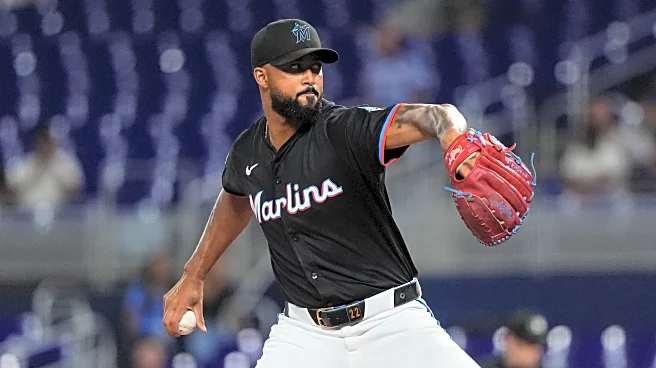



There is perhaps no pitcher who has seen his name surface in trade rumors more over the last five years than Sandy Alcantara. Practically from the day he inked his five-year, $56 million extension, speculation swirled as to when the miserly Marlins ownership group would look to get out from under the rest of the money owed on the deal. With just one guaranteed season left on the contract, this winter might be the last chance for Miami to recoup anything of value for the 2022 NL Cy Young Award winner.
The Yankees are one of a handful of teams rumored to have interest, so let’s dig into whether it would be a worthwhile investment.
2025 Statistics: 31 games started, 174.2 IP, 11-12, 5.36 ERA (82 ERA+), 4.28 FIP, 4.19 xFIP, 19.1% K%, 7.7% BB%, 1.27 WHIP, 1.7 fWAR
2026 FanGraphs Depths Charts Projections: 31 games started, 187 IP, 10-12, 4.15 ERA, 4.01 FIP, 19.9% K%, 7.0% BB%, 1.31 WHIP, 2.5 fWAR
Contract Status: Set to earn $17 million in final year of five-year, $56 million extension signed after the 2021 season. $21 million club option in 2027 with $2 million buyout and $1 million assignment bonus if traded.
Alcantara burst into the national spotlight in 2022, leading all qualified NL starters in innings pitched (228.2) and placing second in ERA (2.28) and third in fWAR (5.9) en route to a unanimous win of the Cy Young Award. Coming in the first season following the signing of a team-friendly extension but for an organization going nowhere, the then-27-year-old emerging superstar was all of a sudden one of the most valuable players in the league when combining on-field production and contract terms. While a not-as-stellar 2023 muddied the waters a tad, he nonetheless remained a highly sought after pitcher.
But then Tommy John surgery cost him all of 2024, and a dismal start to the 2025 season turned a once coveted pitcher into a potential salary dump candidate as the trade deadline approached. Alcantara was by various measures the worst qualified starter of the first half, owner of an ugly 7.22 ERA. It must be noted that he suffered through an extended patch of bad luck as indicated by a FIP (4.64) and xFIP (4.60) more than two-and-a-half runs lower than his ERA and an unsustainably low 53.2-percent strand rate, but this was still a shell of the pitcher who took home his league’s top pitching prize three years prior.
Just as the rumors of an impending exit began to swirl, he turned his season around. From his July 23rd start against the Padres onward, Alcantara much more closely resembled the pitcher from 2022, pitching to a 3.13 ERA and 3.75 FIP in his final 12 outings. He averaged over six innings per start during that stretch and gave up two or fewer runs in eight out of the dozen appearances.
Often the last thing to return after a major operation such as TJS is command, and in Alcantara’s case it appears it really was a simple as taking half the season to shake off the rust of his year-long layoff. In the first half, opposing hitters were slashing .271/.339/.440 as Alcantara posted a concerningly low 8.3-percent strikeout-minus-walk rate (K-BB%). The second half improvement was quite stark, opponents slashing .218/.275/.360 as Alcantara improved his K-BB% to 15.3-percent.
Cutting out the walks is one of the quickest ways to improve your outcomes, but command goes beyond just limiting the free pass. In 2022, Alcantara thrived with his high-octane on the edges of the zone, accruing 42 runs above average in what Statcast defines as the “Shadow” region, or roughly a ball’s width on either side of the four edges of the strike zone. In the first half of 2025, he was worth +15 runs in the “Shadow” region while in the second half he accumulated +17 runs in eight fewer innings.
This was also accompanied by a bit of a philosophy shift in part to help mitigate his struggles against lefties. Because he struggled to consistently spot his heater to the edges, he lost almost all of the chase that made his slider and changeup so valuable in 2022. He cut back on slider and changeup usage and made up for it by throwing a lot more curveballs — a pitch that is more platoon-neutral against lefties than the slider. He accompanied this by separating his fastball usage by hitter handedness, attack lefties with elevated four-seamers while deploying the sinker glove-side and low to righties.
Despite this impressive season turnaround, it is more likely than not that Alcantara will never approach the heights of 2022. Though he’s armed with a fastball that can touch triple digits, he has never been much of a strikeout pitcher, topping out at a 24-percent strikeout rate in 2021 and averaging 21-percent for his career. Instead, he relied on a ground ball rate that hover right above 50-percent for his career prior to 2025, when the fly balls started flying.
Instead, I think combining 2023 and 2025 gives us a pretty good image of the pitcher we can expect going forward. Alcantara struck out 23.6-percent of batters between 2020 and 2022 and allowed 0.77 home runs per nine. Over his last two seasons, his strikeout rate sits at 19.4-percent and home runs per nine at 1.1. Think of him more as a third starter at this point, capable of giving you a high-threes ERA and four-ish FIP. FanGraphs’ Depth Charts projection system pegs Alcantara for 2.5 fWAR in 2026 — certainly nowhere near the heights of his Cy Young winning campaign but still perfectly serviceable for a mid-rotation starter. Do you know how many Yankees pitchers are projected for at least 2.5 fWAR? Max Fried, that’s it.
That brings us to the question of his availability. While rumored at the start of the offseason that the Marlins would be fielding offers on all of their starting pitchers not named Eury Pérez, the tone of speculation surrounding the Marlins has shifted in recent weeks. Team president Peter Bendix declared his intention to compete for a playoff spot in 2026 after improving from a 62-100 record in 2024 to 79-83 in 2025. Miami has an… interesting core of young players who showed enough down the stretch to plant a seed of hope that the group can take the next step in 2026. Keeping their rotation intact, including retaining their best starter of the second half in Alcantara, would in their pursuit of that goal. Much ink has been spilled of late regarding promises from Marlins and Pirates ownership to increase payroll. This could in part be fueled by ongoing and looming grievances over both clubs’ failure to reinvest their revenue sharing income into payroll, but it’s just as likely a consolidated attempt by owners to strengthen their bargaining position ahead of the looming labor battle once the current CBA expires following the upcoming season.
Thus, it remains somewhat of a mystery whether the Marlins intend on keeping Alcantara or are trying to artificially inflate his trade value by restricting his availability. The need certainly exists with the Yankees as Gerrit Cole, Carlos Rodón, and Clarke Schmidt will be unavailable at the start of the season as they recover from their respective surgeries. The Yankees have been rumored to be hesitant to add another nine-figure starting pitcher to payroll alongside Cole, Rodón, and Max Fried, so a one-year rental with potentially recoverable upside falls more into their budget. They’ve been linked with Alcantara at various points over the last three years, so it will be interesting to see if this is finally the moment they choose to pounce.