




The Las Vegas Raiders are expected to have a wide-open competition to fill out the depth chart at wide receiver this summer. After the 2026 NFL draft and offseason as a whole, it’s one of the weakest position groups on the Raiders’ roster, giving undrafted free agent Chase Roberts a chance to earn a spot during training camp.
Las Vegas currently lacks a true “X receiver”, and at 6-foot-3, 209 pounds, the BYU product has the size to fit that profile. He’s also coming off an impressive season, racking
up 54 catches for 802 yards and six touchdowns to earn the fifth-best receiving grade (76.9) among Big 12 receivers, per Pro Football Focus. He was also one of the more efficient wideouts in the conference, ranking 11th with 2.35 yards per route run.
With that in mind, let’s dive into the tape and see what gives Roberts a chance to make the team.
Two elements of Roberts’ game really stood out on film: his football IQ to find and expose holes against zone coverage, and his body control to make sideline catches. Both are on display in the clip above.
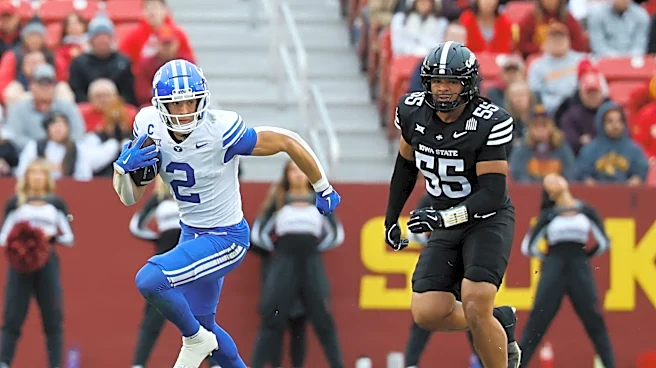
Pre-snap, Iowa State shows a blitz look with the boundary safety at the top of the screen lined up directly over the slot receiver and a little closer to the line of scrimmage than normal, while the nickelback has inside leverage. However, the defense doesn’t bring the heat, where the safety bails toward the sideline as if they’re running Cover 2 or a two-high coverage. But it’s actually Cover 3 Cloud, where the corner squats or doesn’t get any depth, and the other safety rotates to the middle of the field post-snap.
That’s designed to create confusion for the quarterback and wide receivers, but Roberts isn’t fooled and sits in the hole between the boundary safety and squat corner. The quarterback finds him and throws an inaccurate pass toward the sideline. Luckily, the wideout has good ball tracking skills, field awareness and body control to still make the grab while dragging his feet to move the chains.
BYU had a true freshman quarterback last year whose accuracy was sporadic, so Roberts had a handful of catches that were very similar to this one.
This next play is a lot simpler, but it continues to highlight the third-team All-Big 12 receiver’s intelligence as a route runner. He’s running a simple slant route against Cover 1 or man coverage this time and does a great job of maximizing the quarterback’s throwing window to pick up a first down.
One of the issues with the offense’s playcall against this coverage is that the defense has its middle linebacker playing as the low hole defender, meaning he’s reading the quarterback’s eyes and looking to help the defensive backs take away anything over the middle by stepping into the passing lane or delivering a big hit to get a PBU.
However, Roberts does a good job of avoiding that by releasing wide off the line of scrimmage. Notice what that does to the nickelback lined up over him. The nickel wants to maintain outside leverage, so he widens with the receiver’s release, which creates a bigger window or more space between the nickel and the linebacker. On top of that, Roberts slows down after breaking on the slant to avoid running into the linebacker.
So, the quarterback has more than enough room to make the throw, and the wideout immediately turns up the field with the ball in his hands to move the sticks. That’s excellent awareness, both before and after the catch.
We’re building on the previous section, as this rep is similar to the last one; the route just happens further down the field.
Granted, the route isn’t very complicated here. It’s just an over against quarters coverage. But Roberts does show some nuance by flattening his path around the 35-yard line rather than staying on a 45-degree angle toward the pylon.
Since the cornerback is playing off coverage and with outside leverage, flattening the route helps the receiver maximize his separation rather than running into coverage, especially since no defender on the other side of the field is looking for a crossing route. It’s a simple adjustment, but it’s also big in Klint Kubiak’s playbook since the Shanahan coaching tree likes to design over routes with sight adjustments that are based on the coverage.
So, the quarterback has a wide-open target to throw to, and that’s where Roberts’ YAC skills come in as he breaks a tackle and works off a block to create an explosive play.
This time, the route is even simpler with the former Cougar getting schemed open on the short curl off of a delayed and switch release with the other two receivers. But what he does with the ball in his hands is what makes this catch special.
Immediately after catching the ball, Roberts knows where the defender is and makes a move to force a missed tackle. Then, he recognizes that the cornerback has overpursued a bit and pivots outside to run to open grass or find the open lane before showing some burst to pick up the first down.
To be honest, the undrafted free agent is kind of an enigma after the catch. His lack of speed (4.64-second 40-yard dash) shows up in his route running, but he displays plenty of acceleration with the ball in his hands. It’s almost like the football is a “power-up mushroom” for the BYU product.
Also, while Roberts doesn’t have much wiggle and only forced five missed tackles per PFF last season, he still managed to record a solid 4.6 YAC per reception. That speaks to his ability to find and exploit rushing lanes, on top of the burst mentioned above.
As a route runner, one of the 25-year-old’s biggest strengths is his deceptiveness to disguise route combinations or concepts.
Here, BYU makes it look like they’re running a typical goal line pick or rub route, where the inside slot receiver works toward the flat and the outside slot receiver releases inside to make contact with the defenders and create separation for his teammate. Texas Tech is ready for it, though, as the safety sits outside the hashmark and the linebacker avoids the pick, giving the defense an inside and outside presence on the receiver they think the play design is called for.
However, Roberts breaks outside and is wide-open for a touchdown behind the two defenders mentioned above. That’s the result of him doing a great job of disguising the play design by giving a hard inside release and eyeing the linebacker as if he were trying to set the pick. Then, with the nickelback’s momentum going toward the middle of the field, he uses his hands before breaking outside to create separation in the endzone.
Essentially, this turns into a blaze out for the receiver, which is another common route in the Shanahan/Kubiak playbook.
We’ll wrap up with another beautiful route from Roberts. He’s running a stick-nod route, which is a double move that’s common in the red zone because it’s designed to create space in the middle of the field by combining a short out with a slant or a seam route.
With Georgia Tech playing man coverage on the goal line, where the nickel is about a couple of yards inside the hashmark to serve as the low hole defender and the free safety is lined up over the slot. So, the wideout has to beat two defenders to create space in the middle of the field: the nickel and the safety.
To accomplish that, Roberts sells the out route by getting his head and shoulders pointed toward the sideline. That makes both defenders think he’s breaking toward the sideline, where the nickel loses him for a second and doesn’t get enough depth, while the safety gets turned around and can’t recover when he breaks inside. That creates the space in the middle of the field mentioned above, allowing the receiver to be open for a touchdown.
Two major factors can stand in the BYU product’s way of making the Raiders’ roster this summer: his lack of speed and hands.
As previously mentioned, a lot of his routes—especially the deep ones—are slow, and that can be a bigger issue in the NFL when the quarterback has less time to throw than in college. Additionally, Roberts had eight drops at a 12.9 percent rate in 2025, per PFF, and isn’t a natural hands catcher. That’s especially significant for someone who profiles a possession receiver.
There isn’t much he can do about the speed at this point, but if Roberts can prove to be more sure-handed in training camp, he has a good opportunity to make the team in Las Vegas.