


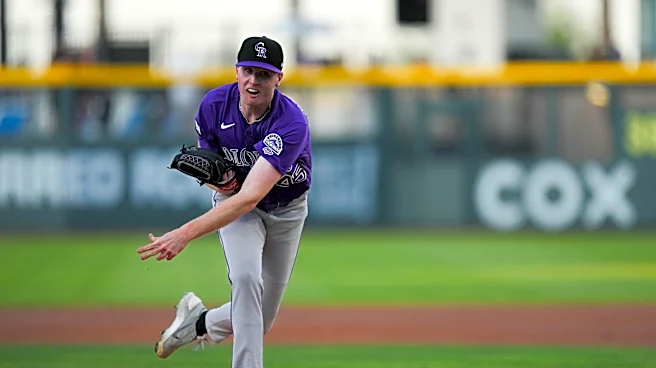
The Colorado Rockies didn’t give us much to celebrate in 2026, and with October baseball happening elsewhere, I’ve been relegated to staring at Rockies players’ Baseball Savant pages and rewatching old game footage.
Since I’ve already spent an unreasonable amount of time doing exactly that, I figured we might as well hand out a few awards.
Statcast measures just about everything imaginable on a baseball field, from bat speed and exit velocity to sprint speed and pitch velocity. Those numbers don’t
always tell the whole story, but they can reveal things about players that traditional statistics might miss.
These aren’t MVPs, Silver Sluggers, or Gold Gloves. Think less Cooperstown, more Dundies.
We’re simply recognizing some of the more interesting things Rockies players did in 2026. Only performances in a Colorado uniform count, with a minimum of 100 competitive swings for average bat speed and 100 tracked batted balls for average exit velocity. Take the measurements for what you will.
Without further ceremony to stand on, let’s dive in.
Batting
Fastest Bat: Sterlin Thompson (75.4 mph)
Thompson averaged 75.4 mph across 119 competitive swings in his brief major-league stint, narrowly beating Hunter Goodman (75.0) and Mickey Moniak (74.3). With MLB hitters averaging roughly 72 mph, Thompson brought some serious bat speed to the plate.
Highest Average Exit Velocity: Edouard Julien (90.8 mph)
Julien averaged 90.8 mph on 165 tracked batted balls, edging Goodman (89.8), Troy Johnston (89.7), and Moniak (89.7). That’s above the MLB average of roughly 89 mph, although the quality of his contact rarely translated into playable MLB production.
Hardest-Hit Ball: Hunter Goodman (116.2 mph)
On June 26 against Minnesota, Goodman crushed a two-run homer that traveled 451 feet. At 116.2 mph off the bat, it was the hardest-hit ball by a Rockie all season, reaching a level of exit velocity rarely seen even across MLB.
Six days earlier, Thompson had recorded an infield single with an exit velocity of just 32.6 mph, the softest non-bunt hit in our Statcast data.
That’s an 83.6-mph difference. One ball left the yard. The other barely left the infield.
Both counted as hits.
Lowest Chase Rate: Edouard Julien (18.6%)
Julien collects his second award after swinging at just 18.6% of pitches outside the strike zone, well below the MLB norm of roughly 28–30%.
Adael Amador (24.7%) and Kyle Karros (24.8%) also showed impressive restraint.
For all that discipline, Julien’s offensive results were very poor. He demonstrated an ability to avoid chasing bad pitches, but that alone wasn’t enough to make him a productive hitter.
Pitching
Fastest Pitch: Seth Halvorsen (101.9 mph)
On May 17 against Arizona, Halvorsen grabbed a strike against Geraldo Perdomo with a 100.7-mph fastball before upping the ante with a blistering 101.9-mph heater, the fastest pitch thrown by a Rockie all season.
Unfortunately for Halvorsen, Perdomo ripped it for a double.
Fastest Average Four-Seamer: Chase Dollander (98.9 mph)
Dollander averaged 98.9 mph across 280 four-seam fastballs, the highest mark among Rockies pitchers.
With the typical MLB four-seamer sitting around 94–95 mph, that’s serious velocity over a substantial number of pitches, not just one particularly hard throw.
How much of that velocity Dollander retains will be worth watching as he works toward a return from injury sometime in 2027.
Fielding
Strongest Arm: Cole Carrigg (96.9 mph)
Carrigg averaged 96.9 mph on his qualifying throws, ahead of Brenton Doyle (93.1) and Tyler Freeman (90.9). That’s exceptional arm strength even by major-league outfield standards, and nearly four mph harder than Doyle, who is known for a powerful arm.
His arm was capable of producing throws exceeding 100 mph, although getting the ball to its intended destination was another matter. On September 10 against the Yankees, Carrigg unleashed a throw that sailed over home plate.
But when he kept it on target, the results could be spectacular. On June 17 against the Cubs, Carrigg delivered a 99.8-mph throw to third base to complete a double play.
Two throws, two very different outcomes. The arm strength was never in question.
Most Outs Above Average: Ryan Ritter, TJ Rumfield and Chad Stevens (+2 OAA)
Our first three-way tie!
All three finished with two Outs Above Average, a Statcast measurement of how many additional outs a defender converts compared with expectations.
Doyle or Ezequiel Tovar might have been the names you’d expect atop this category, but neither finished with the team lead. OAA is a cumulative measurement influenced by opportunities, and while +2 isn’t exactly Gold Glove territory, it’s only one part of the defensive picture.
Rumfield showed off his reactions on July 18 against Cincinnati, diving to stop a 100.8-mph grounder from Edwin Arroyo before recovering to record the out at first.
Stevens demonstrated a different kind of defensive ability on June 2 against the Angels, ranging into shallow center field to make a reaching catch on a fly ball from Sebastián Rivero.
The Rockies’ defense was poor overall in 2026, but there were still individual contributors and moments worth appreciating.
Running
Fastest Runner: Jake McCarthy (30.0 ft/sec)
McCarthy averaged 30.0 feet per second, putting him in the 98th percentile across MLB and reaching Statcast’s threshold for elite sprint speed.
Carrigg followed at 28.7, with Braxton Fulford third at 28.6.
Fulford didn’t see much playing time, but his speed was undeniable, especially for a catcher. In fact, he was the fastest catcher in baseball by this metric.
McCarthy also led Colorado with seven runs of baserunning value, including five from taking extra bases and two from basestealing.
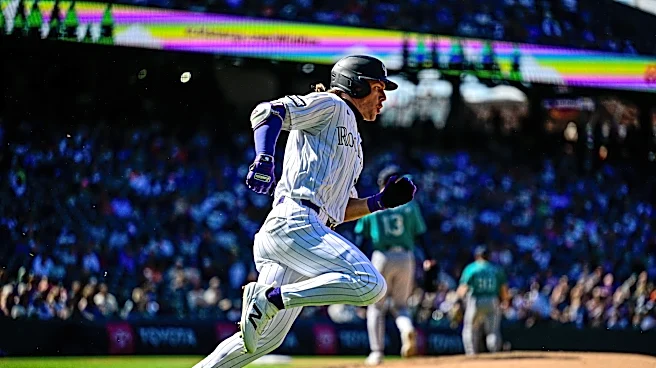
And if you want to see what that kind of speed looks like, consider his July 12 trip around the bases against San Francisco. McCarthy drove a ball into the spacious right-center-field gap at Oracle Park and never stopped running.
It was McCarthy’s second leadoff inside-the-park home run of the season, the first coming against Paul Skenes on June 20. He became the first player to accomplish the feat twice in one year since Edd Roush in 1929.
What it all means
Absolutely nothing in the grand scheme of things. These numbers won’t change the Rockies’ record or tell us much about what 2027 might hold.
But they do offer a few reminders that even in a season we’d rather forget, there were individual performances worth appreciating.
Congratulations to our winners!
Your trophies are imaginary, but the numbers are real.
Join the conversation!
Sign up for a user account and get:
- Fewer ads
- Create community posts
- Comment on articles, community posts
- Rec comments, community posts
- New, improved notifications system!
Download the SB Nation app on iOS or Android.
Please keep in mind ourPurple Row Community Guidelines when you’re commenting. Thanks!