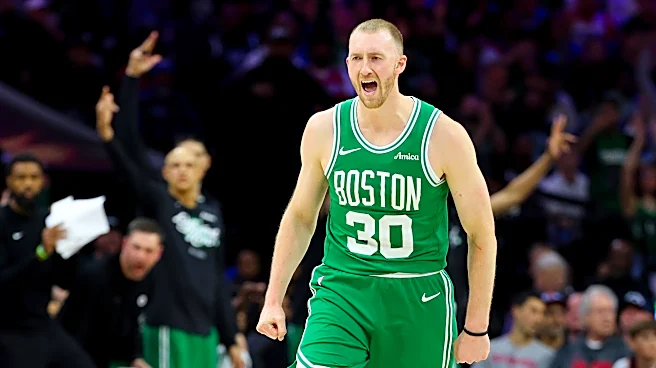






For the first time since he was a sophomore in high school, Sam Hauser finished a season of basketball shooting under 40% from three. At 39.3%, we’re just shy of being able to morally round up, and thus a brilliant streak of shotmaking has come to an end.
Unfortunately, a close to his Celtics tenure may not be far behind.
In many ways, Hauser had a strong season. He averaged career highs in points (9.2), rebounds (3.8), assists (1.5), and minutes (24.8). He also started in 49 games, which was more
than his previous four seasons combined. He had a relatively slow start to the year, but played a genuine part in helping the team vaporize the gap year notion by April.
The second half of the season was particularly encouraging. Over his last 45 games, Hauser started 44 and averaged 10.5 points while shooting 40% from three. He had games of nine and eight made threes in the final month, operating in easily the most prominent role of his career.
Hauser held the starting gig into the playoffs, and was even their most efficient three-point shooter, knocking down 16/38 (42.1%).
The unfortunate truth is that even with his strong shooting performance, Boston was considerably worse with Sam on the floor in their first-round loss.

A -16.3 net rating swing is hard to wrap your head around, especially when it’s the offense that took the largest hit. The answer is in the shot location data.
With Sam on the court, the Celtics attempted significantly fewer shots at the rim (16.9 frequency vs. 21.8 without him) and saw their three-point efficiency dip to 29.1%, compared to 38.2% in his absence. They leaned into far more midrange attempts as a result.
The explanation is not complicated. Hauser is a highly respected marksman, but he’s also third in the entire NBA in three-point attempt rate, with 83.9% of his field goal attempts coming from behind the arc. A team’s worries are limited to keeping vision on him and closing out hard. There is no true threat of a drive when the defense is in rotation — he finished the series with four shots at the rim.
None of this is meant to bury him. Hauser is a good basketball player. He’s a smart team defender, moves the ball quickly, and can shoot off movement as well as anyone on the roster. The Celtics have gotten a ton of value from this partnership.
That’s actually the point.
At some stage, you’ve seen everything a player can give you. Boston is at that stage with Sam Hauser, and they probably know it.
Hauser is a specialist with one of the more useful skills you can have in basketball. The questions this offseason aren’t really about what he is, they’re about how the Celtics can redistribute his minutes to build a flexible rotation.

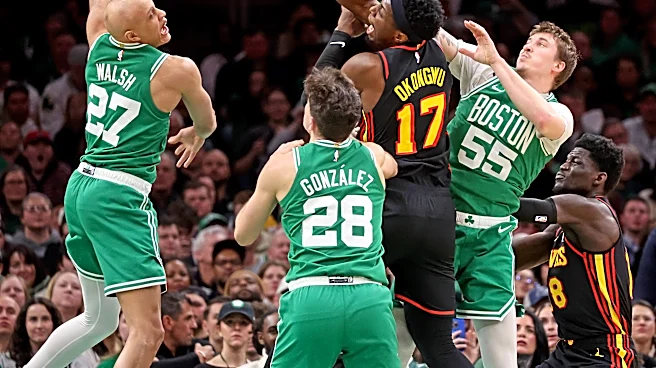
Jordan Walsh, Baylor Scheierman, Hugo Gonzalez, and Ron Harper Jr. project to be more dynamic two-way pieces. They bring athleticism, and while their skills are less refined, their roles are more malleable. Walsh and Gonzalez are wing-stopper types you can throw into matchups against the other team’s best perimeter options. Scheierman and Harper Jr. can make things happen on or off the ball, and have no hesitation to make a play when the ball swings their way.
The Celtics are elite at protecting the basketball, ranking first in limiting their own turnovers, but they rarely force mistakes, finishing second to last in steals. While Hauser is a solid positional defender, he has a conservative style that doesn’t generate many deflections or turnovers. Shifting minutes to that group would be an injection of defensive playmaking and help the Celtics build on their advantage in the possession battle.
Opening the door to see if any of them can take another step forward is in the Celtics’ best interest, and Hauser is the right option to make that happen.
His contract is clean and genuinely good value — four years, roughly $11.6 million annually through 2028-29. A lot of teams need supplementary shooting and haven’t grown their own. Boston has built the infrastructure to handle the loss of a shooter like Sam.
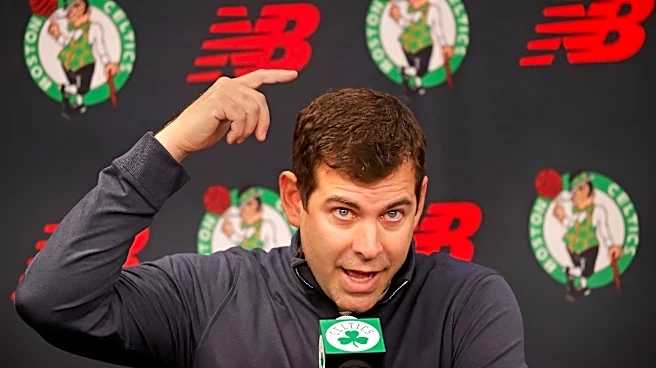
Brad Stevens spoke candidly in his end-of-season press conference about the Celtics’ lack of rim pressure contributing to their early exits the past two years.
“One of the things we’ve got to figure out is how to have more of an impact at the rim. And we do need to add to our team to do that,” Stevens said.
As much as the organization values Hauser, he is a culprit in their rim pressure deficiency. He also likely represents the most tradable contract to find help in that regard.
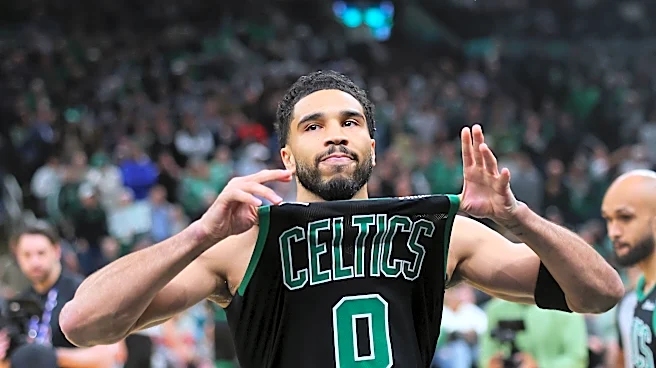
The Celtics’ salary picture makes this even clearer. Tatum, Brown, and White account for 77.7% of the active roster payroll. Everything below them drops quickly to rookie contracts and minimums. Hauser’s $10.8 million next season is the closest thing Boston has to a mid-sized contract. It’s the most realistic tool in trade conversations, and the easiest pathway if the Celtics want to acquire a proven impact player without dismantling their core. Hauser’s contract would get them in the ballpark, and his shooting ability should make him an attractive trade target rather than just a number on a spreadsheet.
Hauser has been a great success story for this front office. He developed from an undrafted unknown into a reliable rotation piece on a championship team. The issue isn’t about what he is doing wrong, but that the Celtics have likely capped out in terms of how much value they can get from him as the first wing on the floor after Brown and Tatum.
They have an opportunity to pivot away from their flaws into a more dynamic version of themselves. Finding someone who can threaten the paint off a closeout, while opening the door for the wing group to develop, is a good place to start building the next great version of this team.