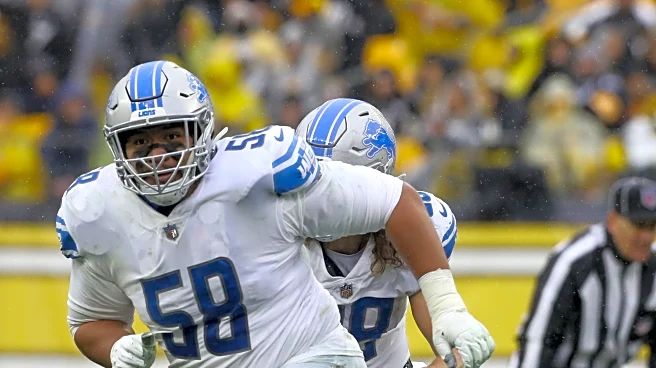

Well, well, well. Look what the cat dragged in. The Detroit Lions return to Ford Field for the home season finale against the 42-year-old Aaron Rodgers, making his 27th career start against Detroit, as the Lions look
for their 16th straight win following a loss, a streak dating back to 2022.
Back in 2021—the last time the Lions played the Steelers—Detroit was desperate for answers and wins. Dan Campbell took over play-calling duties from Anthony Lynn against a Steelers team riding a four-game winning streak, and it resulted in a 16–16 tie, the first non-loss of the Campbell era. Now, Campbell is back behind the play-call sheet once again, with the Lions needing a win in the worst way as the Terrible Towels head to Motown.
Both the 8–6 Lions and 8–6 Steelers are fighting for their playoff lives, and they’ll be doing so while navigating what could be a revolving door on the offensive line for both teams due to injury. That matters a lot. A lot of what decides this game is going to start, and possibly end, up front.
Here are five key statistical matchups that could swing it.
Note: Unless otherwise indicated, all statistics are sourced from NFL Pro, TruMedia, FTN Fantasy, or Pro Football Reference.
More 13-personnel the merrier
Similar to the Rams preview, you can’t talk about the Steelers’ offense without talking about their 13-personnel usage. Under offensive coordinator Arthur Smith, Pittsburgh leans into 13-personnel on 15.0% of their offensive snaps (2nd), deploying tight ends Darnell Washington, Pat Freiermuth, Jonnu Smith, and occasionally H-back Connor Heyward to fully embrace the offense’s condensed, heavier-set identity.
Fortunately for the Lions, the Steelers’ run game doesn’t actually gain much from loading the field with extra tight ends. Their rushing efficiency dips from 3.9 yards per rush overall (28th) to 3.8 yards per rush out of 13-personnel, while their rushing success rate slides from 49.1% (7th) to 48.1%. Their explosive run rate also drops from 5.4% (t-28th) to 3.7%. The lone area of improvement comes in yards before contact per rush, which rises from 1.14 (27th) to 1.37.
While Jaylen Warren and Kenneth Gainwell are a solid enough duo, this isn’t a rushing attack that should scare Detroit—especially with Pittsburgh down both left tackle Broderick Jones (IR) and left guard Isaac Seumalo (out) and center Zach Frazier dealing with a triceps injury. The Rams gashed the Lions on the ground, particularly out of 13-personnel (25 carries, 138 yards, three touchdowns), but this should be a ground game that Kelvin Sheppard’s defense can control, limit damage against, and potentially force negative plays. Notably, the Steelers’ stuff rate jumps from 16.6% overall to 23.5% when operating out of 13-personnel. Bottle it up, get them behind the sticks, and keep the defense from getting stuck on the field for extended stretches.
Where 13-personnel does help Pittsburgh is in the passing game, giving Aaron Rodgers a tight-end-centric look that improves production across nearly every metric.
Note: Unless otherwise indicated, all statistics are sourced from NFL Pro, TruMedia, FTN Fantasy, or Pro Football Reference.
Pittsburgh Steelers — 13-personnel passing offense
- 98.9 passer rating
- 68.9% completion percentage
- 47.6% success rate
- 0.00 EPA/dropback
- 11.1% explosive play rate
Not breathtaking numbers by any means, but that’s the reality of the Steelers’ passing offense under their weathered signal caller. And 13-personnel remains one of their most effective groupings when they’re hucking it. Despite the heavier bodies on the field, Pittsburgh still generates an impressive 6.24 yards after catch per completion from 13-personnel. That figure would rank third league-wide from all personnel groupings, trailing only their own overall mark (6.89) and the Lions (6.33).
Detroit’s linebackers and defensive backs will need to be ready to corral some large, hard-to-bring-down bodies like Washington and Metcalf, limiting the extra yards that quietly prop up this offense.
The Steelers have five players ranked inside the NFL’s top 30 in receiving yards from 13-personnel, led by Metcalf’s 139 yards (3rd) and Freiermuth’s 62 yards (15th). How the Lions handle Metcalf and the tight ends in coverage matchups will be one of the more intriguing chess matches in the game plan. If the Lions can keep 13-personnel from snowballing against them (again), the Steelers will be left asking Rodgers to win the game with an offense that doesn’t exactly scare anyone.
Let’s make this short and quick
At this stage of his career, much like late-career Ben Roethlisberger, Aaron Rodgers is deathly allergic to contact. Like my dog and the bathtub, he’ll do just about anything to avoid it.
Rodgers is tied with Tua Tagovailoa for the lowest average time to throw in the NFL at 2.65 seconds, while his 5.7 average depth of target ranks dead last among qualifying quarterbacks. Only 31.8% of his passes travel to or beyond the first-down marker, also last in the league. To stay upright, Rodgers is living on quick, short throws that effectively function as an extension of the run game—a defining trait of the Steelers’ passing offense right now.
Defensively, the Lions have faced the second-fewest pass attempts of 2.5 seconds or less this season (210) and the second-fewest passes of five air yards or fewer (198).
Lions pass defense — Short (≤5 air yards) & Quick (≤2.5 seconds)
- 125 pass attempts (31st)
- 8 passing touchdowns, 1 interception
- 5.0 yards/attempt (t-10th)
- 81.6% completion percentage (20th)
- 105.7 passer rating (23rd)
- 50.4% offensive passing success rate (t-16th)
- -0.04 EPA/dropback (t-19th)
- 6.4% explosive play rate (24th)
- 13.6% pressure rate (20th)
Unfortunately, the Lions’ pass defense hasn’t just struggled recently—it has been consistently below average all season against short, quick passing attacks. Teams have been able to chew up coverage for cheap yards with “pea shooters” that double as a run-game substitute, exactly what the Steelers will attempt to do. Those numbers dip even further against man coverage, where Detroit has already faced 49 short, quick attempts — the sixth-most in the league.
The area where the Lions must win—and have had success—is limiting yards after the catch. Detroit allows just 4.3 YAC per completion overall (t-2nd) and only 5.1 on short, quick throws (t-3rd). That ability will be critical against Pittsburgh. On those plays, when Aidan Hutchinson and the pass rush can’t meaningfully impact Rodgers—the Lions have generated just 29 quick pressures this season (t-26th)—coverage discipline and tackling become non-negotiable. That matters even more considering the Steelers rank among the league’s worst passing offenses on plays requiring 3+ seconds to throw, where they’re far more prone to sacks, turnovers, and incompletions (and, surprisingly, haven’t even drawn a vintage Rodgers DPI prayer yet). The quickest way to the quarterback is right up the middle, so Alim McNeill and the interior pass rush could play a huge role in disrupting the quick rhythm throws if they can step up.
Make Rodgers uncomfortable, erase the easy throws, and suddenly the Steelers are asking a 42-year-old quarterback to survive a game he’s been trying to avoid all season.
Possessions not at a premium
Two other areas where the Steelers’ offense consistently loses on the margins show up in their inability to sustain drives and control the game.
Pittsburgh ranks last in the NFL—somehow even behind the Raiders—in average time of possession at just 27:26. It’s been even worse over the last three games, where they’ve gone 2-1 despite averaging only 25:56 with the ball.
They’re also second-worst in the league, ahead of only the Raiders, with a 41.8% three-and-out rate. That figure is the third-worst single-season mark by any team since 2021 and sits in the bottom 10 league-wide over the past decade.
That combination should allow the Lions offense to live on the field while keeping their defense from being overworked or gassed. It’s an opportunity for Detroit to reassert its identity—dictating tempo, controlling possession, and playing the game entirely on its own terms.
Lack of Watt-age
Four-time First Team All-Pro T.J. Watt will miss just the 13th game of his nine-year career. Last week marked only the second win the Steelers have ever recorded without him, as they now sit at 2-10 in games Watt has missed.
Pittsburgh will also be without one of its other productive edge rushers in fellow Wisconsin alum Nick Herbig, who would normally fill in opposite Alex Highsmith. With both Watt and Herbig sidelined, that responsibility now falls to Day 3 rookie Jack Sawyer.
Even if Watt hasn’t been quite as dominant as his peak seasons, he remains a monster on the edge. Evaluating Steelers defensive metrics from this season can get thrown out the window because of how drastically the Steelers’ defense changes without him — especially with Herbig also out. Over the past three seasons since Herbig was drafted, Pittsburgh has played roughly 180 snaps (about three games’ worth) without either edge on the field, and the results have been ugly.
With both players available, the Steelers allow a 44.8% offensive success rate. Without them, that number balloons to 52.2%—a figure that would rank worst in the NFL over that span—while also surrendering a 50.0% third-down conversion rate (32nd).
Despite Pittsburgh still fielding a strong interior defensive line featuring Cameron Heyward, Keeanu Benton, and rookie Derrick Harmon—and despite the Lions recently navigating a gauntlet of interior fronts from the Eagles, Cowboys, and Rams—this matchup shifts without the threat of a presence on both edges. Against a familiar face in defensive coordinator Teryl Austin, and without Watt and Herbig, Detroit should be able to exploit defensive flaws that are typically masked by heat off the edge, particularly in the second and third levels.
Post-It Note
The Steelers have had no semblance of consistency at safety this season, cycling through the junk drawer of journeymen. Jalen Ramsey, Kyle Dugger, Juan Thornhill (since released), Chuck Clark, DeShon Elliott, and Jabrill Peppers have all logged at least 100 snaps, with Pittsburgh most recently relying on the converted cornerback Ramsey alongside the acquired Dugger.
One of the most vulnerable areas in their zone-heavy scheme—exacerbated by that lack of continuity—has been defending post routes. The Steelers have allowed 15 completions on post routes this season, the second-most in the NFL. In total, offenses are 15-of-21 throwing to posts against Pittsburgh, good for a 71.4% completion rate (31st), a 145.4 passer rating (29th), 280 yards, and two touchdowns.
Unfortunately for Pittsburgh, Jameson Williams specializes in vaporizing coverage on post routes. This season, Williams has eight receptions on posts (t-3rd), 240 receiving yards (3rd), one touchdown, and 104 yards after the catch (2nd).
Look for the Lions to take at least one deep shot to Williams—and for the Ford Field faithful to try to tear the roof off in response.