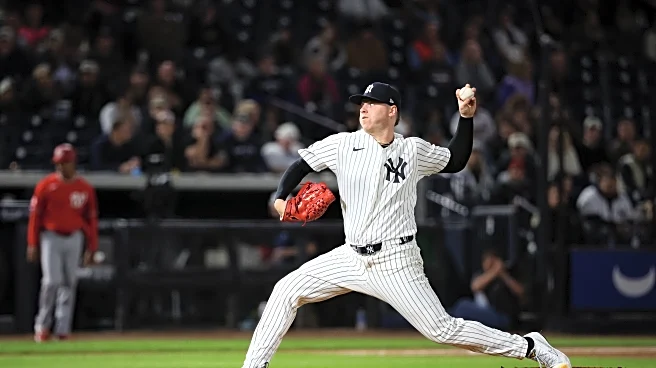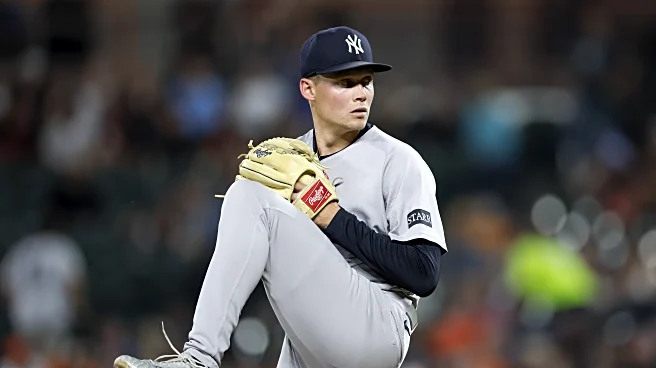

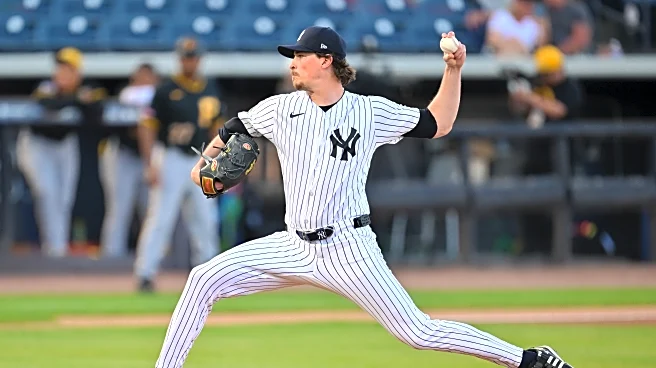
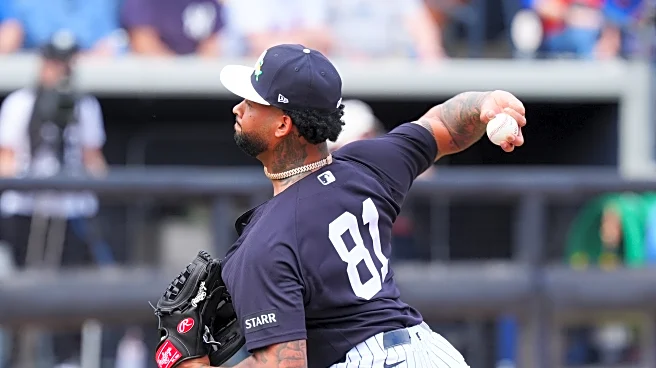
When Gerrit Cole was forced to miss the 2025 season with Tommy John surgery, several young pitchers were forced to step up ahead of schedule to provide valuable innings in the ace’s stead. Cam Schlittler stole headlines with his late season surge, however there was another rookie pitcher who was arguably just as impressive, just in a different fashion. Will Warren was quietly one of the best rookie starters in MLB last season, and he is poised to take another huge step in his development at the major
league level in 2026.
2025 Stats: 33 starts, 162.1 IP, 9-8, 4.44 ERA (92 ERA+), 4.07 FIP, 3.91 xFIP, 24.1% K%, 9.1% BB%, 1.22 HR/9, 1.37 WHIP, 2.1 fWAR
2026 FanGraphs Depth Charts projections: 43 appearances (21 starts), 132 IP, 7-8, 4.25 ERA, 4.14 FIP, 22.9% K%, 8.3% BB%, 1.23 HR/9, 1.30 WHIP, 1.4 fWAR
Among all rookie pitchers in 2025, Warren finished with the most starts (33), innings pitched (162.1), and strikeouts (171), while accumulating the sixth-most fWAR (2.1), establishing a floor as a bona fide backend MLB starter, while also flashing glimpses of a ceiling of being able to dominate an entire lineup — like he did when he struck out ten Rangers across 5.2 scoreless innings in May.
Of course, it’s also hard to forget him giving up seven runs in relief in Game 2 of the ALDS against the Blue Jays. We can chalk that up partially to a rookie pitcher being thrust into the cauldron of his first playoff experience — plus, it’s not like any of the Yankees pitchers pitched particularly well against a Blue Jays offense that was all hitting their stride at the same time.
Warren showed he has the stuff and pitchability to stick at the back of any major league rotation, the question in 2026 being opportunity. He faces a similar situation to the start of last year, when he was guaranteed a rotation spot while the team dealt with injuries to their other starters. FanGraphs Depth Charts projection system expects that he will make 21 starts before being moved to the bullpen once Gerrit Cole and Carlos Rodón return from their elbow surgery rehabs.
There are several things Warren can do to ensure that his name is one of the last to come up for consideration for a demotion from the rotation when Rodón and then Cole are brought back into the fold, and encouragingly it looks like he is already working on those improvements this spring. He struck out three in each of his first two scoreless spring starts, but it’s process rather than results I would like to look at.
The thing that has caught my eye the most this spring is Warren’s four-seamer. The pitch is operating about a mile per hour faster than it did last season, with roughly two inches more induced vertical movement (rise) and roughly two inches less horizontal movement arm-side. The result in those first two starts was ten swings and misses on 27 swings for an eye-popping 37-percent whiff rate (for reference, only four qualified pitchers — Edwin Díaz, Edwin Uceta, Devin Williams, and Mason Miller — had better than a 37-percent whiff rate on their four-seamer in 2025).
One of the biggest subjects of pitching research in 2025 was the importance for starting pitchers to throw multiple types of fastball, be that the four-seamer, sinker, or cutter. I’ve written multiple times on the site how important it was for Warren to follow that trend, noting the similarity between him and Michael King and how the Yankees’ former pitcher leveraged that approach to becoming one of the most coveted free agent starters this past winter.
The ability to separate the four-seamer and sinker into two discrete pitches with divergent movement profiles is as key for Warren as it was for King. Because of how similar the two pitches look out of the pitcher’s hand, having a four-seamer that stays on plane versus a sinker that dives downward arm-side creates so much uncertainty for the hitter and the swing path needed to make contact. With the increased riding life and decreased horizontal run, Warren’s four-seamer now flies even straighter than the sinker, which is why you saw hitters whiff underneath four-seamers that were well inside the zone in the video of his first two spring starts.
For a pitcher who throws his fastballs as much as Warren — his four-seamer and sinker earned a combined 62.6-percent whiff rate with about two four-seamers thrown for every sinker — it would behoove Warren to improve the raw characteristics of those pitches. Indeed, with the increased velocity and induced vertical break, Warren’s four-seamer has earned a Stuff+ grade of 110 this spring after grading out as roughly league average last season. There were times last season where Warren would throw a fastball in the zone when the count leverage favored a secondary for chase — and indeed Warren stands to benefit from scaling back his fastball given how nasty his sweeper, changeup, and curveball are — so possessing a four-seamer with better raw stuff should mitigate damage if he continues to deploy it in this manner.
I’m expecting big things for Warren in 2026. It’s true that he will have to fend off the likes of Cam Schlittler, Ryan Weathers, and Luis Gil if he wants to retain his rotation spot when Cole and Rodón return. However, he has continued to demonstrate this spring that he is a process-oriented pitcher always looking for ways to improve, which is why I feel Warren can work his way to becoming a mainstay of the Yankees rotation this season.
See more of the Yankees Previews series here.