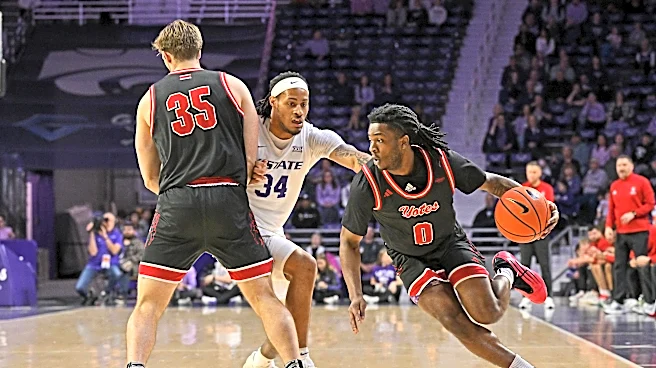








With portal season winding down, Missouri still had two items on its shopping list: a ball handler inclined to facilitate and a floor spacer whose shot keeps defenses from packing the paint.
On Tuesday, the program filled the shooting need with South Dakota guard Jordan Crawford’s commitment, which came one day after an official visit to Columbia.
The North Carolina native averaged 14.9 points and 1.4 assists last season. More importantly, his 40.3 percent 3-point mark off the catch stands out. Even if that number slips against SEC foes, Crawford should still profile as the roster’s top floor spacer. Missouri also saw him up close when he dropped 18 points in the Coyotes’ loss at Columbia.
Now, there are reasonable questions about his ability to create for others or defend consistently. Yet it’s also important to remember that he’s being imported to supplement depth, likely toward the middle of the rotation. Moreover, the market has reached a point where the shelves are mostly filled with imperfect options.
Put simply, the players still looking for homes are those whose skill sets are best suited for a specialist role. For Crawford, this means being primarily valued for his shooting ability as a floor spacer rather than as a primary ball handler or creator.
Through that lens, bringing in Crawford is a logical move.
Let’s Meet Jordan Crawford
- From: Charlotte, North Carolina
- Previous School: South Dakota
- Position: CG
- Ht/Wt: 6-3/178
- 247Composite Ranking: NR
- EvanMiya Forecasted BPR: 0.09 (No. 1,022)
Once again, the easiest selling point with Crawford is his jumper.
Injuries to Isaac Bruns and Shey Eberwein pressed him into a more expansive role for the Yotes, but Crawford anchored his game in canning triples. Knocking down 36.9 percent of those attempts on high volume is what likely piqued MU’s interest. So, when we look at his body of work, we need to understand that he took on pick-and-roll opportunities out of necessity.
Once we dig into the data, spot-up touches dominate. This helps provide more context for his work on ball screens. When turning the corner, Crawford hunts pull-ups instead of applying rim pressure. As a result, his playmaking stays modest — an 8.8 percent assist rate reinforces that he’s more a finisher than an organizer.
When watching Crawford’s work as a spacer, few surprises emerge. A healthy portion of those attempts resulted from spacing in five-out sets. While he doesn’t get a ton of lift, Crawford possesses mostly clean mechanics. There’s a slight dip after the catch, but his shot pocket is still relatively high. He keeps his shot compact with a high release point, and it’s quick enough to get off clean against quality closeouts.
On the other hand, the remainder of Crawford’s scoring profile is less compelling.
For example, he shot only 45.9 percent from inside the arc, and his free-throw rate (25.7) suggests he wasn’t hunting contact on drives. In other words, Crawford’s drives were opportunistic, and his finishing was functional. Examining his rim attacks from spot-ups further underscores what the data conveys.
Even with an open lane, Crawford doesn’t get much vertical pop. As a result, some layups become contested runners, floaters, or off-balance scoop finishes. Importantly, keep in mind that the Summit League, one of the nation’s weaker defensive conferences, isn’t filled with rim protectors.
The SEC, by contrast, is known for fierce rim protection and regularly features tough defense around the basket.
Additionally, Crawford’s PNR opportunities weren’t always a feature of USD’s offense. Instead, they typically appeared in secondary or late-clock situations. His pull-up triples from high PNRs also show he needs coverages that grant him airspace — namely, a big in drop or a guard going under.
These distinctions drive home that the best version of Crawford comes from fitting into a clearly structured offense, where he finishes what others start. He can attack some closeouts, make fundamental reads as a scorer in PNRs and keep an offense flowing. Yet his profile and film imply that he can help stabilize a lineup.
We can see that by looking back at South Dakota’s lineup data. Before Bruns went down with a season-ending foot injury, he and Crawford forged a partnership that produced healthy net ratings. But those robust margins narrowed after Bruns was sidelined — and in groups where Crawford’s duties as an initiator expanded.
While that may sound modest, it doesn’t diminish his potential value.
Crawford doesn’t turn the ball over. He creates some gravity with his jumper, imposing a toll if defenses sell out to clog gaps. That has critical utility in lineups that will rely on Jason Crowe Jr.’s shot creation, Jamier Jones’ forceful downhill drives, and frontcourt players who — for now — rely on drop-offs and lobs around the rim.
However, the larger issue with Crawford comes on the defensive end.
Per Synergy Sports data, he ranked in the 23rd percentile nationally on possessions that unfolded in the half-court, while other wonky metrics suggest he created some drag on a team that struggled on that end of the floor. Crawford also struggled against quality competition, allowing 1.377 points per possession against teams that finished in the top 150 of KenPom.
Now, those shaky metrics are tolerable when a player brings some disruption or playmaking, like creating steals. A player can also offset them by helping with the glass. Unfortunately, Crawford doesn’t tick those boxes.
That said, he was also on the floor as a member of some stronger defensive units, including one that allowed just 74.1 points per 100 possessions. The caution, of course, is ascribing too much credit to Crawford, but team-level data suggests he can operate within a well-organized unit. And in Columbia, he’ll be surrounded by wings with positional size and a frontcourt that’s not lacking length and mobility.
A granular accounting of Crawford’s defensive profile reinforces that tension.
If we limit our view to his most common plays on that end of the floor, his performance (0.873 PPP) grades out close to Division-I average. That’s tolerable for a player who is likely to play a supporting role. Calling up footage of those possessions also induces a fleeting sense of optimism.
Closing down shooters, for example, doesn’t produce many highlights. But it’s also the kind of routine task that has undercut MU’s ongoing efforts to field a defense that is better than average.
Similarly, there were stretches last season where Crawford didn’t look like a player who finished in the 18th percentile nationally for guarding pick-and-rolls. At times, he could even create a bit of chaos in high PNRs that resulted in takeaways.
That said, MU still faces a tough balancing act. The program has spent much of the spring acquiring players capable of executing a scheme that prioritizes pressure, switching and flexibility. Even if you’re charitable in assessing Crawford’s performance, he still cuts against the identity that MU appears intent on crafting.
Advanced statistical models tell a straightforward tale: Crawford can make a very real — but narrow — contribution on the offensive end. The question is whether those marginal gains are enough to offset the risk of giving them back on defense.
At a lot of mid-major programs, the fit would be easier to envision. Crawford’s shooting and low turnover rate would pack enough punch that a team could absorb some defensive limitations. The use case is different at a high-major operation. For Gates and his staff, the trick is figuring out how to fit Crawford into lineups that offer enough defensive coverage.
Recent history tells us they can find ways to optimize mid-major transfers like DeAndre Gholston, Marques Warrick and Jayden Stone. But in each of those seasons, there was defensive slippage when those players checked in.
Balancing that tradeoff, which has been elusive over four seasons, will go a long way toward dictating how impactful Crawford can be.