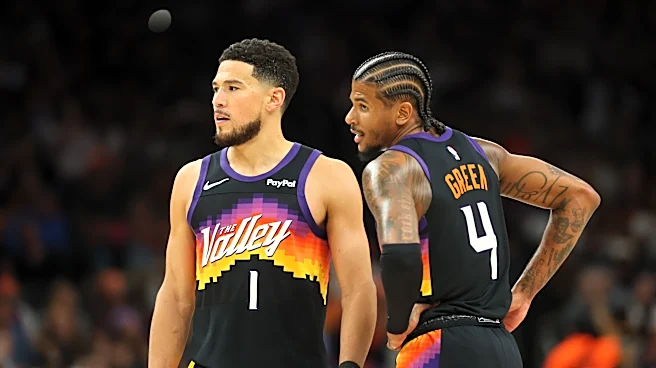




Although the NBA Playoffs are far from over, the Suns’ season is a wrap, and Phoenix fans are already more concerned with offseason things than who ultimately gets to lift the Larry O’Brien trophy. The internet is full of Suns trade proposals and free agency talk, with a little draft speculation thrown in here and there.
In this article, I’m not going to speak on what the Suns should do, but rather what they can do, how they can get things done, and the tools they have to work with.
First, let’s look
at some key league thresholds for the 2026-27 season:
- Cap: $165 million
- Luxury Tax Threshold: $201 million
- First Apron: $208 million
- Second Arpon: $222 million
Salary Cap SITREP
Second, let’s summarize where the Suns stand right now.
The Suns are currently looking at a cap sheet of $185,670,477 for 11 players (and $23.2 million in dead money) under standard NBA contracts for the 2026-27 season. That puts them over the cap and just $15,329,523 under the luxury tax threshold. They have three players — Highsmith ($1 million guaranteed), Bouyea (non-guaranteed), and Ighodaro (non-guaranteed) — on contracts that aren’t fully guaranteed or are club options ($6,898,968 total value). If they were not to bring back any of those three, it would get them a total of $178,771,509 in guaranteed salary and put them $22,228,491 below the luxury tax threshold.
One thing to keep in mind is that the luxury tax threshold is NOT the same as the first tax apron line. The first apron is $8 million above the luxury tax threshold.
Phoenix starts out the offseason $23,329,523 below the first tax apron, but could get that up to $30,228,491 by waiving the three players on non-guaranteed contracts. While that extra $6.9 million of space added to the cap sheet cushion by waiving three non-guaranteed contracts might look good at first glance, it doesn’t actually cover the cost of replacing them with three other players on vet minimum contracts. Yes, it would actually cost more to do that unless the replacements were all players with one year of experience or less. As doing it really wouldn’t help free up a significant amount of salary to use elsewhere, I won’t mention it again. Another thing that isn’t a concern regarding the cap sheet is two-way contracts, because they don’t count against the cap.
In short, here’s where the Suns stand at this moment:
- Usable Cap Space: None
- Space Under the Tax Threshold: $15,329,523
- Space Under the 1st Tax Apron: $23,329,523
- Space Under the 2nd Tax Apron: $36,329,523
That’s going to make it very difficult to re-sign their own free agents without going over the first tax apron and virtually impossible to re-sign them without paying luxury taxes this season. The only possible way to do that would be to make some drastic cost-cutting trades to shed a lot of salary…and doing that could be much harder than you expect.
According to Spotrac’s Keith Smith, he’s projecting only 4 teams will have enough open cap space to just take on salary without sending much or any back in return.
While deals with any of these teams could be made, it’s a good bet the Suns wouldn’t be the only team calling them to work out deals to shed some of their own salary. That doesn’t mean it would be impossible, though.
Shedding salary works in the Suns’ favor in two ways. First, it gives them more space to operate in and potentially avoid the tax aprons. Second, it could give them a bit more flexibility in pursuing free agents other than their own. Having Bird rights (Mark Williams) and Early Bird Rights (Collin Gillespie and Jordan Goodwin) allows them to go over the aprons to re-sign them. No worries there.
For signing other free agents, they have to rely on “exceptions” rather than cap space to do so.
Exceptions Available to the Suns
Author’s Note: All salary figures denote maximum amounts allowed for the first salary year of the contract.
Full (non-taxpayer) Mid-Level Exception: $15,049,000 (up to 4 years)
While the Suns will have enough space under the tax threshold and the first tax apron to use the full MLE to sign a free agent, using it hard caps a team at the first tax apron. If the Suns were to use it, that would leave them with only $8 million to sign other players, including re-signing all of their own free agents. Use the Full MLE, without shedding a LOT of salary first, and we can only wave goodbye to the possibility of bringing back Collin, Goodie, and Mark W. There is no way around a hard cap. None.
Yes, it’s possible to shed enough salary to make using this exception practical, but I’ve already gone over the likely difficulty in doing that, so it’s best to just shelve the idea of using the full MLE. Although going over either of the tax aprons is undesirable, not having the option of going over the first apron greatly hamstrings the front office if they are serious about putting a better team on the floor in 2026-27.
Taxpayer Mid-Level Exception: $6,066,000 (up to 3 years)
The TPMLE is actually a portion of the full MLE that can be used by tax-paying teams as well as any team over the cap. It’s worth only 40% of the full MLE, but using it doesn’t hard cap the team at the first tax apron. It does, however, hard cap the team using it at the second apron. Since the Suns definitely want to avoid going over that, consider this as their main option to sign a free agent (other than their own) this offseason. It’s not a lot to work with, so don’t count on landing a big fish with it, although it could be enough to bring back a solid rotation player.
Although both forms of the MLE can be split in order to sign more than one player, teams are only allowed to use one form of the mid-level exception in a given season.
Bi-Annual Exception (BAE): $5,478,000 (up to 2 years)
While this is available to the Suns, it also hard caps teams that use it at the first tax apron. See my comments in the Mid-Level Exception portion of the article on why this is a “bad thing”.
Second-Round Pick Exception: $2,450,000 (up to 4 years)
This can be used to sign a player to either a three-year contract that includes a third-year team option or a four-year contract with a fourth-year team option. Players who are signed using the second-round pick exception won’t count against a team’s cap between July 1 and July 30 of their first season. That allows teams to preserve all the cap room they need until July 31 without having to worry about their second-rounders cutting into it and allows those players to sign their first NBA contracts before taking part in Summer League games.
Veteran Minimum Exception: $2,450,000 (up to 2 years)
Teams have unlimited use of this exception to fill out their rosters unless doing so would violate an existing hard cap.
Traded Player Exceptions (TPE)
- $5 million (Nick Richards), expires 2/5/27
- $2 million (Nigel Hayes-Davis), expires 2/5/27
Here are the rules for using TPEs:
- TPEs cannot be combined with each other or with players to acquire a higher-salaried player.
- They can only be used to acquire players via trade, not to sign free agents.
- Teams can use them to take in up to $250,000 more than the TPE value (if under the first apron).
On the surface, these TPEs don’t seem to be very valuable, but they could be very handy in certain situations. For example, if the Suns have a trade set up to send out Royce O’Neale’s $10.9 mil salary in exchange for two players, one making $10 million and the other making $5 million, they don’t need a TPE to make it work but by taking back more than 100% of the salary they send out hard caps them at the 1st tax apron…unless they use the $5 million TPE to absorb the seocnd player’s salary which helps them avoid the hard cap. They basically get to apply a salary imbalance from a previous trade to a new one, which counts on the books as the Suns sending out more salary than they received.
More on Avoiding a 1st Tax Apron Hard Cap
Last season, 27 of the NBA’s 30 teams ended the season hard capped at either the first (19) or second tax apron (8). There are multiple ways to get hard capped at either of the two, but here I’m going to concentrate only on the first tax apron. There’s no way the Suns should even consider going over the second tax apron again, so getting hard-capped there isn’t something we need to be concerned about.
With over $23 million in dead money on their cap sheet, the Suns’ odds of fielding a team better than the one they had this past season aren’t good…unless they’re willing to not only pay luxury taxes again AND take a step or two over that first tax apron line. Yes, they could take measures to cut salary from their cap sheet to stay under it, but those won’t be easy to do and would most likely result in a roster less talented than last season’s.
That’s why it’s important to avoid a first tax apron hard cap. To do that, they have to avoid doing any of the following:
- Use the bi-annual exception (BAE) to sign a player to a contract or to acquire a player via trade or waiver claim.
- Use more than the taxpayer portion of the mid-level exception to sign a player to a contract.
- Use any portion of the mid-level exception to acquire a player via trade or waiver claim.
- Acquire a player via sign-and-trade.
- Sign a player who was waived during the regular season and whose pre-waiver salary was higher than the non-taxpayer mid-level exception.
- Use an outgoing player (or multiple players) in a trade for matching purposes to take back more than 100% of the outgoing salary.
A Final Note on Trades
While I’m not proposing that the Suns should use any of their very limited supply of future draft picks as trade sweeteners this offseason, they can, and here is a list of their tradable picks:
2026: 2nd round pick (47th)
2027: 1st round pick (least favorable of Cleveland, Minnesota, and Utah)
2029: 2nd round pick (own)
2033: 1st round pick (own), 2nd round pick (own)