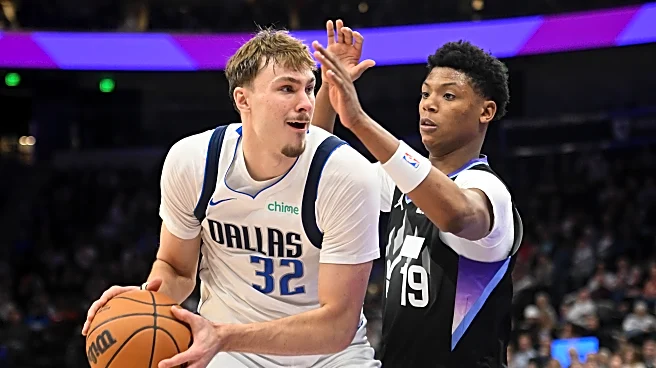

The 2025-26 NBA rookie class is absolutely packed with characters certain to draw intrigue from all corners of the basketball map. Of course, you have your Cooper Flagg, VJ Edgecombe, and Kon Knueppel
upper-echelon of players who seem poised to one day control the ground they walk upon, but it isn’t challenging or interesting to talk about how excellent Dylan Harper is as a downhill attacker, or how seamless a fit Derik Queen has proved to be in a professional environment. I could harp on about the unexpected 3-point renaissance ushered by Brooklyn’s Egor Demin. I could rave about Cedric Coward and his miraculous journey from basketball limbo to becoming one of the most promising young players in his class.
Those topics have been discussed to death and will continue to be the headlines of their respective memoirs, biopics, documentaries, etc. More studious individuals than I have the patience to dive play-by-play into each of these players’ bodies of work to this point in the year. I’ll leave the in-depth, broad-stroked analysis to those characters.
Here’s what captures my attention: a player whose arrival was preceded by the promise of salvation to an organization in desperate need of a hero. The prize of a team that had gutted itself, tearing its foundation to meager scraps, all in the hopes of acquiring an all-world talent. An individual who carries a tremendous burden of expectation — an expectation both to elevate the ceiling of his team and to ascend to stardom.
The Utah Jazz tanked in 2025. They tanked hard. And after successfully finishing with the fewest wins in the entire association, their great reward arrived via a reverse-order, lottery-finalized draft. That reward was Airious “Ace” Bailey.
Ace has not been the most impressive rookie in his class. He won’t get many votes for Rookie of the Year. He may not even be the go-to guy when Utah is finally prepared to compete for more than just a spot in the playoffs. Ace Bailey is a mystery; one with tremendous promise, but a mystery nonetheless. So, what does Utah have in its bright-eyed rookie forward? Where does he stand among his fellow rookie classmates, and where does his roadmap lead to?
Welcome to the rookie ladder: just as they arrived, each of these newbies has a spot on the totem pole. That order has changed since draft night, and understanding the “why” and the “how” will be critical in projecting future development in the NBA. Keep in mind, of course, this is the rookie landscape through my eyes, meaning it is far from inarguable. I am aware of this fact.
NBA Rookie Ladder, January 2026:
Name, Draft Position, Season Stats:
- Cooper Flagg (1) – 18.8 pts, 6.3 reb, 4.1 ast
- Kon Knueppel (4) – 19.0 pts, 3.5 ast, 43.5% 3pt
- VJ Edgecombe (3) – 15.6 pts, 4.3 ast, 1.5 stl
- Dylan Harper (2) – 10.6 pts, 3.5 ast, 3.2 reb
- Derik Queen (12) – 12.6 pts, 7.5 reb, 4.3 ast
- Egor Demin (8) – 10.4 pts, 3.4 ast, 39.8% 3pt
- Cedric Coward (11) – 14.0 pts, 6.5 reb, 2.9 ast
- Ace Bailey (5) – 10.2 pts, 3.4 reb, 0.5 blk
- Jeremiah Fears (7) – 13.9 pts, 3.7 reb, 3.2 ast
- Maxime Reynaud (42) – 10.1 pts, 6.5 reb, 1.2 ast
In the short term, the Ace Bailey experience has been more akin to a teppanyaki-style pyrotechnics display than an all-you-can-eat buffet. There will be pyrotechnics — fire shooting from his fingertips, jaw-dropping displays of skill, the works — but if it’s a sustainable, reliable, and consistent eating experience you’re after, you’d better push your money into the Flagg, Knueppel, Harper eatery.
Me? I love the idea of a Japanese steakhouse, where the meal’s preparation is on full display for all participants, and watching every step, every flash of spectacle (of which there are many, in Ace’s case), and the evolution of what promises to be an incredible result. Ace Bailey is a work in progress; there were many reasons why he slid in the draft from 2nd to 5th. Likewise, there are many reasons to believe that his final product will be well worth the wait.
With respect to Cody Williams, a player who is finally striding in the right direction after a harrowing rookie campaign, Ace Bailey is a far more complete prospect than the Jazz’s highest selection from the season prior. Much more than just a lengthy frame with athletic tendencies, Bailey entered the NBA with elite athleticism and a pro-level diet of shot selection.
He’s already thrown down more than a few dunks this season, with a degree of difficulty and defiance of the laws of physics that make me question his humanity. Just take a look at this flat-footed yam that turned a pivot point into a launch pad.
I mean, what on Earth was that?
Earlier in the year, a late-game situation was approached with a nothing-to-lose up-and-under reverse two-handed slam that has me exhausted simply trying to describe it. He is aerobatic, he is graceful.
His defensive upside projects incredibly favorable as well, with footspeed to match some of the league’s shiftiest ball-handlers, and the length to erase any perceived offensive advantage in a heartbeat.
In the midst of a league-wide return of the mid-range shot, Ace Bailey feasts on a supply of turnarounds, fallaways, and pull-ups. Eyes wide, grin flashing, Ace proudly declared that “[If] nobody wants to take [a mid-range], I’ll take it. I love it!” in an interview with Kevin O’Connor (am I allowed to reference O’Connor on a Utah Jazz platform anymore?).
And with a surprising amount of patience and maturity for a player with a one as the first digit of his age, Ace is deliberate, smooth, and skilled at getting his high-release jumper off with minimal interference.
Don’t be alarmed to see Ace falling below his draft order on the rookie ladder; everything is still moving according to plan. If you feel antsy while awaiting his development, exercise a bit of patience. If the early positives are any indicator, Bailey projects to be a highly dangerous weapon in Will Hardy’s arsenal.
Calvin Barrett is a writer, editor, and prolific Mario Kart racer located in Tokyo, Japan. He has covered the NBA and College Sports since 2024.




