


The New York Giants will travel to take on the Houston Texans in Week 7 as the G-Men look to bounce back from last week’s implosion against the New Orleans Saints. The Giants are 3-2-1 following their loss to the Saints, but still lead the NFC East. The Texans, meanwhile, are 2-4 and second in the AFC South. The story of the game will be J.J. McCarthy’s first start as the Giants’ quarterback following his 243-yard fourth quarter last week. However, there are plenty of things to pay attention to on the defensive
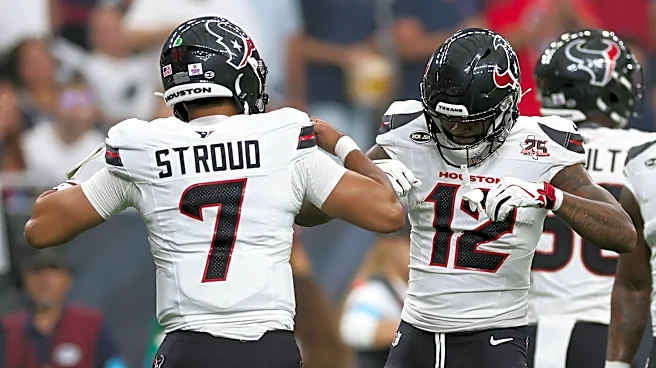
side of the ball as the Giants seek to slow down C.J. Stroud and the Texans offense.
Stats that matter
Health in the secondary
The Giants have transformed their defense over the last three weeks. They’ve gone from a fairly standard “Baltimore 2.0” defense using simulated pressures and coverage rotations out of the middle of a Match Quarters shell to confuse protections and quarterbacks to one of the NFL’s most aggressive defenses. The Giants are blitzing at one of the highest rates in the NFL, and winning their rushes at one of the league’s highest rates.
But unlike the Minnesota Vikings, the Giants are calling their hyper-aggressive blitz schemes out of man coverage, and calling Cover-0 at the highest rate in the NFL and Cover-1 at one of the highest rates as well. Between that and still using a high rate of Match Quarters, the Giants have one of the highest rates of man coverage in the NFL.
A key aspect of man coverage, and press-man in particular, is that it requires a specific skill set.
One question that isn’t being discussed widely is whether the Giants will be healthy enough on Sunday to call those aggressive schemes. Paulson Adebo is, as of this writing, still on the injured reserve, Colton Hood has yet to clear the concussion protocol, and Greg Newsome II and Jevon Holland left Sunday’s loss with concussions of their own.
While Deonte Banks is playing very well, there was a real drop-off from Newsome II to Colton Hood before his injury, and the Saints targeted reserve corner Nic Jones to good effect. The effectiveness of the Giants’ blitzing defense could come down to whether they get healthier during the week.
Perhaps due (in part) to the injuries at the second level, the Giants incorporated more simulated pressures against the Saints. There were multiple plays where the Giants had defenders showing blitz in the A-gap only to drop into coverage. That, however, created rushing lanes that quarterback Tyler Shough exploited. The good news is that C.J. Stroud isn’t the same type of athlete as Shough and isn’t nearly as effective a runner.
However, Stroud is a very effective passer who is playing some of his best football this year, and the Texans have a full complement of receiving weapons.
Slowing down C.J. Stroud
The Giants have one of the best passing defenses in the NFL this year, but that might have as much to do with the caliber of offenses (and the weather) they’ve faced over the last month as their own defense.
This week they’ll face a stiff test in the aforementioned Stroud.
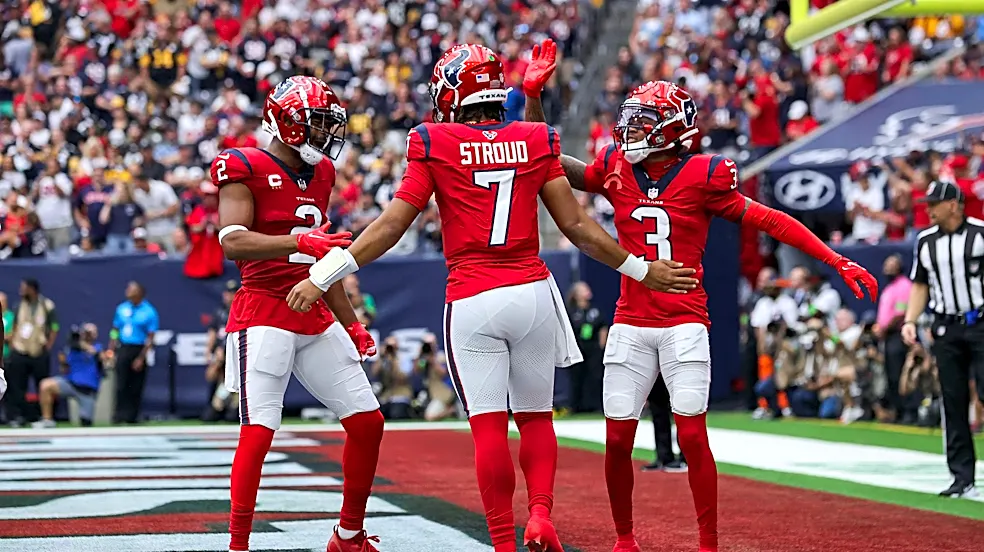
While the results haven’t been there, Stroud has been playing some of the best football of his career and is the reigning AFC offensive player of the week. He completed 24 of 34 attempts (70.6%), for 312 yards (9.2 per attempt), and 3 touchdowns to just two interceptions in a thrilling 34-31 win over the Jaguars.
He’s operating quickly, seeing defenses well, placing the ball with precision, and attacking down the field. Stroud will also have a deep receiving corps with Nico Collins, the newly-acquired Marvin Harrison Jr., a returning Tank Dell, and 2025 third-round pick Jaylin Noel.
Collins is among the best X receivers in the NFL and the Texans offense — and Stroud himself — is simply different with Collins on the field. And while Marvin Harrison Jr. flopped as a WR1 with the Arizona Cardinals, he has a pre-existing relationship with Stroud from their time together at Ohio State. Likewise, Harrison Jr. might fit better as a WR1b or WR2 with another receiver drawing most of the attention.
Noel had a breakout game against the Jaguars with 107 yards on 4 catches. He only has 17 catches on the season, but that’s on just 21 targets (80% catch rate), and he’s third in the NFL averaging 19.6 yards per catch. He’s proving to be both reliable and a real big play threat.
And speaking of explosive big play threats, the Texans are getting Dell, an undersized, spark plug, back from injury. Dell hasn’t played since a gruesome knee injury ended his season back in 2024, and it’s unknown whether he’ll have the game-changing ability he showed before the injury. However, the Giants can’t afford to overlook his potential for explosive plays.
The injuries to the Giants’ secondary might make matching up with the Texans’ receiving corps difficult, so the answer could be attacking Stroud. That, of course, circles back to the Giants’ blitz schemes and whether the Giants can effectively blitz Stroud without being picked apart if Stroud is able to decipher the Giants’ rushes.
Can the Giants stop the run?
This is turning into an evergreen question for the Giants.
New York’s run defense has been wildly inconsistent, alternating between stout and incredibly porous.
The Giants have given up the second most rushing yards, the most runs of 20+ yards, and the second-most runs of 40+ yards in the NFL. However, the Giants defense’s Run Stop Win Rate is an “okay” 23rd, while they’re 20th in rushing EPA per play allowed and 16th in rushing success rate allowed.
As John Harbaugh has said, the issue seems to be a tendency to give up those big plays. When the Giants’ run defense breaks, it tends to break badly, with poor angles and missed tackles allowing decent runs to turn into explosive runs.
The good news this week is that the Texans simply aren’t good at running the ball.
Their carries are split between 2025 fourth-rounder Woody Marks and veteran Davind Montgomery, but neither has been particularly effective. Marks is averaging 3.5 yards per carry on 58 rushes, Montgomery is averaging just 2.7 per carry on 52 carries this year, and each back has two touchdowns.
Likewise, the Texans’ run blocking is merely “OK”, coming in at 22nd in the NFL.
On paper, this looks like a meeting between a resistible force (the Texans’ run game) and a movable object (the Giants’ run defense). It’s possible that this could be a “get right” game for one of these two struggling units, though it’s not clear which one that would be.
If (and that’s a load-bearing “if”) the Giants are able to contain Montgomery and Marks, their best bet for slowing Houston’s offense would be to force the ball out of Stroud’s hands. The Giants likely don’t want to find themselves in a shootout in J.J. McCarthy’s first start, so they may actually prefer Houston to run the ball. That could mean bringing enough pressure to disrupt Stroud and discourage the pass, or it could mean playing more light boxes to encourage the run. Either strategy comes with a risk — the former requires an injured secondary to contain a potent passing attack, while the latter demands the Giants be stout and tackle securely with reduced personnel.
Either way, the Giants could be in for a tough test on defense.