



Coming into the season, one of the more polarizing prospects that was supposed to make his debut was Justin Crawford. One would think that a player that had as good a set of numbers from his minor league days as Crawford had would be the actual opposite of polarizing, but his case became an argument in “data vs. production”. From the scouting community, there was an overwhelming sense that Crawford’s success at the major league level would be muted due to his swing path and tendency to hit the ball
on the ground. From Fangraphs:
Whether mechanical intervention will improve Crawford’s output, or whether it will happen naturally as he gets stronger, we just won’t know until he’s allowed to face and adjust to big league pitching over a long period of time. His groundball rate has at least been trending in the right direction since he turned pro. He was way up in the 70% range when he first debuted, and his spray chart looked like the most cartoonish slash-and-dash hitter. Zac Veen is a recent prospect whose underlying data contained similar warning signs (Crawford is also fairly chase prone), but his on-field performance began to dip once he reached the upper levels, while Crawford’s has not. Make no mistake; Crawford’s tools are going to help a big league club in some capacity, just probably as an action-pressing nine hole hitter who bunts and slashes his way on base.
Offensively, we could pretty much cut and paste any report we’ve written about Crawford since he was drafted here. He still hits the ball on the ground way too much, he still runs like the wind, he still puts the ball in play a lot, and he still swings at way too many pitches for a guy who has what is otherwise a 1990s leadoff man profile. He made some real improvements around the edges of his very durable broad profile in 2025—he cut his chase rate by over five points year-over-year, which got it from catastrophic to merely bad, while turning a few grounders into line drives—but for the most part what you think about his offensive game still depends on whether you think his reliance on nine-hopper singles can sustain a plus-or-better hit tool outcome in the majors. We’re probably a little less high on that profile than a lot of our peers in the public prospect analysis space.
And yet, so far this year as he has in his minor league career, he has produced. It’s still way, way too early to make any kind of definite determination about how actual career arc will be created, but he has gotten off to a start that has been quite good for a team that has had little production from its nine hole spot in the lineup over the past several seasons (all stats for Crawford and/or ninth spot in lineup through Monday’s game).
2026: .315/.403/.481
2025: .246/.307/.398
2024: .230/.279/.333
2023: .265/.314/.398
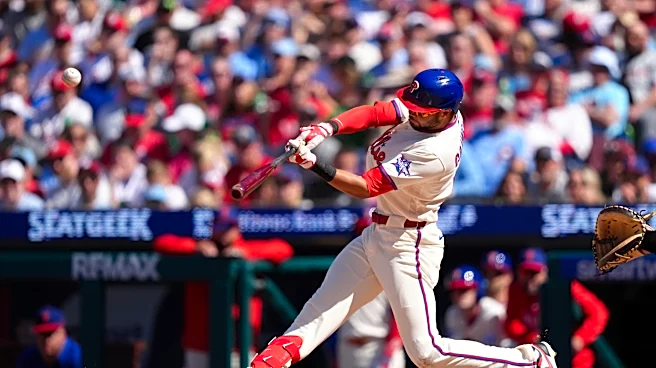
Based on what we’ve seen from Crawford, there are reasons to believe that he can actually producing. After all, bat control like this doesn’t come around too, too often.
With 10% of the season already in the books, it’s worth at least exploring what has happened so far with Crawford since he’s an interesting player.
Failure to launch
We all knew that one of the traits scouts have wanted Crawford to change has been how often he hits the ball on the ground. Baseball has changed so much from the Whitey Herzog days when Astroturf allowed players to hit the ball on a carpet and have it scoot into the outfield for a hit. Fielders have improved so much both in terms of their positioning and how well they field that a ball on the ground is almost an automatic out.
As of Monday, Crawford has an average launch angle when he hits the ball of -3.2o. If that number strikes you as a startingly low number, you’re not alone! I went back through the Statcast era (2015 on) to find qualified hitters that had a launch angle that was a negative throughout the entire season. To the surprise of no one, there were very few:
Eric Hosmer ‘18: -1.5o
Wilson Ramos ‘19: -0.1o
Raimel Tapia ‘21: -4.4o
Gilberto Celestino ‘22: -1.9o
Jake Mangum ‘25: -0.7o
These hitters are not ones that one would mistake for being productive in those seasons, so while it doesn’t mean it can’t happen, history suggests that it’s not going to happen. It’s possible for a player to go through an entire season having an average launch angle that low, but as you can see, the opposing team would be more than happy to have that happen. There just isn’t much of a threat to the defense.
Now, can we expect Crawford to have this low of a launch angle all season long? Probably not. At some point, he’s going to figure out how to drive the ball in the air and he does have some good power when he barrels up a baseball. He’s a lot of hittable pitches as well; he’s just hitting them into the ground.

For now, it’s just a curious thing, a negative launch angle, to see since it’s so rare that it happens for a full season. Maybe some balls in the air change things, maybe not.
BABIP, you BIP, we all BIP
Whenever one sees a ball trickle through the infield on the ground, get blooped down the line, get nubbed down the line, one silently says a prayer to the baseball gods to say think you. Specifically, the BABIP gods that allowed the ball to miss gloves on it’s way to the grass in the first place. It helps the personal numbers because, as is said, “it’s a line drive in the books!” However, having a high BABIP can often times signal that a regression is coming and with Crawford, it could be something to consider.
As of Tuesday morning, Crawford’s .405 BABIP is tied for 15th in the game among all active hitters and could be one that is ripe for regression. But what if it doesn’t regress as much as we think it will? He’s going to hit the ball on the ground as we see from above, but it’s not as though he isn’t hitting the ball hard. His average exit velocity of 88.5 miles per hour, right in the middle of the pack (and better than some current Phillies hitters). What if he’s going to be able to continue to just find holes and poke baseball down the line and keep being productive?
There’s no reason right now to change much of anything with Crawford. He’s finding success in the major leagues and isn’t being asked to do a lot hitting from the nine hole in the lineup. He can continue seeing how pitchers attack him and adjust accordingly. Moving him up in the lineup doesn’t really seem to be in the cards at the moment, nor should it be. He’s doing just fine where he is, though if he moved up a spot or two to better use his speed instead of anchoring him in front of Turner/Schwarber/Harper, that would be fine as well.