



Like it or not, sacks are still the pass rusher’s currency of choice, even if there are advanced metrics available that give us a much clearer picture of a player’s pass-rushing efficiency.
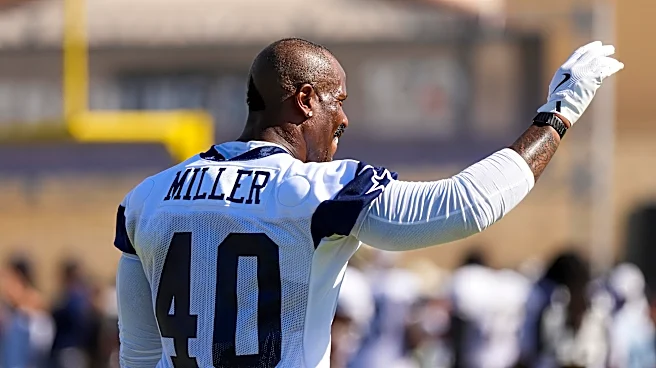
And, of course, the first wave of reporting about the Von Miller signing was all about sacks, both about his being the NFL’s active career sack leader and about his nine sacks with Washington last year, his most in a single season since 2021.
And Von Miller raised expectations himself on the Night Cap show with
Shannon Sharpe and Chad Johnson:
“I can still walk into 8-10 sacks now. And that’s just walking in.”
Even the $2 million in incentives in Miller’s Cowboys contract is structured around the number of sacks:
- $500k — 8 sacks + playoffs
- $1m — 10 sacks + playoffs
- $1.5m — 12 sacks + playoffs
- $2m — 14 sacks + playoffs
But this focus on sacks may be a little short-sighted, as John Owning points out.
Sacks, pressures, pass-rush win rates — are we splitting hairs here, or is there value in looking at some advanced metrics in more detail?
There may be, especially if you want to get a better feel for how Von Miller might slot into the Cowboys’ pass-rush rotation.
To do that, we’ll start by comparing Miller against last year’s defensive rotation in Dallas as well as this year’s presumptive edge-rush rotation. Then we’ll take a closer look at what pass-rush win rate can tell us about this year’s unit.
Two ways to measure pass-rush success
For this comparison, I’m using two metrics that look at pass-rush success from slightly different angles: Pressure% and Pass-Rush Win Rate.
- Pressure% is a simple calculation that adds up sacks, hits, and hurries into a total pressure number and divides it by a player’s pass-rush snaps. The data for this calculation is based on the PFF pressure numbers. For example, Von Miller recorded 36 pressures on 289 pass-rush snaps in 2025. That gives him a 12.5% Pressure%. Also, PFF doesn’t count half sacks, so where the PFF shows 10 sacks for Von Miller, official NFL statistics credit him with 9.0.
- Pass-Rush Win Rate (or Win%) is a proprietary PFF metric that looks at something slightly different than Pressure%. Rather than simply counting pressures, it measures how often a pass rusher is credited with winning his matchup against the blocker. PFF describes its underlying “beaten defender” data as a way of measuring how successful a pass rusher is at beating his man. That distinction is important because the pass rusher doesn’t control how long the quarterback holds the ball. A defender can beat his blocker, but if the quarterback gets rid of the ball quickly enough, the defender may not be credited with a sack, hit, or hurry. PFF can still credit him with a pass-rush win.
So, in simple terms:
Pressure% asks: How often did the pass rush produce a recorded pressure?
Win% asks: How often did the pass rusher beat his blocker?
Those aren’t necessarily the same thing — and the difference between the two is where this gets interesting.
Establishing some pressure and win-rate benchmarks
Before we look at the Cowboys, it helps to establish what constitutes a good Pressure% and Win%.
Using PFF data for 99 edge rushers who recorded more than 180 pass-rush snaps in 2025, the players neatly divide into five performance tiers of roughly 20 players each, with almost all having the same cutoffs — only the top tier shows a slightly different cutoff.
body .sbnu-legacy-content-table td, body .sbnu-legacy-content-table th, body .sbnu-legacy-content-table { border: 1px solid #000 !important; border-collapse: collapse !important; } body .sbnu-legacy-content-table td, body .sbnu-legacy-content-table th { padding: 0px 6px !important; }| Pressure% |
Win% | Description |
| >15 | >16 | Blue-Chip Players |
| >12.5-15 | 12.5-16 | NFL starter quality at position |
| >11.0-12.5 | 11.0-12.5 | Average to slightly below average player |
| >9.0-11.0 | 9.0-11.0 | Underperformer |
| <9 | <9 | Red Flag |
| Source: PFF, 99 Edge rushers with >180 pass rush snaps | ||
These aren’t official PFF thresholds (even if I’m using their color scheme), and there is obviously some subjectivity in drawing the lines. They’re simply a useful framework for putting the Cowboys’ numbers into context.
And this is where things start getting interesting, because a player’s Pressure% and Win% don’t always tell the same story.
And the relationship between the two numbers can be particularly revealing.
body .sbnu-legacy-content-table td, body .sbnu-legacy-content-table th, body .sbnu-legacy-content-table { border: 1px solid #000 !important; border-collapse: collapse !important; } body .sbnu-legacy-content-table td, body .sbnu-legacy-content-table th { padding: 0px 6px !important; }| Relationship | What it tells us | What it can mean | Cowboys example |
| Pressure% > Win% | Pressure production is running ahead of the player’s overall win rate. | His pressure production is running ahead of the rate at which PFF credits him with winning pass-rush reps. That can indicate a player who is particularly effective at turning his wins into pressures, although the two metrics aren’t directly interchangeable. | James Houston: 13.7 Pressure% / 11.4 Win% |
| Pressure% ≈ Win% | Pressure production broadly matches the player’s rate of winning pass-rush reps. | What we see in the pressure numbers is consistent with what is happening at the line of scrimmage. There is little evidence that either metric is significantly understating or overstating the player’s performance. | Sam Williams: 8.9 / 8.7 |
| Pressure% < Win% | The player is winning more pass-rush reps than his pressure numbers would suggest. | The player’s underlying pass-rush performance may be better than his pressure production indicates. Wins can fail to become pressures when the quarterback gets the ball out before the rusher can affect the play. | Donovan Ezeiruaku: 10.5 / 12.6 |
Here’s a look at the 2025/26 Cowboys edge rushers and how they stack up in both metrics. The table is sorted by Win%, players in red are no longer with the Cowboys, players in green are new additions to the edge rusher room in 2026.
body .sbnu-legacy-content-table td, body .sbnu-legacy-content-table th, body .sbnu-legacy-content-table { border: 1px solid #000 !important; border-collapse: collapse !important; } body .sbnu-legacy-content-table td, body .sbnu-legacy-content-table th { padding: 0px 6px !important; }| 2025/26 Cowboys Edge Rusher pressures | |||||||
| Player | Pass Rush Snaps | Sacks | Hits | Hurries | Total Pressures | Pressure% | Win% |
| Jadeveon Clowney | 227 | 9 | 2 | 29 | 40 | 17.6 | 16.7 |
| Dante Fowler Jr. | 248 | 3 | 7 | 20 | 30 | 12.1 | 14.3 |
| Donovan Ezeiruaku | 343 | 2 | 12 | 22 | 36 | 10.5 | 12.6 |
| James Houston | 182 | 6 | 10 | 9 | 25 | 13.7 | 11.4 |
| Rashan Gary | 415 | 7 | 12 | 35 | 54 | 13.0 | 11.3 |
| Tyrus Wheat | 47 | 3 | 2 | 1 | 6 | 12.8 | 11.1 |
| Von Miller | 289 | 10 | 4 | 22 | 36 | 12.5 | 9.5 |
| Sam Williams | 270 | 1 | 3 | 20 | 24 | 8.9 | 8.7 |
| Marshawn Kneeland (†) | 76 | 1 | 0 | 2 | 3 | 3.9 | 6.8 |
| Malachi Lawrence | — | — | — | — | — | — | — |
| Marist Liufau | — | — | — | — | — | — | — |
The first thing that jumps out is Jadeveon Clowney. His 17.6 Pressure% puts him comfortably in the blue-chip tier, and his 16.7 Win% backs that up. His nine sacks last year weren’t an isolated statistical quirk. The underlying pass-rush numbers show a player who was consistently productive when rushing the passer.
Dante Fowler presents a different profile. His 12.1 Pressure% puts him around the average-to-starter boundary, but his 14.3 Win% moves him comfortably into the starter-quality range. He won considerably more pass-rush reps than his pressure total alone would suggest.
James Houston presents yet another profile. His 13.7 Pressure% puts him comfortably in the starter-quality range, and it’s actually higher than his 11.4 Win%. In other words, Houston’s pressure production was stronger than his underlying win rate would suggest. He didn’t win his pass-rush reps at an especially high rate, but when he did, those wins translated into pressures at a good clip. That makes Houston a useful example of why Pressure% and Win% shouldn’t be viewed interchangeably.
And then there is Donovan Ezeiruaku. His 10.5 Pressure% is below the threshold for starter-quality production in our framework. But his 12.6 Win% moves him into the starter-quality range. That is a good signal for a player just entering his second season. It also ranks him second among all qualifying 2025 rookies, behind just Abdul Carter (14.6). Josaiah Trotter (15.3) actually ranks higher than both Carter and Ezeiruaku, but he falls below our 180-snap threshold.
The pressure numbers say promising rookie. The win numbers say there may be more here.
On to the new additions to the 2026 edge rusher rotation, where there is again no single number that tells the entire story, even if all veteran additions (green) have a Pressure% that marks them as starter-quality.
- Rashan Gary is the pressure-first profile: his 13.0 Pressure% is considerably higher than his 11.3 Win%, meaning his pressure production is running ahead of his rate of credited pass-rush wins. His numbers look similar to Houston’s, but Gary has produced them over a much higher snap count.
- Wheat is the small-sample wild card: his pressure rate is also considerably higher than his win rate, but with just 47 pass-rush snaps, there simply isn’t enough data to know whether that profile is sustainable.
- Miller is the cautionary profile: his pressure production looks respectable, but his underlying win rate raises questions about how consistently he is actually beating blockers.
- Lawrence is the blank canvas: the rookie has no NFL sample yet, so we don’t know whether his pass-rush wins will translate into the kind of pressure production the Cowboys need.
And then there is Von Miller
Miller’s 2025 numbers tell a very different story from Ezeiruaku’s. His 12.5 Pressure% is right at our starter-quality threshold. His 9.5 Win%, however, falls into the underperformer range.
That doesn’t mean the nine sacks he recorded in Washington weren’t real, or that Miller suddenly forgot how to rush the passer. It means we should be careful about assuming that last year’s sack total is a good projection for what he will produce in Dallas.
The more interesting question isn’t whether Miller can repeat nine sacks. It’s what kind of pass-rush player is Dallas getting if he doesn’t?
And then, of course, there’s all the stuff that doesn’t show up on these numbers, his leadership, his Super Bowl experience, his value as a mentor to guys like Donovan Ezeiruaku and Malachi Lawrence, and from what I’ve been reading, his overall value as a teammate.
What the Cowboys are really adding
The Cowboys don’t need Von Miller to be the Von Miller of 2012. They need him to be a useful part of a pass-rush rotation. And that’s a considerably lower bar.
If Miller can reproduce something close to his 2025 12.5 Pressure%, he would immediately have a place in this rotation. That number was better than Ezeiruaku’s 10.5 and close to Gary’s 13.0.
Importantly, Miller doesn’t need to reproduce 12.5 over a starter’s workload. If Dallas deploys him selectively, his ability to maintain something close to that efficiency on 150–250 high-leverage pass-rush snaps could be very valuable and may be a more realistic — and more useful — expectation..
That’s why I wouldn’t build a projection for Miller around nine sacks. I’d build it around something much simpler:
Can he continue to generate pressure at roughly the rate he did last year while playing a defined rotational role?
If the answer is yes, the Cowboys will have added a useful veteran pass rusher for a relatively modest investment. And if he happens to turn some of those pressures into sacks along the way, that’s a bonus, not the entire reason for the signing.
And that may actually be the most important takeaway from all of this. The Cowboys aren’t adding Von Miller because they expect him to single-handedly recreate his nine-sack season. They’re adding another piece to a pass-rush rotation in which different players may create pressure in different ways.
That’s a much more realistic expectation. And it also gives us a better way to judge the unit once the 2026 season begins.
What kind of roster bet are the 2026 Cowboys making at OLB?
Individual player evaluations only tell part of the story. Put the 2025 and 2026 rosters together into a four-box matrix like the one below, and a broader pattern emerges.

The interesting thing is that Dallas isn’t simply replacing productive players with unproven players like Malachi Lawrence or even Marist Liufau, who have no track record as NFL pass rushers.
Dallas lost two of its most productive edge rushers in Clowney and Fowler, but the replacements aren’t simply bets on potential. Rashan Gary and Tyrus Wheat (warning: low sample size) already show the underlying win rates and pressure production that Dallas wants.
And Donovan Ezeiruaku is the intriguing one: his underlying win rate suggests a better pass rusher than his pressure total would indicate.
Von Miller is almost the opposite: his pressure rate and low win rate suggest that while his nine-sack season may be difficult to repeat, his underlying pressure production deserves more credit than the sack total alone might suggest.
It’s obviously far too small a sample to draw any statistical conclusions, but the reports from Friday’s practice are at least consistent with the idea that Miller can still win isolated pass-rush reps.
- Tommy Yarrish of DallasCowboys.com credits him with two pressures on four snaps.
- Todd Archer of ESPN reports Miller took at least three snaps in team drills and had a QB pressure on two of them.
- Clarence Hill of alldlls.com saw Miller beat Terence Steele for two pressures on Dak Prescott.
That leaves us with Sam Williams in the Low Wins/Low Pressure quadrant. He needs to show that he can move into one of the other quadrants to have a shot at the roster, and time is running out for him to do so.
I only touched briefly on the value Von Miller brings beyond the pure pass rusher stats, so I’ll leave you with Charles Robinson of NFLBlueBook.com, who argues that the Cowboys defense already looked poised to take a leap – and that was before adding Von Miller.
Quinnen Williams and Kenny Clark give Dallas two proven interior players capable of dominating blockers and collapsing the pocket. Rashan Gary — acquired from Green Bay — delivers power and explosiveness. Donovan Ezeiruaku and rookie first-round pick Malachi Lawrence bring a pair of athletic edge rushers to the Dallas rotation.
Then comes Miller.
At 37, he isn’t being added to play every snap or carry the front by himself. Dallas doesn’t need that version of him. It needs the one who produced nine sacks for the Washington Commanders last season and still understands pass rushing at a level few players ever reach. It needs him in favorable situations, attacking an offensive tackle who can’t count on the protection sliding his way. And it needs him to teach everything he can to a front seven that has gotten younger and deeper.
That’s where the collection of talent matters. Williams can demand a double-team inside. Clark can prevent the middle from becoming an escape route. Gary can dictate protection from one edge. If Lawrence or Ezeiruaku develops quickly, Parker can rotate waves of rushers without asking one player to solve everything. And Miller gets to become the closer.
That front should also change what is possible behind it.
The interior line makes the edge rushers better. The rush allows the corners to play aggressively. The secondary’s versatility gives Parker opportunities to disguise intentions. Downs and Barham create uncertainty because an offense can’t be sure where either will align. Meanwhile, Miller can play measured snaps and no longer has to beat an entire protection plan. And Williams no longer has to create pressure by himself.