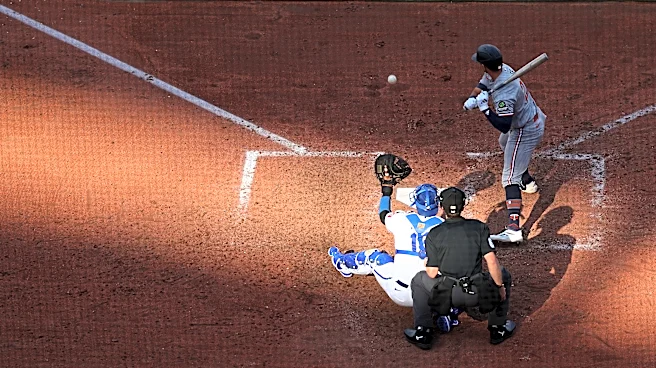



Since forever, the skills that made a good catcher were consistent: the ability to control the run game, the ability to manage a pitching staff, the ability to block pitches, the ability to call a good game.
But then the sabermetric revolution happened, a revolution that was obsessed with measurable metrics. And around the same time, we got PITCHf/x data, which showed us the objective location of pitches. Combine that with the fallibility of human officiating, and we collectively put two and two and two together:
catchers should try to convince umpires that balls were strikes, and we should incorporate how good catchers were at that into our evaluation of them.
This has always been a problem for Salvador Perez, who was and continues to be excellent at all the traditional catching metrics but not-so-excellent at pitch framing. The gulf is gigantic, and it manifests itself in Wins Above Replacement. Whereas Fangraphs’ version of WAR includes pitcher framing, Baseball-Reference’s version does not. Salvy’s career fWAR is a remarkably low 19.0, while his bWAR is 35.8—a whopping 88% higher.
The framing value debate is a the center of Salvy’s Hall of Fame discussion, because voting a 20ish-WAR catcher in the Hall is worlds different than voting a 40ish-WAR catcher. Unfortunately for Salvy, lots of people think that pitch framing is important, and that means that a lot of people won’t vote for him when, in their eyes, he genuinely isn’t a very good catcher based on the total value he brings.
I’ve long thought that this was, to be blunt, stupid. I recognize that turning balls into strikes results in real, tangible run value. But you know who’s job it is to turn balls into strikes? The pitcher, that’s who. You know who’s job it is to call balls and strikes? The umpire, that’s who. We should not credit or debit a third party (the catcher) for managing to trick the umpire into doing their job worse.
Especially because Salvy knows the zone. He knows it very well. He knows it so well, in fact, that in his first opportunity in the new ABS system that he knows it better than the ump—or well, so it seemed.
On Opening Day, Salvy successfully overturned three challenges from umpire Doug Eddings, all at just about the same spot at the bottom of the zone. He started off the year with four consecutive successful challenges. While he’s not perfect now, it has been immediately apparent that Salvy is really good at knowing the zone.
The haters might say that the knowing the zone doesn’t matter and it’s about convincing the umpire that he doesn’t know the zone, to which I say—do you hear yourself? What are we doing?
Look: I think the Salvador Perez Hall of Fame case is really interesting, and I’m not even arguing that he for suresies should eventually get in. Salvy has longetivity and all sorts of counting stats, like home runs and hits and RBIs and Gold Gloves and Silver Sluggers. But he’s only been in the top 10 of MVP voting once, and he’s never even had a top-five finish. Do we reward being consistently good as much as being game-changingly great for a shorter period of time? That’s an interesting argument!
What is not an interesting argument is that Perez shouldn’t be in because of framing. Ugh. Gag me. I hope Salvy establishes himself as the most effective catcher in the ABS era, and I hope I never have to hear about framing ever again.